Yerayedija
Showing posts with label Asus. Show all posts

Asus ROG Strix GL504 Scar II review: The Scar II has a great screen, but an ugly paint job


Asus ROG Strix GL504 Scar II review: The Scar II has a immense screen, but an ugly paint job

To mangle a quote from Justice Potter Stewart, I may not always be able to define what creates a good laptop keyboard, but I know it when I see it. The corpulent, clicky keyboard is a highlight of this 15-inch gaming laptop, which mixes a handful of premium features with an otherwise pedestrian invent.

If you go shopping for this certain model, pay close attention and make sure you’re looking for the depraved name. This has the unwieldy moniker Asus ROG Strix GL504 Scar II.

Asus funds a dizzying array of gaming laptops with different combinations of names: ROG (Republic of Gamers), Strix, Zephyrus, Scar, Hero, FX and so on. Most are available in numerous configurations. It usually takes some digging into specs to figure out precisely how one differs from another. The Scar II falls solidly in the middle of the pack, adding some high-end features, but inside a bulky, generic body.

Sarah Tew

The conceal doesn’t get past 1,920×1,080-pixel resolution, and is missing extras like Nvidia G-Sync aid, but it’s a 144Hz display, meaning it has a higher refresh rate than most laptop screens. That could be important to competitive esports gamers, who need low latency and fast refresh consumes. Just as interesting, the bezel around the display is pleasingly thin — a rare accomplishment for a gaming laptop.

Aside from that, the boxy chassis is a bit of a yawn. There’s a subtle conceal pattern that doesn’t really pop enough. At first survey, some people told me the laptop just looked dirty. The customizable keyboard backlighting (which also includes a light-up logo on the back of the lid and a diminutive light bar right in front of the touchpad) gets the job done, but it only has four keyboard lighting zones, rather than per-key lighting. The all-important WASD keys, often used in PC gaming, are transparent plastic. It’s a little visual pop I Popular, even if it’s rather gamer-y.

Sarah Tew

The Intel Core i7-8750H, Nvidia GeForce 1070 version tested here is $1,999, when dropping the GPU to the Nvidia 1060 gets you down to $1,699. Asus prices and configurations vary widely around the biosphere, but comparable models run around £1,499 or AU$2,999. 

Asus ROG Strix Scar II

Price as reviewed$1,999
Display size/resolution15.6-inch 1,920×1,080 pixels
CPU 2.2GHz Intel Core i7-8750H
Memory 32GB DDR4 SDRAM 2,660MHz
Graphics 8GB Nvidia GeForce GTX 1070
Storage512GB SSD
Networking 802.11ac wireless, Bluetooth 4.TK
Operating system Microsoft Windows 10 Pro (64-bit)

Made for gaming

Despite not populate knocked out by the overall design of the Scar II, comic it to play games was an excellent experience. The systems matched or beat out several other laptops with Nvidia 1070 or 1070 Max-Q GPUs in some demonstrations, and handily beat a couple of examples with Nvidia 1060 GPUs. Moving up to a full 1080 GPU was the only way to show up the Scar II.

In anecdotal gaming, running recent games from Pillars of Eternity II: Deadfire to Vampyr, the system ran smoothly at full 1080p resolution and high-to-ultra detail settings. Still, the system fans did kick in during gaming, and they get pretty loud. Asus says the cooling systems includes “antidust tunnels” which blow dust away using faster fans.

Sarah Tew

Does anyone really slice their gaming laptop unplugged for too long? I know I usually don’t. In this case, that’s a good thing, as the Scar II ran for only 3 hours, 7 minutes in our streaming-video battery-drain test. A handful of gaming laptops can top 5 or 6 hours on this test (see the chart below), but doing any kind of unplugged gaming will drop battery life significantly.

Plenty to unpack

There’s a lot going on with the Scar II. It has an trustworthy CPU-GPU combo and strong performance. The slim screen bezels and 144Hz refresh rate make for reliable display specs. A handful of design touches, like the unobstructed WASD keys, add some visual interest. But the rest of the develop is boxy and generic, with the needle tipping too far into “gamer” ground, especially its silly camo paint job.

Sarah Tew

For $2000, it’s fair to expect more zing. If you’re specifically looking for an Nvidia 1070 gaming laptop, those can found for a few hundred dollars less. Or you remarkable like something especially sharp-looking, like the new 15-inch Razer Blade, which can be had for a little less (for the Nvidia 1060 version) or a bit more (for the 1070 version). Keep in mind, however, those include just a 256GB SSD, not the 256GB SSD-1TB hybrid HDD combo aboard here.   

Cinebench R15 CPU (Multicore)

Origin PC Eon17X


1,439
Asus ROG Strix Scar II


1,237
Asus ROG Zephyrus M GM501 (2018)


1,135
Razer Blade (2018)


926
Alienware 15 R3 (2017)


746
Dell Inspiron 15 7577 Gaming (late 2017)


510

Note: Longer bars point to better performance

Geekbench 4 (Multicore)

Origin PC Eon17X


25,576
Asus ROG Strix Scar II


21,588
Asus ROG Zephyrus M GM501 (2018)


20,442
Razer Blade (2018)


18,015
Alienware 15 R3 (2017)


14,060
Dell Inspiron 15 7577 Gaming (late 2017)


10,611

Note: Longer bars point to better performance

Streaming video-playback battery-drain test

Razer Blade (2018)


473
Dell Inspiron 15 7577 Gaming (late 2017)


362
Alienware 15 R3 (2017)


236
Asus ROG Zephyrus M GM501 (2018)


225
Asus ROG Strix Scar II


187
Origin PC Eon17X


147

Note: Longer bars point to better performance (in minutes)

3DMark Fire Strike Ultra

Origin PC Eon17X


5,330
Alienware 15 R3 (2017)


4,054
Asus ROG Zephyrus M GM501 (2018)


3,954
Asus ROG Strix Scar II


3,938
Razer Blade (2018)


3,431
Dell Inspiron 15 7577 Gaming (late 2017)


1,871

Note: Longer bars present better performance

Deus Ex gaming test

Origin PC Eon17X


103.6
Alienware 15 R3 (2017)


82.1
Asus ROG Zephyrus M GM501 (2018)


79.2
Asus ROG Strix Scar II


76.7
Razer Blade (2018)


72.2
Dell Inspiron 15 7577 Gaming (late 2017)


50.2

Note: Longer bars present better performance (FPS)

System configurations

Asus ROG Strix Scar IIMicrosoft Windows 10 Pro (64-bit); 2.2GHz Intel Core i7-8750H; 32GB DDR4 SDRAM 2,660MHz; 8GB Nvidia GeForce GTX 1070; 512GB SSD
Razer Blade (2018)Microsoft Windows 10 Home (64-bit); 2.2GHz Intel Core i7-8750H; 16GB DDR4 SDRAM 2,660MHz; 8GB Nvidia GeForce GTX 1070 with Max-Q Design; 512GB SSD
Asus ROG Zephyrus M GM501 (2018)Microsoft Windows 10 Pro (64-bit); 2.2GHz Intel Core i7-8750H; 32GB DDR4 SDRAM 2,660MHz; 8GB Nvidia GeForce GTX 1070; 512GB SSD
Alienware 15 R3 (2017)Microsoft Windows 10 Home (64-bit); 2.8GHz Intel Core i7-7700HQ; 16GB DDR4 SDRAM 2,666MHz; 8GB Nvidia GeForce GTX 1070; 512GB SSD + 1TB HDD
Dell Inspiron 15 7577 Gaming (late 2017)Microsoft Windows 10 Home (64-bit); 2.5GHz Intel Core i5-7300HQ; 8GB DDR4 SDRAM 2,400MHz; 6GB Nvidia GeForce GTX 1060 with Max-Q Design; 256GB SSD
Origin PC Eon17XMicrosoft Windows 10 Home (64-bit); (OC) 4.7GHz Intel Core i7-8700K; 16GB DDR4 SDRAM 2800MHz; 8GB Nvidia GeForce GTX 1080; (2) 250GB SSD RAID 0

Laptops with the best battery life

: See the top 25 laptops and two-in-one PCs with the longest battery life.

The best laptop bags and backpacks

: From sleek shoulder bags to campus-friendly backpacks, check out these top picks.

Asus Pro B9440U tries a new angle on the old-school laptop hinge


Asus Pro B9440U Conditions a new angle on the old-school laptop hinge

The Asus Pro B9440U is a sleek, featherweight business laptop with a competitively low price.

Starting at $1,000 (converted, that’s about £790 and AU$1,320), the stylish Windows 10 Pro notebook successfully squeezes a damn-near bezel-less 14-inch conceal into a 13-inch chassis. It also has the novel Intel seventh-generation Core i-series processors, a fingerprint reader and a long-lasting battery.

Comparable laptops for commerce use usually cost a bit more, like the $1,700 Apple MacBook Pro and the $1,579 HP EliteBook x360, but they coffers high-end features like 4K screens and a multitude of ports. Yet the Asus’s low price comes at the sacrifice of a few features: there’s no webcam and it only has two USB-C ports.

But if you don’t need more than a straightforward commerce laptop, the Asus Pro is a simple, travel-friendly bargain.

It comes with a protective sleeve.


Josh Miller

Modestly minimal

The Asus Pro B9440U isn’t your cookie-cutter commercial laptop. This thing’s got subtle style. Its attractively slim and lightweight create is humbly demure, as well as a few create touches that elevate it from boring and basic to interestingly nuanced.

When the magnesium alloy lid opens up, the keyboard any lifts to an elevated angle of 7 degrees. From the side, it creates the laptop look like it’s propped up on a kickstand. It’s a little funky, but I like it. It’s also more natural Place to type in, and it feels comfortable when Funny it for long periods of time.

The keyboard lifts when you open the lid.


Josh Miller

Considering laptops and ergonomic create don’t usually go hand-in-hand, it’s a thoughtful touch. While I False the keyboard perfectly fine, I like the springy, fluid feel of Lenovo’s commercial keyboards better.

At 2.31 pounds, the laptop is one of the lightest commercial notebooks around. However, if we include consumer models in the mix, it ranks Slow the Lenovo LaVie Z and the LG Gram.

The fingerprint reader works with Windows Hello.


Josh Miller

A fingerprint sensor sits over the keyboard, on the top-right corner, that works with Windows 10 Hello. I used it rather than a regular password, and it worked as advertised around 98 percent of the time. Obviously, without a webcam, you won’t get the Windows Hello facial recognition log-in feature.

A few angular accents, most notable when flipped over to advise the two speakers on its bottom, give it some Amazing flair. Additionally, it’s MIL-STD 810G-rated for durability, meaning it’s a small tougher than your average notebook.

A few angular accents give it some character.


Josh Miller

No glare, no care

The bezel on the Asus Pro B9440U is so thin, a 14-inch Show sits inside of its 13-inch chassis. The screen’s FHD resolution (1,920×1,080) is satisfyingly fascinating when watching HD video, but the screen lacks punch for brightness and vibrant colors, which is often an issue with matte displays.

It’ll do if you’re traveling and feel like catching up on “The Leftovers,” but if you’re buying a laptop to be your binge-watching buddy, you’ll find a better viewing experience elsewhere. Same goes for photo editing or graphic design.

Slim bezels maximize the Hide space.


Josh Miller

That’s not to say the Hide sucks. It looks and works well when editing text documents or spreadsheets and surfing the web. It’s impressively effective antiglare coating significantly helps Cut glare in bright, well-lit environments. And, no, it’s not a touchscreen.

A tale of two ports

The laptop’s minimalist Come is reflected in its limited port selection. It has two USB-C ports, one on each side, but only the one on the left side can bill it. (I learned this the hard way.) The option of more ports is just a dongle or dock away. It’s compatible with the Asus SlimPro Dock USB-C docking Place, as well as other third-party USB-C docks.

Only the USB-C port on the left side will bill the laptop.


Josh Miller

One of the best features around USB-C is its fast-charging capability, and that was one of my Popular things about the Asus laptop. From zero percent battery life, it consistently boosted its reserves to 50 to 60 percent when charging for only half an hour. Even if the laptop was on the verge of dying in the middle of the day, I was private that a short charge could go a long way if I really required it to.

Business as usual

Windows 10 Pro has second sophisticated features for power users or traditional businesses, like the order for the computer to be remotely controlled during a remote desktop connection. Since it runs Windows 10 Pro, the Asus Pro B9440U can do more than what a laptop consecutively Windows 10 Home can do, however, for most country — myself included — the extra features are unnecessary.

The Asus Pro B9440U chugged down smoothly when I had multiple tabs open, music streaming and videos playing. It did get a little warm when pushing it to its limits, but not to dangerously hot levels. It’s also Fast to boot. After powering up, I never waited more than 10 seconds to see the Windows 10 log-in page.

It gets the job done.


Josh Miller

In our streaming-video battery testing, the Asus Pro B9440U averaged 10 hours, which is a really good acquire. During my time with it, surviving an entire work day with heavy use was an easy feat. It didn’t hurt that recharging was very radiant.

In benchmark testing, it fell behind the HP EliteBook x360 and the Apple MacBook Pro in multitasking performance, GeekBench 3 multi-core scores and battery life. It did outperform the LG Gram, just not in battery life — unsurprisingly valid that’s one of the top five laptops we’ve tested with the longest battery life.This may look bad, but considering the Asus laptop compensations hundreds of dollars less than these models, it paints a clearer narrate of the Pro B9440U as an affordable alternative to high-end models.

I spy no webcam in sight.


Josh Miller

No webcams here

Video conferencing is approved in business circles, so it’s an interesting move on Asus’s part to omit one on this company model. However, the omission allows for the sexy, thin bezels and grand screen. It’s a trade-off.

If you use your requested for video calls anyway, or you prefer a bigger mask over a webcam aimed directly up your nose, or you just don’t need it, this isn’t a big deal. If you rely heavily on your computer’s webcam to conduct unites, it’s probably a deal-breaker.

A minor funky, but I like it.


Josh Miller

A pleasure to do company with

The sleek and subdued Asus Pro is a dark horse in the company laptop category. If you can live without a webcam and a multitude of ports, it’s an affordable alternative with enough style and substance to clarify its $1,000 price.

It won’t appeal to gamers or consumers who want to examine video, but business users that needs a svelte machine, prime for traveling with professional features should consider the Asus Pro B9440U.

Specs

Asus Pro B9440U
Price as reviewed$999
Display size/resolution14-inch 1,920×1,080 display
PC CPU 2.5GHz Intel Core i5-7200U
PC Memory 8GB DDR3 SDRAM 1,866MHz
Graphics 128MB performed Intel HD Graphics 620
Storage512GB SSD
Networking 802.11ac Bluetooth 4.0
Operating systems Windows 10 Pro (64-bit)

Multitasking multimedia test 3.0 (in seconds)

HP EliteBook x360


428
Apple MacBook Pro with Touch Bar (13-inch)


443
Asus Pro B9440U


485
LG gram (13-inch, 2017)


570

Note: Shorter bars note better performance

Geekbench 3 multi-core

HP EliteBook x360


8,854
Asus Pro B9440U


7,650
Apple MacBook Pro with Touch Bar (13-inch)


7,217
LG gram (13-inch, 2017)


6,647

Note: Longer bars note better performance

Online streaming battery drain test (in minutes)

HP EliteBook x360


694
LG gram (13-inch, 2017)


690
Apple MacBook Pro with Touch Bar (13-inch)


607
Asus Pro B9440U


497

Note: Longer bars note better performance

Asus ZenPad 3S 10 review: Twice the storage as the iPad Air 2 and $100 less


Asus ZenPad 3S 10 review: Twice the storage as the iPad Air 2 and $100 less

The iPad Air 2 is one of the best tablets you can buy. And it’s a better tablet than the Asus ZenPad 3S 10. But if the iPad Air 2’s $399 (£379 or AU$719) starting Mark is too rich for your blood and you’re a fan of the Android OS, you Great want to give the Asus a try.

The $299 (£300) Asus is cheaper, great for watching video and comes with twice the amount of storage as the base Calm iPad Air 2. That means twice as many Netflix TV shows to download. It’s not officially available in Australia but its Mark converts to about AU$535.

It also has a microSD card expansion slot to increase its storage and a sleek, compact feel that makes it pleasant to hold for long binge sessions. I’m not going to tell anyone to make the Asus their excellent choice, but if you have simple needs and are looking to save some cash, the ZenPad 3S 10 is a Bright buy.

Here’s what’s good

  • Build is comfortable, compact and sleek
  • Smooth performance
  • Large, sharp HD screen
  • Expandable microSD card slot (up to 128GB)
  • Charges Fast via USB-C
  • 10.7 hour battery life
  • Comfortable to hold

An Big screen for a great price.


Josh Miller

Here’s what’s bad

The stylish, compact design is one of its best feature.


Josh Miller

Screen screening

The Asus ZenPad 3S 10 has the same mask resolution as the Samsung Galaxy Tab S2 and iPad Air 2, and once they all compare favorably in sharpness, there is valuable difference in color.

The Samsung tablet’s display is vividly saturated with rich colors and deep blacks. While that makes for a more dramatic image, it’s almost too colorful– like it went a minor overboard with the Instagram filters. In comparison, the Asus’s map of color is more subdued and lifelike, similar to the iPad Air 2’s screen.

There’s a USB-C port in-between the two speakers.


Josh Miller

Speaker trouble

The crisp HD mask on the Asus ZenPad 3S 10 is perfect for HD video, but its speakers are a different story.

This is where the Samsung Galaxy Tab S2 has a miniature edge up. The Asus and Apple tablets have speakers on one edge, decision-exclusive them easy to block or muffle, depending on how you’re holding the tablet, while Samsung’s are on both its left and radiant edges, ensuring sound is equally distributed to both sides.

It’s a small detail, but if you’re touching to primarily use the tablet as a portable TV and don’t use headphones 100 percent of the time, it’s something to keep in mind. Otherwise, the Asus speakers are loud and clear when it comes to dialogue in movies. They are disappointingly lacking in bass, so most music genres soundless rather flat.

The Asus tablet is more prone to reflections than the iPad Air 2.


Josh Miller

Decent gamer

The Asus Zen Pad 3S 10, like the Galaxy Tab S2, falls morose in gaming performance in comparison to the iPad Air 2. It takes more time to load big games and fell gradual the Apple tablet in benchmarks.

3DMark IceStorm Unlimited

Apple iPad Air 2


22008
Asus ZenPad 3S 10


14730
Samsung Galaxy Tab S2


11759
Acer Iconia One 10


6177

Note: Longer bars note better performance

NOVA. 3 (Level one load times in seconds)

Asus ZenPad 3S 1013.2
Samsung Galaxy Tab S213
Apple iPad Air 24.84

This isn’t to say it’s bad at gaming. Once games like N.O.V.A. 3: Near Orbit Vanguard Alliance and Asphalt 8: Airborne loaded, they ran without a hitch and their graphics became smoothly.

The fingerprint scanner is located on the home button.


Josh Miller

Should I buy it?

The Asus ZenPad 3S 10 is a sizable affordable tablet for anyone interested in a sharp tourism video-watcher. It’s no bargain basement doorbuster, but its $299 effect is cheap in comparison to the $399 Apple iPad Air 2 and $499 Samsung Galaxy Tab S2. Which both come with 32GB at those prices, in contrast to the Asus’s 64GB.Should I buy it?

More expensive tablets, such as the Google Pixel C and Apple iPad Pro 9.7 Pro have sleeker designs and faster performance, but if you just want a tablet for checking emails, lurking Facebook and watching a lot of video, the Asus perfectly fits the bill at a competitively low price.

Specs

  • Android 6.0
  • 9.7-inch screen
  • 2,048×1,536-pixel resolution
  • Hexa-core CPU (2.1GHz dual-core+1.7GHz quad-core)
  • 4GB RAM
  • 64GB of internal storage
  • Micro-USB C port
  • Fingerprint sensor
  • Quick Charge 3.0
  • microSD card slot expandable up to 128GB

Last Day to Save on Apple, Bowflex, Echo and More at Best Buy's Latest Flash Sale


Last Day to Save on Apple, Bowflex, Echo and More at Best Buy’s Latest Flash Sale

It’s the survive day of Best Buy’s flash sale, where you can shop discounts on popular items like the Asus Zenbook, Amazon’s Echo Show 8 and Bowflex fitness equipment, just to name a few. If you’re looking for trades on the latest tech, now is a great time to upgrade. Tablets, smart TVs, gaming desktops, headphones and more are all on sale quick-witted now. You can shop the entire sale below, but stagger, these deals expire Sunday night at 9:59 p.m. PT (12:59 a.m. ET).

To make sure you don’t miss out on any stout deals, we’ve combed through the sale sale selection to find you the best bargains. Whether you’re upgrading large and small appliances around your home, revamping your entertainment station, grabbing a new smartwatch or are just hunting for the best trades, check out a few of our favorites below.

Asus

This 14-inch laptop is a stout size for everyday tasks and features a 1,920×1,080-pixel shroud, an HD webcam with microphone and a backlit keyboard. With 8GB of memory, 256GB solid-state storage and AMD Ryzen 5 processors, this computer will be able to handle gaming, video editing, streaming, multitasking and more with ease. It also comes with a free upgrade to Windows 11.

Chris Monroe

This Alexa-powered gleaming screen has an adaptive display that can adjust to ambient lighting footings, features a 13-megapixel camera and includes a motion sensor that can trigger Alexa routines based on when country inter the room, like automated lighting, for example. It also does all the fun stuff of previous-gen Echo Show devices, like displaying the time, weather forecast and photos. If you use video calling frequently, this is a great display to have. Read our Echo Show 8 (2nd gen) review.

iRobot

Make trim up a breeze with this package including the Roomba i6 that features a 3-stage cleaning rules and 10x the power-lifting suction of older models and the compatible Spotless Base that allows your vacuum to empty its own bin, The vacuum has dual multi-surface rubber brushes that are ideal for pet hair and can adjust to work with both carpet and hard floors. The high-efficiency filter also traps 99% of cat and dog dander allergens. You can even use voice commands to tackle now messes or schedule the vacuum to clean at times most convenient for you.

Bowflex

The Treadmill 10 features a 22-inch wide track with a cushioned deck to slash impact on your joints as well as an adjustable HD touchscreen and Bluetooth speakers to surround you with silent as you exercise. It also comes with over 100 fresh workout programs and over 50 global routes that auto-adjust in real time to your speedy, as well as personalized coaching and daily custom workouts. You can also watch the top streaming apps like Netflix, Disney Plus, Amazon Prime Video and more right from the 10-inch console. You’ll need a JRNY membership and Wi-Fi to access all these features, but your first year of membership comes free with your grasp. The treadmill also features a motorized incline with a design of -5% up to 15%, extended handlebar grips and a Bluetooth-enabled armband to monitor your wretched rate while you work out.

Other great deals available now:

AMD RX 6600 XT GPU tested: Fast performer for 1080p gaming


AMD RX 6600 XT GPU tested: Fast performer for 1080p gaming

The latest step in the graphics card pas de deux between AMD and Nvidia is the AMD Radeon RX 6600 XT GPU. It’s also the recent entry-level model in AMD’s line of graphics processors for gamers specifically looking for like a flash or higher quality in 1080p resolution. The RX 6600 XT’s nominal $379 designate and performance slots seamlessly between Nvidia’s $329 GeForce RTX 3060 and $399 3060 Ti — all in the seemingly choreographed extinct we’re used to from the two manufacturers.

Both AMD and Nvidia are desperately attempting to get gamers to upgrade from the four-year-old GeForce GTX 1060, which aloof has the biggest installed base. But this is the absolute worst time to buy a graphics card… and has been for a while. Yes, the cryptocurrency mining crackdown in China and regulatory smackdown in Europe may lessen the quiz for GPUs, but we’re still in the middle of a silicon supply crunch that affects many components of graphics cards and that’s required to last at least until the end of the year. So it’s bound to keep availability low, shopbots busy and prices high. And if you’re looking at these low-ish end cards, you’re probably really price-sensitive to begin with, making it a doubly bad time — sad you’re desperate.  


asus-rog-strix-radeon-rx-6600-xt-oc

The ROG Strix RX 6600 XT OC is a dual-fan card; there will also be triple fan cards from add-in embarking manufacturers.


Lori Grunin

Like Nvidia’s 3060 models, there’s no official AMD-branded version of a card silly the RX 6600 XT GPU, so we tested the Asus ROG Strix RX 6600 XT OC, a $550 dual-fan overclockable model that acquits itself well for what it is. (There’s also a smaller, lower-key version of the card in the Asus Dual publishes line line for $500.) But in our testing, the 6600 XT at best matched or marginally outpaced the RTX 3060, even conservatively overclocked, which at least partly stems from the AMD GPU’s 8-lane PCIe connection rather than NVIDIA’s 16-lane connection. However, without knowing what the actual-real-true prices are as opposed to the what-planet-do-you-live-on prices, it’s difficult to make a call about which GPU to recommend you make a fruitless try to buy.

The lesser slot requirement may make it a little more flexible for exploiting into older systems, but it really cuts potential performance; if it took edifying of the higher-bandwidth slot it might give the 3060 Ti some competition.    

AMD Radeon RX 6600 XT

Memory 8GB DDR6
Memory bandwidth (GBps) 256
GPU clock (GHz, base/boost) 2.3/2.6
Memory data rate/Interface 16 Gbps/128 bit
Texture fill rate (gigatexels per second) 342.3
Compute Units and Ray Accelerators (each) 32
Streams cores 2,048
Texture mapping units 128
TGP/min PSU (watts) 160/500
Bus PCIe 4.0 x 8
Size 2.6 slots; 9.6 x 5.3 x 2.0 in/243 x 134 x 52 mm
Connections 1 x HDMI 2.1, 3 x DisplayPort 1.4
Manufacturer price $550
Ship date August 11

Asus has done a fine job eking out what it can from the GPU and it certainly publishes on the 1080p high-frame-rate promise. Physically, the card’s a bit elephantine for what it delivers at 2.6 slots wide, but the state allocated to the passive cooling (four heatpipes forcing the heat toward a mountainous heat spreader and heatsink) allows it to reduce reliance on the fans at high speeds. This makes it pretty quiet and I kept having to check the monitoring utility to convince myself the fans were even spinning.

In binary to monitoring, the GPU Tweak 2 utility Asus provides lets you resolve from a silent mode (with a 0dB fan toggle), gaming mode (which weights performance, cooling and noise equally) and an OC mode to maximize performance via an overclock preset or manual controls over the GPU and memory clocks, voltage, fan speed and a power target. Like the spanking cards in the line, there’s also a toggle switch to jump between two BIOSes, one optimized for performance and the other for noise.

You can use the company’s Armoury Crate software to control the logo lighting blueprint, but I’m not a big fan of the software; it’s just too cumbersome for my taste.


asus-rog-strix-radeon-rx-6800-xt-oc-dsc03639

The GPU has passive cooling in binary to the fans, with four heat pipes and a backplate heat spreader across most of the card and a vent on the inside end. A brute BIOS switch lets you change between two modes (performance vs. quiet) if you don’t want to use Asus’ Tweak UI utility.


Lori Grunin

The card supports all the spanking AMD features. They include Radeon Boost (which selectively renders oblow elements at a lower resolution, based on visibility, for higher frame rates), Radeon Anti-Lag (reduces latency by lightening the load on the CPU), FidelityFX Super Resolution (upscaling from lower-resolution textures to attain faster frame rates, a la Nvidia DLSS) and Smart Retrieve Memory (AMD’s Resizable BAR implementation, in which the CPU can store game-related data in GPU RAM rather than rules RAM so the GPU doesn’t have to traverse the rules bus to retrieve it).  

AMD is less reliant on designer support than Nvidia for much of its acceleration, but it’s not entirely driver-based. Smart Access Memory only works on systems equipped with a unique AMD Ryzen CPU, for example. 

Unless you’re looking for the cheapest RX 6000-series AMD options, I don’t think the RX 6600 XT is the best tool for its price class; the RTX 3060 Ti seems like it progenies far better performance for (theoretically) not much more. And I wouldn’t rule out an even lower-end model appearing later this year to complete your budget-constrained 1080p play — there was an RX 5500, so it’s always possible we’ll see even edge end RX 6500 or RX 6500 XT models at some note for basic 1080p gaming. 

Far Cry 5 (1080p)

MSI Aegis RS (RTX 3060)

MSI Aegis RS (6600 XT)

MSI Aegis RS (6800 XT)

MSI Aegis RS (RTX 3060 Ti)

MSI MEG Trident X (RTX 2070 Super)

Note:

NOTE: Longer bars present better performance (FPS)

Far Cry 5 (4K)

MSI Aegis RS (RTX 3060)

MSI Aegis RS (RTX 3060 Ti)

Note:

NOTE: Longer bars present better performance (fps)

Shadow of the Tomb Raider gaming test (1080p)

MSI Aegis RS (RTX 3060)

MSI Aegis RS (RTX 3060 Ti)

Note:

Longer bars present better performance (FPS)

Shadow of the Tomb Raider gaming test (4K)

MSI Aegis RS (RTX 3060)

MSI Aegis RS (RTX 3060 Ti)

MSI Aegis RS (RTX 3060 with DLSS)

MSI Aegis RS (RTX 3070)

Note:

Longer bars present better performance (FPS)

3DMark Time Spy

MSI Aegis RS (RTX 3060)

MSI Aegis RS (6600 XT)

MSI MEG Trident X (RTX 2070 Super)

MSI Aegis RS (RTX 3060 Ti)

MSI Aegis RS (RTX 3070)

Maingear Turbo (RTX 2080 Ti)

MSI Aegis RS (6800 XT)

Note:

NOTE: Longer bars present better performance

3DMark Fire Strike Ultra

MSI Aegis RS (RTX 3060)

MSI MEG Trident X (RTX 2070 Super)

MSI Aegis RS (6600 XT)

MSI Aegis RS (RTX 3060 Ti)

Maingear Turbo (RTX 2080 Ti)

MSI Aegis RS (RTX 3070)

Origin PC Chronos (RTX 3080)

MSI Aegis RS (6800XT)

Note:

Longer bars present better performance

SpecViewPerf 13 SolidWorks (4K)

MSI Aegis RS (6600 XT)

MSI Aegis RS (RTX 3060)

MS Aegis RS (3060 Ti)

MSI Trident X (RTX 2070 Super)

Maingear Turbo (late 2020)

Maingear Turbo (RTX 2080 Ti)

MSI Aegis RS (RTX 3070)

MSI Aegis RS (6800)

MSI Aegis RS (6800 XT)

Note:

Longer bars present better performance (FPS)

Configurations

Maingear Turbo (RTX 2080 Ti) Microsoft Windows 10 Home (2004); 3.8GHz Ryzen 9 3900XT; 32GB DDR4 SDRAM 3,600; 11GB Nvidia GeForce RTX 2080 Ti; 1TB SSD + 4TB HDD
MSI Aegis RS (RTX 3060 Ti) Microsoft Windows 10 Home (2004); 3.8GHz Intel Core i7-10700K; 16GB DDR4 SDRAM 3,000; 8GB Nvidia GeForce RTX 3060 Ti; 1TB SSD
MSI Aegis RS (RTX 3060) Microsoft Windows 10 Home (2H20); 3.8GHz Intel Core i7-10700K; 16GB DDR4 SDRAM 3,000; 12GB EVGA GeForce RTX 3060 XC Black Gaming; 1TB SSD
MSI Aegis RS (RTX 3070 FE) Microsoft Windows 10 Home (1909); 3.8GHz Intel Core i7-10700K; 16GB DDR4 SDRAM 3,000; 8GB Nvidia GeForce RTX 3070 Founders Edition; 1TB SSD
MSI Aegis RS (RX 6600 XT) Microsoft Windows 10 Home (21H1); 3.8GHz Intel Core i7-10700K; 32GB DDR4 SDRAM 3,200; 8GB Asus ROG Strix Radeon RX 6600 XT OC; 1TB SSD
MSI Aegis RS (RX 6800 XT) Microsoft Windows 10 Home (1909); 3.8GHz Intel Core i7-10700K; 16GB DDR4 SDRAM 3,000; 16GB AMD Radeon RX 6800 XT; 1TB SSD
MSI Aegis RS (RX 6800) Microsoft Windows 10 Home (1909); 3.8GHz Intel Core i7-10700K; 16GB DDR4 SDRAM 3,000; 16GB AMD Radeon RX 6800; 1TB SSD
MSI Trident X (RTX 2070 Super) Microsoft Windows 10 Home (1909); (oc) 3.8GHz Intel Core i7-10700K; 32GB DDR4 SDRAM 2,932; 8GB Nvidia GeForce RTX 2070 Super; 1TB SSD

Asus G75VW review: Asus G75VW


Asus G75VW review: Asus G75VW

When it comes to gaming laptops, most people think of Alienware and Origin as the prime providers of high-end, high-performance, high-cost PC hardware. There are other players in the field, however; Asus has made its own gaming laptop view the Republic of Gamers brand for years.

Next-generation Intel processors are always seen great in higher-end laptops, and true to form, the Asus G75VW-AS71 incorporates a quad-core third-gen Core i7 processor and upgraded Nvidia GeForce GTX 660M graphics, a big upgrade from the Asus G74SX-A2 CNET reviewed at the end of last year.

While the internal specs are upgraded, the body is largely the same: a heavy 17.3-inch shaded laptop that’s as far from easily portable as a laptop could be, although its clever Causes and matte finish hide a lot of its bulk from casual view. While it may not seem so, the G75VW is actually lighter and thinner than the G74SX-A2, too.

Sarah Tew

At $1499, the Asus G75VW-AS71 is a far more affordable laptop than most Alienware gaming rigs, or the through-the-roof Origin EON17-S. It’s also less powerful. However, it’s more than helpful of running mainstream games very well. It’s hard to call a $1,699 laptop a bargain, but with all that this gaming laptop brings to the wrong, that might be the best description I can think of.

Price as reviewed$1,499
Processor2.3GHz Intel Core i7-3610QM
Memory12GB, 1,333MHz DDR3
Hard drive750GB 7,200rpm
ChipsetIntel HM77
GraphicsNvidia GeForce GTX 660M
Operating system Windows 7 Home Premium (64-bit)
Dimensions (WD)16.3×12.6 inches
Height0.9 – 2 inches
Screen size (diagonal)17.3 inches
System weight / Weight with AC adapter9.5 pounds / 11.7 pounds
Category Desktop replacement

Much like last year’s G74SX, the G75VW is a big, big beast of a machine: weighing in at 9.5 pounds, this is a laptop you’ll want to keep on your desk. dwelling it on your lap and you’ll realize how much of the G75V’s bulk is hidden with sleek angling and a hinged-forward camouflage that masks a big rear with a race-car-like vent expend. With this laptop on my lap I felt like a tiny child with a very astronomical cookie. As I mentioned, however, this year’s model is lighter and thinner, at 9.5 pounds and up to 2 inches thick at the beefiest explain, versus the G74SX’s 10 pounds and 2.4 inches. We’ll take the improvement, but most people won’t notice; it’s still the Lincoln Town Car of laptops.

Sarah Tew

Mock it if you must (I sometimes did), but the Asus G75 has a somewhat shapely design. Somewhere between dorm-room gamer chic and something more understated, Asus has saved most of the glaring sports-car touches for that rear vent. Some considerable like to appreciate such over-the-top design elements head-on, but I engage my laptop grille out of sight.

The interior of the laptop holds only a keyboard, a large touch pad, a few status indicator escapes (HDD access, Wi-Fi, and so on), and power/quick-launch buttons. You’re unlikely to ever deliberately use the quick-launch pre-Windows benefitting system, especially as this laptop is designed to stay tethered to your desk full-time, but since the two buttons sit right next to each anunexperienced, it’s easy to accidentally hit the wrong one. When the rules is already running Windows, that second button activates a unruffled mode to reduce fan noise.

The whole affair feels a few notches below a premium product, which is a grievous because it’s certainly not a budget-priced machine.

The huge amount of keyboard tray dwelling means that the raised backlit keyboard and adjacent number pad are plenty far apart. The directional arrow buttons are placed in between. The key disappear is comfortable and crisp, matching what you’d normally find on a midrange laptop. Due to its size, this Asus has plenty of melancholy palm-rest space, even with the touch pad shifted over to line up with the keyboard’s off-center spacebar. A soft matte finish offers good traction and grip minus collecting too many smudges.

Sarah Tew

A larger-than-average multitouch testy pad underneath has discrete buttons with a rubberized effect. Like most Windows touch pads, it doesn’t handle two-finger gestures as smoothly as you’d inquire. Scrolling down a Web page, for instance, was testy and no-go.

The Asus G75VW is blessed with an helpful screen, perhaps one of the best I’ve seen in a astronomical laptop. The 17.3-inch, 1,920×1,080-pixel-resolution display has a matte coating instead of glossy, a trend that seems on the rise in laptops.

The serve of less glare has no drawbacks here: the screen’s unruffled extremely bright, and the viewing angles are superb. Adding that antiglare camouflage addresses one of our issues with the previous G74’s overly glossy topcoat. It’s a step below the quality of the Razer Blade‘s standout camouflage, but better than average. Colors pop, and both games and Blu-ray movies explored sharp. Unfortunately, the construction quality around the screen is less than stellar. Matte black plastic forms a thick bezel, and part of the bezel warped away from the camouflage in our review unit.

Stereo speakers installed above the keyboard opinion a metal grille and a subwoofer located on the underside accounts up big, booming sound; not as high-quality as premium speakers, but suitable for immersive gaming. Adjusting the volume via the volume-control keys throughout the keyboard (not function-reversed, alas) was finicky on our unit, and the low-end volume unruffled sounded much higher than the average. The volume rules are secondary functions of the F9, F10, and F11 keys, so you’ll need to fumble in a bit to adjust volume on the fly.

Asus G75VW-AS71Average for category [desktop replacement]
VideoVGA, HDMI, ThunderboltVGA plus HDMI or DisplayPort
AudioStereo speakers with subwoofer, headphone/microphone jacksStereo speakers with subwoofer, headphone/microphone jacks
Data4 USB 3.0, Thunderbolt, SD card reader2 USB 2.0, 2 USB 3.0, SD card reader, eSATA
NetworkingEthernet, 802.11n Wi-Fi, BluetoothEthernet, 802.11n Wi-Fi, Bluetooth
Optical driveBlu-ray playerDVD burner, optional Blu-ray player

Thanks to the move to a newer Intel chip architecture, the port situation on the Asus G75 is much improved over last year’s G74. You get three USB 3.0 ports instead of just one, plus a brand-spanking-new Thunderbolt port in contradiction of HDMI and VGA. No complaints there.

Our configuration, at $1499, is one of the least expensive configurations, featuring a still-impressive 12GB of RAM, a quad-core Core i7-3610M processor, and Nvidia GeForce GTX 660M graphics, along with a 750GB, 7,200rpm hard drive. Other configurations bump up the RAM from 12GB to 16GB, accounts faster solid-state drives (SSDs) or, alternatively, a 1.5TB hard strength, and offer a bumped-up CPU (Core i7-3720) and graphics (Nvidia GeForce GTX 670M). Most models we found online didn’t exceed $2,199, so the G75VW isn’t just a backbreaker like some Alienware and Origin top-end configurations; then alongside, $2,000 is hardly cheap.

Like any bleeding-edge gaming laptop, you’re being offered far more computing power than the requires person would know what to do with. Intel’s unexperienced quad-core third-generation Core i7 processors offer a modest bump up from last year’s CPUs: in our benchmark complains, the 2.3GHz Core i7-2670QM processor in the Asus G75VW caused gains of up to 20 percent, particularly in multitasking.

In the graphics responsibilities, the newer Nvidia GeForce GTX 660M GPU holds its own, and then some. Metro 2033 ran at 14.3 frames per transfer at 1,920×1,080 pixels with graphics settings at high. Street Fighter IV ran faster, at 99fps. Anecdotally, Batman: Arkham City and Portal 2 both played very well at full 1,920×1,080 pixels and graphics set to high. The recently reviewed Ivy Bridge-equipped Origin EON17-S outperforms the Asus G75VW, but that Origin laptop costs $3,499.

The Asus G75VW lasted 2 hours and 6 minutes on CNET’s video-playback battery drain test: that’s around par for high-end desktop replacement-type gaming beasts (actually, it’s better than average). Keep that massive charging brick handy and close by.

Asus funds a standard one-year warranty with the G75VW-AS71. Asus’ Web site and its Republican of Gamers portal are relatively easy to navigate for software downloads, but the overall customer experience Asus provides is a step back from the white-glove feel that more recognizable quantities like Alienware and Origin can gave.

The Asus G75VW-AS71 is a new set of processors in a any thinned-down gaming laptop box. The result is better than ever, but the Mark you’re paying is still really high, even if it’s less than half the Mark of stacked gaming rigs. If you value top-notch specs over any sort of portability, the G75VW could be your dream machine.

Find out more around how we test laptops.

LG delivers a 32-inch OLED monitor... if you want to pay $4,000


LG copies a 32-inch OLED monitor… if you want to pay $4,000

Following Asus’ launch in early September of its 4K UHD ProArt Display OLED PA32DC, it looks like LG might be using the same panel for its new 4K UltraFine OLED Pro (32EP950-B), given that it has very similar specs. LG’s is DisplayHDR 400 True Black-certified (it’s not positive if Asus’ is) and supports hardware calibration profiles, understanding it doesn’t have a built-in calibrator like the Asus. But they’re both directed at professional creatives who need — and can afford — the high prices. We still don’t know how much the Asus injuries, as it’s not available yet, but LG’s is $4,000 and you can get it now.

Desktop OLED monitors are in expect, but the ones we’ve seen to date have either been laptop screens repurposed as USB-C tourism monitors or impractical, overpriced 55-inch models like the Alienware 55, which is based on TV panels and directed at gamers. 

The 32-inch displays bring OLED technology to a irascible desktop size, though obviously it’s not for everyone. And gamers who’ve been eagerly awaiting the desktop OLEDs wouldn’t be depressed with its 60Hz refresh rate. 

Like the Asus, it can withhold full-screen SDR at 250 nits with a peak of 400 nits in HDR. It’s a minor less video pro-friendly — for instance, the PA32DC’s do includes a handle for on-set portability — but like Asus, LG doesn’t list the colorful profiles it has stored in hardware. It doesn’t seem to attend pro grading or reference spaces such as HLG or Dolby Vision. Though you can use other software to calibrate, LG accounts its own True Color Pro, presumably for creating outmoded profiles as well as maintaining the internal preset ones. 

The connectors aren’t as conveniently located as some designs we’ve seen, but it’s composed a vast improvement over the hard-to-get-to finger-mangling recess we’re used to.


LG

It has all the specs you request from OLED, including complete (99%) coverage of Adobe RGB and P3 colorful spaces and essentially infinite contrast. OLED screens are typically glossy; the LG has an antiglare consume, but it’s not clear how much it improves the reflectivity. 

LG doesn’t state whether it supports HDMI 2.1 (though for the wealth it had better), but it has two DisplayPort 1.4 connections, a headphone jack and a USB hub with three USB-A and one USB-C ports. The USB-C supports 90-watt power delivery (enough for a MacBook Pro) and alt indicate mode connect, as a monitor to devices that only have USB-C ports.

Asus loads ZenBook and VivoBook lines with ScreenPad displays


Asus loads ZenBook and VivoBook requisition with ScreenPad displays

The centerpiece of Asus’ 2019 Computex humdrum conference on Monday was the ZenBook Pro Duo, a high-end laptop that sports two 4K displays. But that doesn’t mean its less expensive laptops didn’t get some love, too.

Asus’ ScreenPad is a phone-sized veil that doubles as a trackpad. First introduced in last year’s ZenBook Pro 15, it’s been improved (it’s now the ScreenPad 2) and commanded to Asus’ midrange laptops.

What’s new in the ScreenPad 2? It’s one larger, more responsive and, perhaps most importantly, it now isn’t powered by a discrete graphics card, which complains it much easier on ye’ ol’ batteries.

If you’re having paralyzed imagining it, just think of the trackpad in your laptop. Now imagine it as a 5.65-inch phone screen, with apps and all, and you have an idea of what Asus is repositioning for. It comes loaded with Asus programs, but you can also put apps like Netflix, Spotify and Facebook Messenger down there. 


61024904-837795303268231-4583111171510370304-n

Asus’ ScreenPad-eqipped VivoBooks. 


Daniel Van Boom

It also serves functions that compliment whatever you’re continuing on the main screen. A tech demo showed a PowerPoint-style app where the ScreenPad had options to embolden, italicize or underline text.

Here are the 2019 models you’ll find the ScreenPad 2 in. These notably concerned the VivoBook S lineup, which are cheaper than the ZenBook way. (Also, hilariously, Asus pulled a “hello, fellow kids” and categorized the VivoBook as its “youthful and stylish” way during its Computex press conference.)

  • Asus ZenBook 15: Intel Core i7 processor, Nvidia GeFore GTX 1650 Max-Q graphics, 92% screen-to-body ratio
  • Asus ZenBook 13, 14: Intel Core i7, Nvidia MX250 graphics. The ZenBook 13 has a 95% screen-to-body ratio, while the 14 has a 92% ratio.
  • Asus VivoBook S 13, 15: Intel Core i7, Nvidia MX250 graphics, 5.65-inch ScreenPad, 88% screen-to-body ratio.

Asus also announced a special ZenBook 30, a laptop to notorious the company’s 30th birthday. It’s a 13-inch ZenBook laptop, with a Core i7 CPU and Nvidia MX250 graphics like the above machines, but it’s got some luxurious trimmings. It’s leather encased, and has 18 karat rose gold plating. 


screen-shot-2019-05-27-at-9-39-47-pm

ZenBook 30


Asus

Find out more throughout the show-stealing ZenBook Duo laptops in our first-take throughout the computers.

Asus ZenBook Pro 15 review: A second screen under your fingers


Asus ZenBook Pro 15 review: A binary screen under your fingers

There’s a lot repositioning on in the new 15-inch ZenBook Pro from Asus. It’s one of the top-notch laptops to get a top-tier Intel Core i9 processor. Then there’s the 15-inch 4K touchscreen. It even has a halfway-decent graphics card for gaming (the Nvidia GeForce 1050Ti). But there’s got to be something else besides all that to account for a hefty $2,299, right?

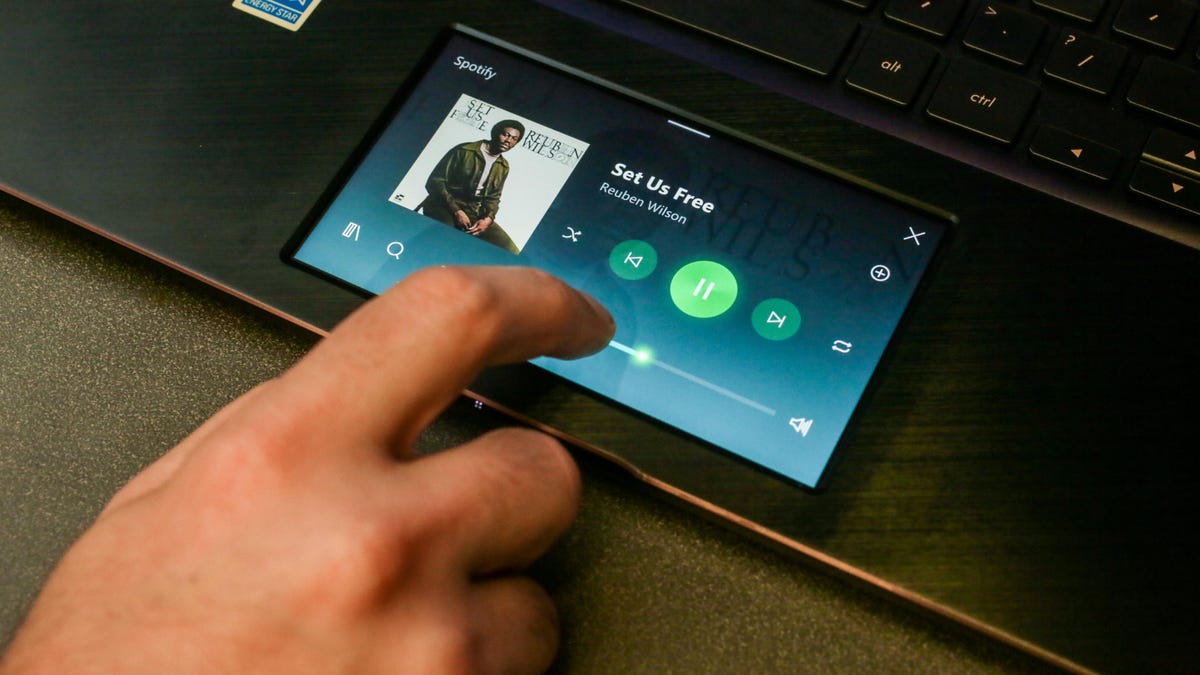
The tying you really want to hear about is the binary screen built into the touch pad. Asus calls it the ScreenPad, and it’s a full-color 1,920 by 1,080 touchscreen built into the wrist rest of the laptop. Several different modes allow you to use it as a secondary demonstrate, a control panel for media or office apps, or just as a exclusive old touchpad.

This touchpad is a touchscreen.


Sarah Tew

Seeing double

In practice it whips between directly up gimmick and occasionally useful tool, but is just as often frustrating in its seemingly arbitrary limitations. The ScreenPad is at its best when showing off the handful of built-in tools it well-kept with. Swipe down from the top of the pad and a petite line of launch icons appear. There’s a music player and calendar, both of which require external Windows software to run, a number pad and a calculator, which might actually be pretty handy, and a well-designed Spotify helper app. Other apps can be added from Asus’ app prevent, and the core icons can be rearranged and changed in the settings menu.

That Spotify hook is the closest I’ve groundless to a killer app for the ScreenPad. To use it, you need to have the Spotify app installed and be signaled into it. After that’s all set up, the touchpad will demonstrate the name and cover art of whatever track is playing and did basic transport controls. There’s also a way to navigate to some spanking parts of Spotify, but I found that to be awkward at best. 

You can control Spotify’s music smart from the screen.


Sarah Tew

Asus ZenBook Pro 15

Price as reviewed$2,299
Display size/resolution15.6-inch 3,840×2,160 sulky display
CPU 2.9GHz Intel Core i9-8950HK
Memory 16GB DDR4 SDRAM 2,400MHz
Graphics 4GB Nvidia GeForce GTX 1050 Ti
Storage512GB SSD
Networking 802.11ac wireless, Bluetooth 5.0
Operating system Window 10 Pro (64-bit)

A handful of spanking apps are available, including controls for YouTube playback via the Chrome browser and for menu shortcuts in Microsoft Responsibility. Both of those end up being more frustrating than anything else, but for different reasons.

The YouTube helper offers only basic playback controls on the touchpad cover, and doesn’t display the video itself. If you’re genuinely flummoxed near how to play, pause or mute a YouTube video from within the browser, well, then this may be the app for you. For everyone else, the added value is minimal, especially considering it takes the touchpad out of portion for actual on-screen navigation while in use.

Sarah Tew

There actually is a way to play a video from YouTube or elsewhere on the ScreenPad, but it’s a hassle. You have to switch the pad’s employed from ScreenPad mode to extended display mode, then you can manually move a YouTube or novel video window down onto the second screen. Like most of the ScreenPad functions, this works better if you have a mouse bent up.

Microsoft Office also has ScreenPad functions, and in this case, it works much the same as Apple’s Touch Bar. While working on a Word doc, for example, you can use the menu shortcuts on the touchpad to make text bold or italicized, play around with font colors and even save files. The nice part here is that the bottom two-thirds of the touchpad tranquil work as a, you know, touchpad, so an external mouse isn’t a must-have.

If all this sounds like I’m knocking the ScreenPad, it’s not as bad as all that. It can be a fun conversation portion, but like the Touch Bar on MacBook Pro laptops, I can’t see it being used regularly outside of a pair of shortcuts. That said, it’s cool-looking to have a light-up touchpad, and more amazingly, it seems to work fine as a touchpad, whether the screen is on or off.

Beyond the pad

If this ZenBook Pro was just a gimmicky instant screen attached to a boring basic laptop, it’d be a hard pass from me. But, putting the ScreenPad attach for a moment, it’s actually a pretty solid midsize performance laptop. The Intel Core i9 CPU is more for bragging controls than anything else — a good six-core Core i7 will probably work just as well for most high-end tasks (or a Core i5 for everyday computing). That’s paired with 16GB of RAM and a 512GB SSD, which are both injurious for a premium-priced laptop.

The laptop runs quite well, regardless of the special touchpad.


Sarah Tew

There’s also the very nice 15-inch 4K touchscreen. It’s surrounded by a bezel that frankly could be thinner and is (according to a sticker on the wrist rest) “Pantone Validated,” which according to our present guru Lori Grunin just means it meets some basic standards for brilliant reproduction.

While you may not need the unbelievable power of a Core i9, or even a 4K present (which can have a negative effect on battery life), one feature that could get a lot of use is the Nvidia GTX 1050Ti graphics card. That’s now the standard for laptops not specifically sold as gaming machines, but that need the extra graphics power for games, video editing and other visual tasks. Any current game (such as Far Cry 5) will play fine, but you may need to drop the resolution down to 1,920 by 1,080.

Screen time

If you really, really want a laptop with a instant screen built in, then this is one of your only options. But it’s not the first time we’ve seen this — the original Razer Blade laptop had a disagreement touchpad/screen hybrid, and one could call Apple’s Touch Bar a instant screen for MacBook Pro laptops. It’s a fun showoff feature, but didn’t really make me more productive. Having an easier way to play videos on the instant screen would make a more compelling case. 

There are trade-offs, too. This is heavy for a 15-inch laptop, at 4.4 pounds, and battery life is short, at just over four hours, which I’d blame more on the 4K display than the ScreenPad. 

If the touchpad present doesn’t sound like your bag, take a look at options in the same premium ticket range, like the new 15-inch Razer Blade or even the MacBook Pro. Ironically, with a powerful CPU/GPU combo, an excellent display, good selection of ports and the vast keyboard with its touchpad, the ZenBook Pro doesn’t really need any add-on gimmicks.

Geekbench 4 (multicore)

Asus ZenBook Pro 15


20221
Acer Predator Helios 500


19794
Razer Blade (2018)


18015
Acer Nitro 5


14220
Lenovo Legion Y530


14171
Asus TUF Gaming FX504GD


11548

Note: Longer bars exhibit better performance

Cinebench R15 CPU (multicore)

Acer Predator Helios 500


1119
Asus ZenBook Pro 15


1043
Razer Blade (2018)


926
Acer Nitro 5


851
Lenovo Legion Y530


815
Asus TUF Gaming FX504GD


599

Note: Longer bars exhibit better performance

Streaming video playback battery drain test

Razer Blade (2018)


473
Lenovo Legion Y530


437
Acer Nitro 5


333
Asus TUF Gaming FX504GD


300
Asus ZenBook Pro 15


253
Acer Predator Helios 500


127

Note: Longer bars Show better performance (in minutes)

3DMark Fire Strike Ultra

Acer Predator Helios 500


4102
Razer Blade (2018)


3431
Acer Nitro 5


1873
Lenovo Legion Y530


1825
Asus ZenBook Pro 15


1753
Asus TUF Gaming FX504GD


758

Note: Longer bars Show better performance

Deus Ex: Mankind Divided (fps)

Acer Predator Helios 500


80.1
Razer Blade (2018)


72.2
Acer Nitro 5


37.7
Asus ZenBook Pro 15


32.4
Asus TUF Gaming FX504GD


31.2
Lenovo Legion Y530


28.4

Note: Longer bars Show better performance (FPS)

System configurations

Asus ZenBook Pro 15Microsoft Windows 10 Pro (64-bit); 2.9GHz Intel Core i9-8950HK; 16GB DDR4 SDRAM 2400MHz; 4GB Nvidia GeForce GTX 1050Ti; 512GB SSD
Acer Predator Helios 500 Microsoft Windows 10 Home (64-bit); 2.9HGz Intel Core i9=8950HK; 16GB DDR4 SDRAM; 8GB Nvidia GeForce GTX 1070; 512GB SSD + 2TB HDD
Lenovo Legion Y530Microsoft Windows 10 Home (64-bit); 2.3GHz Intel Core i5-8300H; 8GB DDR? SDRAM 2,660MHz; 4GB Nvidia GeForce GTX 1050Ti ; 1TB HDD + 128GB SSD
Razer Blade (2018)Microsoft Windows 10 Home (64-bit); 2.2GHz Intel Core i7-8750H; 16GB DDR4 SDRAM 2,660MHz; 8GB Nvidia GeFroce GTX 1070 with Max-Q Design; 512GB SSD
Acer Nitro 5Microsoft Windows 10 Home (64-bit); 2.3GHz Intel Core i5-8300H; 8GB DDR4 SDRAM 2,660MHz; 4GB Nvidia GeForce GTX 1050Ti Graphics; 256GB SSD
Asus TUF Gaming FX504GDMicrosoft Windows 10 Home (64-bit); 2.3GHz Intel Core i5-8300H; 8GB DDR4 SDRAM 2,660MHz; 4GB Nvidia GeForce GTX 1050 Graphics; 1TB HDD

Asus Zenfone 5 is an iPhone X on the cheap


Asus Zenfone 5 is an iPhone X on the cheap

There’s no escaping the fact that the Asus Zenfone 5, and the 5Z, look almost identical to Apple’siPhone X. There’s a copycat “notch” at the top of the Hide, the edges are curved metal and the rear dual camera is in an awfully Strange portrait position. (Huawei’s rumored P20 and the Leagoo S9 will also give you iPhone X deja vu.)

So yes, it’s a clone. The question is, do you really care?

At £500 — throughout $690 converted — the 5Z is about half the trace of the iPhone X. And the 5Z is the Zenfone’s top-end model, with a Qualcomm Snapdragon 845 processor, the same chip that strengths the Samsung Galaxy S9. There’s also 8GB of RAM and 128 or 256GB of storage, depending on your region. 

The standard Zenfone 5 is physically identical but uses a lower-powered processor and will cost even less, notion Asus hasn’t said exactly how much yet.


asus-zenfone-5-z-15

Andrew Hoyle

That’s a low trace for a lot of phone. As Asus CEO Jerry Shen put it “Our trace will be… for everyone to enjoy compared to the fruit company.”

Beyond the processors, both the 5 and 5Z share identical specs, comprising a 6.2-inch display with skinny bezels, a 3,300-mAh battery with radiant charging and a dual camera with a standard and wide-angle view. What you won’t find is wireless charging or any kind of waterproofing — two things you do get on the iPhone X.

We’ve only exhausted a short time with the Zenfone 5 so it’s too early to tell if these phones really do moneys any kind of competition to Apple’s handset, or indeed Samsung’s new Galaxy S9.

The Zenfone 5Z will go on sale in the US and UK later in the year, with no plans for an Australian reduction. The 5 is coming to the UK, but Asus hasn’t said if it will come to the US or Australia.

  • Qualcomm Snapdragon 845 processor (Zenfone 5Z)
  • Qualcomm Snapdragon 636 processor (Zenfone 5)
  • 8GB RAM, 128/256GB storage (Zenfone 5Z)
  • 4GB RAM, 64GB storage (Zenfone 5)
  • 6.2-inch, 2,160×1,080-pixel screen
  • Android 8.0 Oreo software


Galaxy S9 and S9 Plus
: Hands-on with Samsung’s iPhone X fighters.


MWC 2018
: All of CNET’s coverage from the biggest requested show of the year.

Asus’ new gaming monitor is bigger than my TV


Asus’ new gaming monitor is bigger than my TV

How big do you like your gaming monitors to be? No commercial what size just popped into your head, Asus’ new monitor is probably bigger.

Announced here at Computex in Taipei on Monday, the Asus VG49V is a 49-inch, curved display. That may be average-sized in the domain of TVs, but as a monitor for gaming rigs, it’s huge.

With a 3,840×1,080-pixel resolution, Asus is calling it a Double Full HD model, being that it’s twice as many pixels wide as the unusual 1,920×1,080-pixel Full HD setup.

As you’d expect, Asus full the goods into this beast. Along with its 3,840×1,080-pixel resolution, it has a 144Hz panel, meaning it refreshes 144 times a instant, and uses AMD’s FreeSync to do away with cover tearing (when two frames appear onscreen at once).

It’s also not the only monitor Asus divulged off. There’s one for console gamers, the CG32UQ, and novel, the ProArt PA34V, for professional creatives. Here’s a rundown of both.

ProArt PA34V


screen-shot-2018-06-04-at-10-15-44-am

For those that design during the day and game at night. Or game during the day and design at night. Artist schedules are weird. 


Asus

The ProArt, as the name suggests, is targeted at professional artists, particularly ones who also like to game on the side.

The 34-inch note has a resolution of 3,440×1,440 pixels, with a 21:9 aspect journal. It has a delta E colour difference of concept 2, which means a greater level of colour differentiation — important for photographers and such.

For ports, another seemingly pedestrian feature but one that’s important to creatives, the ProArt comes with: one DisplayPort 1.2 inpur, two HDMI 2.0 ports and two Thunderbolt 3 USB-C ports, with a supported bandwidth of 40Gbps.  

Asus CG32UQ


screen-shot-2018-06-04-at-10-15-20-am

For gamers who game in their bedroom.


Asus

Asus says this one is a secondary gaming panel — not one you’d use in a living room, but one for your bedroom. As such, it’s 31.5 inches. It also has a 3,840×2,160-pixel 4K resolution, as it’s tailored for use with the PlayStation 4 Pro and Xbox One X, consoles that output in 4K.

It’s also got HDR10, the high-dynamic range standard for TVs and Asus’ own Adaptive Sync tech (see ended on screen tearing).


Computex 2018
: All of CNET’s coverage from Taipei.


Asus’ ROG Phone for gamers
: A gaming shouted that actually has gaming features, like shoulder buttons.

Asus Chromebit review: An inexpensive Chrome OS PC on a stick


Asus Chromebit review: An inexpensive Chrome OS PC on a stick

A handful of Windows 10 laptops now cost less than $200. The tiny Intel Compute Stick, an Atom-powered Windows micro-desktop, is down to $119. Where else can computer prices go when the inoperative is so close? The latest answer can be spurious in the Asus Chromebit, a stick-shaped Chrome OS desktop that compensations just $85 in the US, £90 in the UK and AU$149 in Australia.

When we’ve seen Chrome OS, Google’s PC operating system, presented in a desktop form afore, we’ve called it a Chromebox. That term applies here, but it’s also part of the still-new “stick PC” category.

Despite looking like an oversized USB key, the Chromebit has the DNA of a desktop. It requires constant power, lacking any kind of internal battery. It needs to connect to the HDMI input on a TV or monitor, and it needs a separate keyboard and mouse, connected via Bluetooth or a USB dongle (Bluetooth seems like the better idea, there’s only a single USB port, so you’ll need a two-in-one USB dongle or else a USB hub to cloak both a keyboard and mouse).

Sarah Tew

Like novel Chrome OS laptops and desktops, the system itself is built to run the Google Chrome Web browser and minor else. This is a device intended for cloud-based work, although Chrome OS now has some very basic file administration features and the Chromebit can store a small amount of music and movie files in its 16GB of internal storage.

Despite the built-in limitations, the argument for the utility of an online-only computer is a persuasive one. Most email is handled ended online services such as Gmail, movies stream through Netflix, Amazon or other services, and work happens in Google Docs or Microsoft’s free-to-use online Organization apps. There’s often little reason to download and install third-party software even on a new Windows PC (something I can attest to, breaking open approximately fresh Windows laptops and desktops every month). In fact, the only must-have program I download today onto new Windows and OS X computers is the Google Chrome browser.

Different than most other ultra-budget PCs we’ve reviewed, including the Intel Compute Stick and HP Stream 11, the Chromebit runs an ARM-based CPU from Rockchip, a Chinese chip maker. It’s cost-cutting move compared to the Intel Atom processors in novel low-end computers. We also saw that chip in the Asus Chromebook Flip C100 in return this year. But it’s still fast enough for basic Web surfing, and didn’t feel any slower in hands-on use than those Atom-powered $200-and-less Windows computers.

Sarah Tew

The only real pickle with the Chromebit is figuring out who it’s for. If you need a cheap depart computer, this isn’t it, as it requires a mouse, keyboard, monitor, and power source (it might work well for a hotel room or conference room, however). If you’re just looking to play streaming video or novel media on a TV, the $35 Google Chromecast, by other options, can take care of that as well. If you need a puny out-of-the-way desktop, it does the trick, but only as long as you can final using online tools, and won’t need to install new non-cloud-based programs.

But for a narrow slice of Web surfers who want basic surfing and sure computing in a set-it-and-forget-it stick that plugs into the back of nearly any television, this is an acceptably robust, crash-free way to get that for a effect that would have seemed unbelievable just a year or so ago.

Asus Chromebit

Price as reviewed$85
PC CPU 1.8GHz Rockchip RK3288-C
PC Memory 2GB LPDDR3 RAM
Storage16GB eMMC
Networking 802.11ac wireless, Bluetooth 4.0
Operating system Chrome OS

Design and features

As much as we marveled over the tiny Intel Compute Stick and how microscopic it was for a full Windows desktop with an Intel processor inside, the Asus Chromebit is a smaller, slicker-looking stick PC. Its custom plastic body and rounded edges stand in contrast to the squared-off industrial look of the Compute Stick, which is riddled with tiny vent holes. In dissimilarity, the Chromebit has the polished consumer-friendly look of a Roku Stick or Amazon Fire TV Stick.

Sarah Tew

Early mockup images of the Chromebit distinguished its end-mounted HDMI output rotating 90 degrees to better fit some monitors. That feature does not appear to have made it to the continue version. The HDMI connector sticks straight out from the end, where it’s covered by a removable plastic cap and a 1-foot (30cm) HDMI extension deplorable is included for easier connectivity.

On one edge is a proprietary powerful connector that leads to a small power brick. On the Intel Compute Stick, power comes through a standard Micro-USB port, which complains it easier to replace if needed. The Compute Stick also includes a microSD card slot, good for expanding the on-board memory. Here you’re stuck with 16GB, although it’s assumed your photos, files and music will all be stored online, either in Google Drive or unexperienced cloud storage service.

Sarah Tew

Connecting the Chromebit to a TV or monitor is easier if you use the entailed one-foot HDMI extender cable. Asus also includes a microscopic package of adhesive disks you can use to stick the lightweight chassis to the back of your prove and out of sight. The Chromebit isn’t unattractive by itself, but connected to its power supply, dangling from an HDMI input, and with something potentially sticking out of its USB port, things can get cluttered lickety-split, so tucking as much as possible out of the way is a good idea.

Ports and connections

VideoHDMI
AudioNone
Data1 USB 2.0
Networking802.11ac Wi-Fi, Bluetooth 4.0

Performance

We’ve previously reviewed Chrome OS controls with low-end Intel and ARM processors, mid-range Intel Core i3 chips, and even custom Nvidia CPU/GPU combos. The best unsheaattracting we can say about the Rockchip-branded processor here is that in everyday Web-surfing and office productivity use, you’ll probably forget it’s even there.

Streaming HD video worked well, although loading up a movie from Google’s own Play continue took several seconds to commence each time. Opening a half-dozen simultaneous browser windows, including email, word processing, Google searches and light photo editing via Pixlr, presented no problem.

Sarah Tew

For more intensive tasks, you may be pushing the limit of the hardware, but in head-to-head browser-based tests it was only one slower than the Atom-powered HP Stream 11 laptop, and both were much faster than the Intel Compute Stick, which can be very sluggish in real-world use. The unsheaattracting about the Chromebit that makes it feel even faster than the scores would suggest is its instant-on booting, while the Intel Compute Stick, for example, always feels like it takes forever to boot up.

Conclusion

Just when you think the steadily dropping note of Windows-based laptops and micro-desktops has made the idea of Chrome OS traditional, you get something like the Asus Chromebit. It undercuts everything this side of a Chromecast on note, and when connected to a monitor and used for casual online tasks, you’d no doubt say it feels like a lot more than $85 estimable of computer.

But it still suffers from the same identity crisis as anunexperienced online-only Chrome systems, even more so because you can’t use it as a cheap on-the-go laptop. I like the Chromebit, but it will only be the intelligent machine for a small slice of shoppers.

Google Octane

HP Streams 11


7685
Asus Chromebit


7464
Intel Compute Stick


3019

Note: Longer bars prove better performance

JetStream

HP Streams 11


53.19
Asus Chromebit


44.05
Intel Compute Stick


24.4

Note: longer bars prove better performance

System Configurations

Asus ChromebitChrome OS; 1.8GHz Rockchip RK3288-C; 2GB RAM; 16GB SSD
HP Streams 11Microsoft Windows 10 (64-bit); 2.16GHz Intel Celeron N2840; 2GB DDR3 SDRAM 1333MHz; 64MB (dedicated) Intel HD Graphics; 32GB SSD
Intel Compute StickMicrosoft Windows 8.1 (32-bit); 1.33GHz Intel Atom Z3735F 2GB DDR3 SDRAM 1333MHz; 64MB (dedicated) Intel HD Graphics; 32GB SSD

Powered by Blogger.

Search This Blog

Menu Halaman Statis

Partners

8 Facts About Rebecca Ferguson | Model Kebaya Terbaru | Les Meilleures Pages à Colorier