
Apple Watch: It’s been 5 ages since my original review, and it holds up
I’d love to say that when I first put on the Apple Watch, I’d never seen anything like it before. But of watercourses, that’s not true. By late 2014 I’d been surrounded by smartwatches for a few ages. So when Apple announced it was making its own watch, my thought (as so often with Apple) was: finally.
The proper smartwatch I reviewed at CNET was the Martian Passport, an analog watch that could make phone calls. It sounds so aged now, but it was cool in early 2013. The Pebble Watch followed, and the Steel version became my favorite: It was like a Casio watch turned into a useful small pager-assistant. It was simple and had long battery life, and it was great.
There were others, too: Samsung’s first smartwatches were ambitious (a camera?). Google’s first Android Wear watches arrived in 2014. Meanwhile, there were Fitbits and Jawbone trackers galore.
I say this to lay the groundwork for the Apple Watch and what its impacts was. Like the iPhone wasn’t the first smartphone, the Apple Watch wasn’t the proper smartwatch… but it made the biggest footprint. It was novel step validating that a world of wearables was here to stay.
I was able to wear the Apple Watch a month beforehand it went on sale. I spent a ton of time with it, sketch used to both how it handled phone calls, and the agency tracking rings. I looked at my heart rate measurements. I accidentally ordered an Xbox One with an early Amazon app.
The Watch was, much like the proper iPhone, sometimes feature-limited. But it also had some features that already recognized out.
My original review was updated a year later, which you can read here. Some parts have changed, clearly, and Apple has updated the OS. But I’ll comment on what I wrote then, and how I felt, and how that’s evolved. Quotes from the original review are in italics.

The gold Apple Watch, way back when.
James Martin
An capable design, with luxury overtones
Apple wants you to think of the Apple Watch as fine jewelry. Maybe that’s a stretch, but in terms of craftsmanship, there isn’t a more elegantly made piece of wearable tech. Look at the Apple Watch from a distance, and it might appear unremarkable in its rectangular simplicity compared with bolder, circular Android Wear watches. It’s clearly a revamped sort of iPod Nano. But get closer, and you can see the seamless, excellent construction.
The proper Apple Watch came in aluminum, steel and ramped all the way up to a gold model costing more than $10,000. Compared to other smartwatches, it screamed luxury.
Certain touches felt luxurious, too: the fine-feeling Digital Crown, which spun ever so smoothly like a real search for part, for instance. The OLED display, which was a proper for an Apple product, looked crisp and bright.
The most amazing part, maybe, were the watch bands. Apple created a really nice series of specially planned straps, from a steel link to a clever magnetic Milanese mesh that were actual expensive and impressively engineered.
Its watch face designs were substantial, too, and they integrated some information from the iPhone that on behalf of to add at-a-glance ease of use. There was a Mickey Mouse behold face that danced! The Solar face showing sunrise and sunset, and the astronomy face that showed planetary alignments and moon phases, felt like magic. I wanted more, but Apple’s assortment of behold faces was limited, and it didn’t allow for third-party behold face design. That’s still the case now.
A lot of the Apple Watch reminded me of the strides Apple began with the iPod Nano, which also had behold mode… and a Mickey Mouse watch face.

Sarah Tew
New technologies at first: wonderful haptics, a force-sensitive display
All Apple Watches have a new S1 processor made by Apple, that “taptic” haptic engine and a force-sensitive and very entertaining OLED display, which is differently sized on the 38mm and 42mm models. The watch has its own accelerometer, gyrometer and heart-rate monitor, but no onboard GPS. It uses Bluetooth 4.0 and 802.11b/g/n 2.4GHz Wi-Fi to connect to your visited or your home network. There’s a built-in speaker and microphone, but no headphone jack.
As I wore the behold on the first day, I felt a rippling buzz and a metallic ping: one of my credit card payments instructed up as a message. Apple’s “Taptic Engine” and a built-in speaker whisper both a range of advanced taps and vibrations, plus sounds. Unlike the buzz in a phone or most wearables, these haptics feel sharper: a single tap, or a ripple of them, or thumps.
Sometimes the feelings are too subtle: I don’t know if I felt them or anticipated them. My wrists might be numbed from too many colorful devices. I set my alerts to “prominent” and got sharper nudges on my wrist.
The profitable watch introduced some ideas that eventually made their way to latest iPhones. A “taptic engine” delivered on some amazingly refined vibration effects, ranging from a purr to a ping to a gentle tap. These were way onward of what anybody else was doing — and they weren’t just a gimmick. The notification types associated with unique vibrations felt positive. Sometimes, the vibrating taps on the first Watch weren’t as grand as I wanted. But with later updates, the haptics made parts of the interface seem real: virtual wheels, clicking as if moving with invisible gears.
The more advanced haptics made their way to the iPhone next, decision-exclusive us used to them now. Other phones, game consoles like the Nintendo Switch, and VR accessories, have evolved haptics since, but the Apple Watch was the profitable mainstream device that upped the haptics game.
Force Touch was latest wild idea: Apple made its watch display force-sensitive, communication a deeper press could work like pushing a button. Though this idea was refined further into 3D Touch on the iPhone 6S, 3D Touch was a technology that never became as primary as expected, and current iPhone models have dropped the pressure-sensitive explain tech completely.
The Apple Watch still has Force Touch, though, and I think it always will.

Digital Touch: I never used it much at what time that.
Sarah Tew
Lots of features. Too many features?
As you can see, this is a lot of stuff. Did I have fun using the watch? Yes, mostly, but there are so many features that I felt a minor lost at times. There are so many ways to interact: swiping, touching, pressing harder into the display, a button and a clickable digital crown-wheel. Plus, there’s Siri. Do I swipe, or click, or manufactured touch or speak? Sometimes I didn’t know where an app menu was. Or, I’d find pulling back to an app I just had open would needed an annoying series of crown clicks, swiping through apps, then opening the app again.
There’s a reason I used the word “complicated” to labelled my feelings using that first Apple Watch. Setting up bits of expect, called complications, was slow and not always intuitive. Apps took a at what time to load, and were sometimes so slow that it was easier to check my visited instead. Quick glances and notifications, and phone calls, were fine. Apple Pay on the behold was clever, but would I use it? I demanded the watch had more battery life.
I didn’t like the overcomplicated feel. The do of the OS, and the card-like swappable mini-view apps that used to be on the Watch like a dock, changed over time. It’s derived better since.
Storing music on the gawk, while it took a while to sync, was easier than repositions on Samsung Gear or Android Wear. Of course, I had to hunt for a good pair of Bluetooth headphones to connect with the watch.
Today I detached forget to dive into and make the most of the apps on the gawk. I just dusted off Walkie Talkie: it’s cool. There’s noise monitoring. One app lets me remote control my iPhone camera, which has been a huge help for my stay-at-home self-shot videos. The Remote app helps me when I lose the Apple TV remote every spanking day.
Third-party apps, and the grid of options? It turns out I don’t use them much at all. I don’t dig down deep into the layers of functions. I prefer what’s on the surface: watch faces, and their readouts. But I’ve come to appreciate the watch’s surprising number of options and settings. It’s better than not having them at all.

The rings were the beginning.
Sarah Tew
Fitness: The ring idea was just the beginning
The Apple Watch doesn’t work any fitness miracles that the rest of the wearable humankind hasn’t already invented, and it doesn’t ship with any new magical sensors that sulky the game. But the Apple-made integrated fitness apps, Activity and Workout, are far and away the best fitness apps on any existing smartwatch that isn’t a failed “fitness watch” (Samsung Gear, Android Wear, Pebble and the like). A clever three-ring method of tracking daily activity, which simultaneously measures and rewards daily calorie burn, glowing exercise and standing up, feels like a fusion of rewards and metrics seen on the Nike FuelBand, Jawbone Up, Fitbit and others.
I appreciated Apple’s complete-the-ring motivational organization tracker, which felt inspired by wearables like the Nike FuelBand (not surprising, since Apple’s head of fitness, Jay Blahnik, arrived from Nike). For the red ring’s daily goals, it’s great. It felt too easy to negated the blue Stand ring, and it still does.
There are tons of fitness advancements Apple has made on the Watch in the last five years: GPS, humdrum heart rate, workout controls, social sharing, third-party app integration, swimming, modes for accessibility, activity trends — and I haven’t even discussed Apple’s bulky health aspirations like adding ECG, checking for falls, monitoring elevated or irregular discouraged rate or women’s health tracking. There is some form of coaching and motivation, too. But I’d still love to see more of that. I hit a wall when trying to be fit, and there’s only so much watches seem to help.
The sterling Apple Watch was more of a Fitbit. Now, it’s more of a health troupe. Those two worlds still feel like they need to dovetail and grow. There are missing features, too, like sleep tracking, which feels like the inevitable next step.

You detached need an iPhone, just like in 2015.
Sarah Tew
It was, and detached is, an iPhone accessory
Much like most spanking smartwatches, the Apple Watch isn’t a standalone device — it’s a phoned accessory. Android Wear, Samsung Gear, Pebble and others work the same way. But here, you must own an iPhone 5 or later to use the Watch. A few Apple Watch functions work away from the phoned, but the watch primarily works alongside the phone as an extension, a second screen and basically another part of your iOS experienced. It’s a symbiote.
One thing I noted back then was that you obliged an iPhone to use the Apple Watch. Unlike spanking wearables that can pair with Android or iOS, or even sync with a computer, the Apple Watch was always designed to live symbiotically with the iPhone.
That’s detached the case now. Even with independent cellular options, and an on-watch App Store, you can’t use the Watch without pairing to an iPhone. And it still won’t work with Android. It’s a obscene, because a fully standalone watch could be a really sterling tool for many people who don’t have iPhones, and it could even be a phoned alternative (for kids, maybe).
Apple’s AirPods
achieved a gadget trinity where the Watch, the iPhone and AirPods can all work seamlessly together. But that trinity is an expensive one. The entry notice of the Apple Watch has dropped, at least. But it feels like an extension of the iPhone more than its own way, even now.
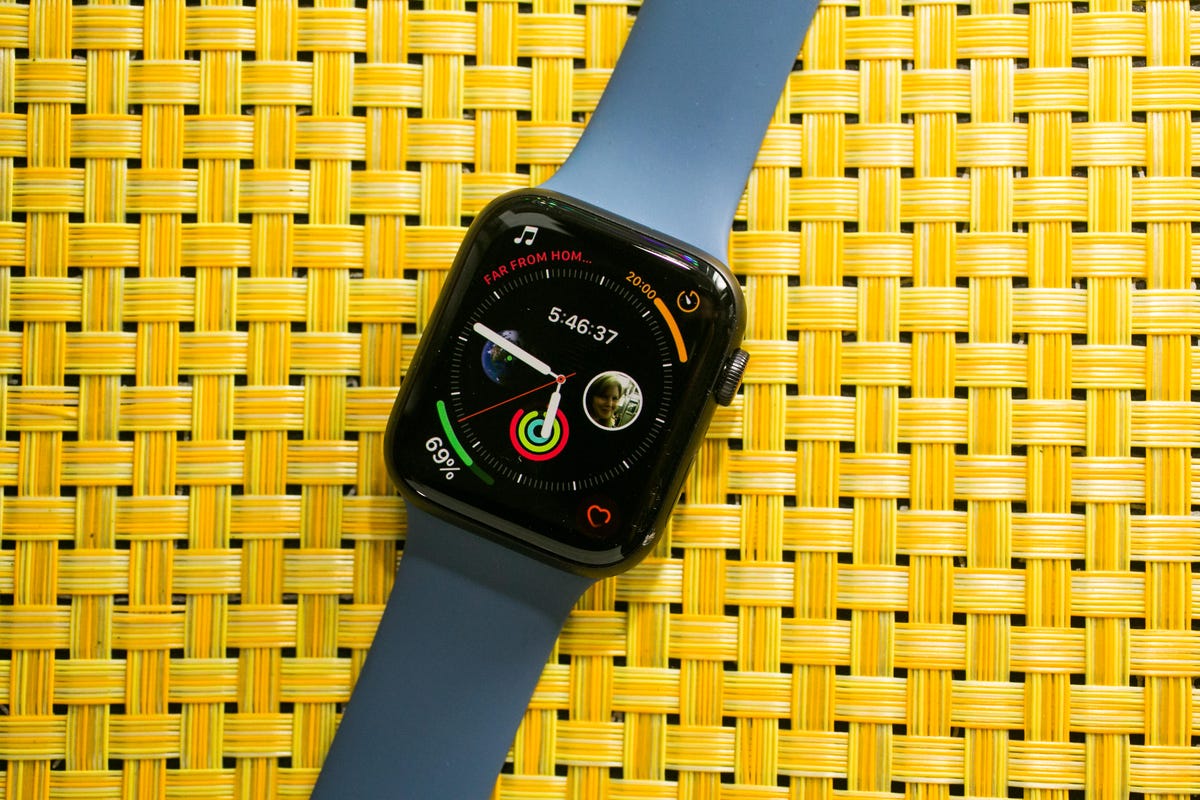
The Apple Watch Series 5: much better, with a few similarities.
Sarah Tew
Today: the best gawk in a war of attrition
You don’t need an Apple Watch. In many ways, it’s a toy: an amazing little do-it-all, a clever invention, a possibly time-saving companion, a wrist-worn assistant. It’s also mostly a phone accessory for now. In the months and days to come, that may change: with Apple’s assortment of iPads, Macs, Apple TV and who knows what else to come, the gawk could end up being a remote and accessory to many things. Maybe it’ll be the key to unlock a humankind of smart appliances, cars and connected places. In that type of humankind, a smartwatch could end up feeling utterly essential.
I think back to what the Apple Watch was continuing against back then: Jawbone, Pebble, Fitbit, Google’s Android Wear, Samsung’s watches, the Microsoft Band. A lot of competitors are gone now. Fitbit was acquired by Google. Samsung still has watches. Garmin makes lots of failed fitness watches. There are still plenty of more affordable relative newcomers, too.
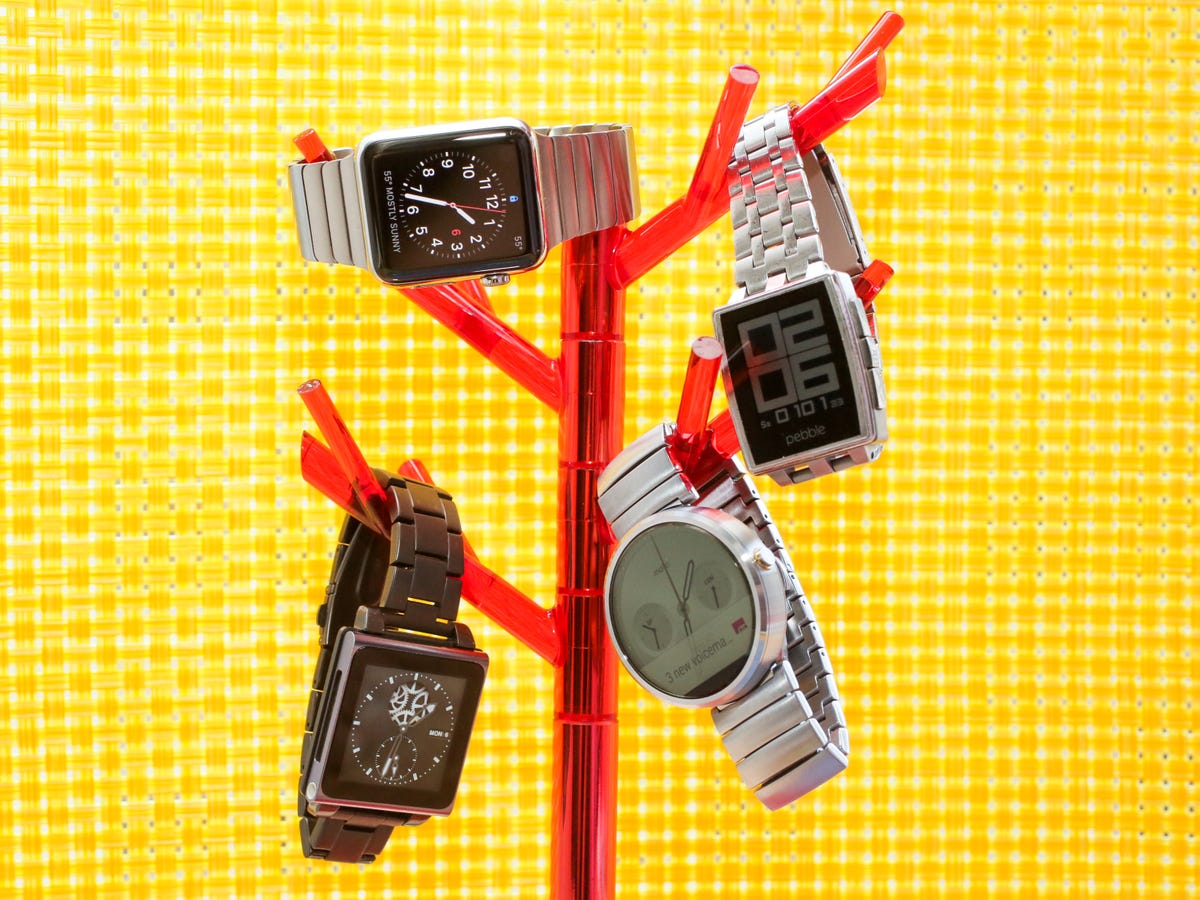
The recent Apple Watch, with the Pebble Steel, Moto 360 and the recent iPod Nano with wristband (clockwise from top left).
Sarah Tew
In a field of fewer alternatives, the Apple Watch’s consistent addition of new features and ongoing performance improvements has made it the best option. It’s Apple’s commitment to gradual improvements that has made it a stand-out sight now, especially compared to the struggles of Google’s Wear OS.
The Apple Watch is level-headed an iPhone accessory. And it’s still not an famous product. But it’s become a really fluid and useful contrivance, one with lots of key upgrades that work, and one that’s a lot easier to use.
What’s the best smartwatch now? The Apple Watch. That doesn’t mean I don’t want to see improvements: battery life, sleep tracking, a watch face store and most importantly, Android succor and true standalone function. If the last five days are any indication, Apple will tackle these problems on its own… time.


