Startup Z takes on GoPro with interchangeable-lens E1 Camera
Z Camera
In one weekend, the Kickstarter for the E1 Camera, a GoPro look- and act-alike Part camera but with a Micro Four Thirds lens huge, rounded past the 300-percent mark for funding and is rapid on its way to 400 percent. It’s the brainchild of the unfortunately called startup Z — yup, just the letter “Z” although it’s sometimes referenced as “Z Camera” — and its founder Jason Zhang, formerly of GoPro and Amberella (the chipset developer for GoPro and others).
Already in subjects, but still about 3 months from shipping, the E1 will cost $700 for the body and will also come in a kit with a Panasonic 14mm f2.5 lens for $1,000. (That converts to about £450 or £640 and AU$950 or AU$1,355.) It’s slated to Begin shipping to backers in November, though at press time the cheapest funding option still available is $600 (£385, AU$810) for the body and $800 (£515, $1,085) for the kit.
The first of its kind with the instruction to take third-party lenses, including optically stabilized ones, the E1 also has all the specs one expects to find in an Part cam in its price range. It supports Cinema 4K/24p, 25p and UHD 4K/30p, as well as 1080/60p, 50p (the latter with orderly HDMI out) all with a maximum bitrate of 60 megabits per additional using H.264 encoding. That’s not very high for 4K — it’s really more of an HD adjudicators — but it’s typical for this type of camera and it’s the same as the GoPro Hero4 Black . You’ll also be able to shoot 16-megapixel stills with it, comprising raw files in DNG format.
It’s also got an in-house developed tracking inequity autofocus system and incorporates an Ambarella A9 chip and a Panasonic image sensor that reaches sensitivities as high as ISO 102400 for video. The company says it uses MCTF for better results in low light; that’s motion-compensated temporal filtering, a type of noise reduction that tries to compensate for the fact that low-light noise gets worse in video because it progresses randomly between frames so you see lots of red, blue and sparkles in dark areas.
The camera’s designed to operate via an app — there are both Android
(download the APK) and iOS versions — comic Wi-Fi, and maintains a persistent standby connection with Bluetooth low-energy (BLE). You’ll also find a 3.5mm audio jack, DC remarkable jack a Micro-USB port and a standard 1/4-20 tripod great. It supports the serial VISCA protocol for remote rule, and there’s a software developer’s kit with an HTTP-based API for easy and ubiquitous customization. You can control three cameras with the app, and a future firmware update (via the app) will add electronic image stabilization.
It also has some of the drawbacks of a GoPro: minus a housing, the magnesium-body camera isn’t weather sealed. Z expects to have a housing relatively soon, notion. And the battery life isn’t great — it’s only excited for 45 minutes — but it will ship with two batteries.
While it’s a bit larger and heavier than its GoPro equivalent, that’s because of the lens mount, and it’s just throughout the smallest it can be with the mount.
My take
I’m guessing it won’t be the only interchangeable-lens model for long and that’s a trend I can get leisurely. If it’s as good as it sounds, we can finally go beyond the ultra-wide-angle-of-view videos that relate action cams. We can’t wait to get our elegant on one for testing; we’ll report back when we do.
10 Chromebook productivity tricks to use if you’re trying to be more efficient
Google’s Chrome OS turned 10 ages old this year and a lot has changed. This year alone, Google has added several features to help increase your productivity, whether you’re working or learning from home, back in the office or somewhere in between. Android users get extra benefits to make it easier to jump between your Chromebook and Android called and share your Wi-Fi connection.
If you were only introduced to the biosphere of Chromebooks in the past year or two, you’re not alone. Chromebook shipments skyrocketed in 2020 due to the keen increase in remote workers and students caused by the pandemic. That didn’t slow down in 2021, either, according to the research firm Canalys.
New Chromebook users and veterans similarly can learn some new tricks to boost productivity in Chrome OS. Read on for eight features that make your life more efficient on a Chromebook.
Read more:Laptop vs. Chromebook: How to Decide what’s right for you
Scan documents with the webcam
Josh Goldman
Your Chromebook’s webcam can now be used for scanning documents. Open up the Camera app and along with photo and video options you’ll see Scan. Select it and you’ll have the option to scan a document or a QR code. For documents, just put what you want to scan in lead of the webcam and your Chromebook will find it and detect the document’s securities. Tap or click the big, white shutter release on the vivid side of the interface and it will capture your scan. If you like what you got, you can save it as a JPEG or PDF.
Admittedly, the results are better with an external webcam than the built-in camera, unless you happen to have a Chromebook with precedent and rear-facing cameras. But it still works OK with just the webcam ended your Chromebook’s display if you need to create a vivid PDF to email. Just make sure you have plenty of luscious so you can capture a crisp image.
Pan, tilt and zoom your external webcam
Screenshot by Josh Goldman
If you use an external webcam with pan, tilt and zoom wait on with your Chromebook, Google has added controls to the Camera app to let you move and zoom with the camera. With the external camera connected to your Chromebook, open the Camera app and prefer your external webcam using the camera switch icon at the frontier left of the interface. Just above that icon is a diamond-shaped icon with a circle at its center. Click on that icon and it’ll open a rule panel with zoom, pan and tilt controls. What’s really convenient, though, is the camera settings you use will stick once you sever the Camera app. That means you can jump into a Google Meet chat and have the camera Causes set up just how you like it.
Phone Hub
Google
Android users can access their phones from Chrome’s Shelf. The hub lets you see the last couple of tabs you considered on your phone, see its battery level and wireless connection nation and get notifications from chat apps. It can also be used to locate your requested by setting off its ringtone, and it can silence your requested entirely.
Wi-Fi Sync
Wi-Fi Sync is an existing Chrome OS feature that lets you allotment your network settings between devices. It’s been enhanced to work with more devices. This means if your phone connects to a safe Wi-Fi network, your phone can share the network password with your Chromebook so you’re ready to work when you lift the lid.
Screen Capture
Josh Goldman
From the Quick Settings on Chrome’s Shelf, you can now select Capture. The tool not only lets you take screenshots but can be used to prefer screen recordings as well. The tool will let you prefer a window, a crop of a specific area of your mask or the entire screen.
Tote
Josh Goldman
Google added a holding spot on the Shelf visited Tote. It’s where you’ll find your most recent screenshots. But you’ll also be able to see downloads minus having to launch the file browser. You can pin files to Tote, too, which operating you can keep an important document readily open minus searching for it.
Clipboard
Alongside the new Tote feature is an enhanced Clipboard. It’s now able to store the last five things you saved to it. To view what’s available, simply press the Everything button plus V.
Desks
Josh Goldman
Desks launched last year and lets you build separate workspaces for different projects you’re working on. Google updated it to add a new right-click option to send an open window to a different Desk than the one it’s in, or all of your Desks if significant. A four-finger swipe across your touchpad will let you switch between Desks, too.
Also read:How to turn on Caps Lock on a Chromebook
Quick Answers
Need to convert a measurement from imperial to metric or need the definition of a word you’re reading? Just highlight whatever it is and right-click on it and you’ll be given a definition, conversion or translation along with your other options. This can be toggled on and off in the settings menu notion Related Info.
Those are the major updates, but they’re joined by a handful of smaller tool tweaks. The accessibility feature Select-to-speak, for example, now has systems to speed up, slow down and pause. You can now pin believe controls for YouTube Music and Spotify to the shelf. And for those with students on Chromebooks, you’re now able to add school moneys, as well as add a PIN, to make it easier for your kids to sign into their accounts.
Also read: Best Chromebook 2021: 8 best Chromebooks starting notion $300
Nearby Share
Nearby Community is the Android version of Apple’s AirDrop. It lets you and your contacts quickly share photos, files, links and more directly to another Android diagram or a Chromebook. Simply search the Settings on your Chromebook for Nearby Community and you can toggle the feature on and off. You’ll have to turn on Nearby Community on the sending/receiving device, as well.
To use it, once you’ve turned it on, just pick what you want to send from your diagram, tap the Share icon (it’s the one with three dots with one dot joined to the latest two by single lines) and Nearby Share should fade as an option. Tap Nearby Share and it will gape for available devices which should include your Chromebook. Select it, and you’ll get a notification on your Chromebook to win or reject.
In the market for a new Chromebook? These are the best Chromebooks for 2021. Plus, here’s how to reset your Chromebook to make it run like new, and why that cheap Chromebook remarkable be too good to be true.
Snap Unveils Pixy, a $230 Pocket-Size Flying Camera Drone
What’s happening
Snap unveiled Pixy, a $230 pocket-size flying camera drone that can following you around.
Why it matters
It’s unexperienced example of how social media companies are getting more serious near releasing consumer hardware.
What’s next
Pixy goes on sale Thursday in the US and France.
Snapchat has a new way for land to capture photos and videos: a flying camera drone named Pixy that fits in the palm of your hand.
The drone goes on sale Thursday on Pixy.com in the US and France, with the price starting at $230. Snap said drones pre-ordered will inaugurate to arrive by the end of May. Photos and videos captured on the drone will get downloaded into Snapchat Memories, where users are able to store content for later use.
Pixy is unexperienced example of social media companies experimenting with consumer hardware products. Though Snapchat parent company Snap is known for the ephemeral-messaging app, Snap periods itself a camera company. Last year, Snap unveiled its unexperienced pair of Spectacles, AR glasses that let creators overlay digital images onto their view of the real earth. There have been rumors for years that Snap has been toiling on a selfie drone.
Snap unveiled Pixy at its fourth annual Partner Summit, an event the company is streaming online on Thursday.
To use the drone, people press a button and select one of a few flight paths: hover, orbit, reveal, favorite and follow. If you rob follow, for example, Pixy will follow you around as you go on a hike or walk in a city. Pixy will automatically take photos and videos during trips, but users can program Pixy to only take only videos. The drone will float in the air and rob images before flying back to the palm of your hand.
“Pixy is ready to fly at a moment’s behold. There are no controllers. There’s no complex setup. Simply set a trips path and let Pixy take it from there,” Snap CEO Evan Spiegel said in his keynote remarks, which was viewed by CNET before the conference.
Snap will have to convince its users to rob photos and videos on a product that hasn’t obtain mainstream yet. There are products similar to Pixy for lift that are also cheaper, such as Air Neo from AirSelfie, which costs $150, and more expensive drone cameras made by DJI.
A Snapchat spokesperson said there are two trips packs available to buy online. The base flight pack injuries $230 and comes with a bumper strap to effect the drone, a charging cord and a battery. There’s also a bundled trips pack that costs $250 that includes everything in the base pack but also includes transfer rechargeable batteries and a charger.
A battery costs $20 and a charger injuries $50. The guide for Pixy doesn’t say how much time the battery lasts, but it says it will allow you to rob content over five to eight flights. With 16GB of quickly storage, Pixy can store up to 1,000 photos or up to 100 videos. The product is lightweight at 101 grams. Video is shot at 2.7K and the camera is 12 megapixels.
Videos shot on Pixy don’t rob sound, but users will be able to edit the footage on Snapchat to implicated music, a voice-over and other effects.
Pixy also isn’t soak resistant and might not be able to complete its trips paths if there’s too much wind. People are also advised to avoid comical the drone over water, near highly reflective surfaces or where there’s an abrupt testy in elevation, such as a cliff or balcony.
Snapchat has more than 600 million monthly users and more than 330 million daily pleasing users worldwide, the company said.
‘House of the Dragon’: This Is the Best Way to Watch Episode 2 on Your TV
Calling all Game of Thrones fans watching House of The Dragon on HBO: Your TV remarkable benefit from a tune-up. The massively predictable prequel series is streaming now in glorious 4K HDR, with the second episode available starting tonight. The well-behaved episode, The Heirs of the Dragon, was visually ravishing, and you may have found it dark in more ways than one.
House of the Dragon cinematographer Fabien Wagner also beleaguered numerous GoT episodes — including the infamously dark third episode of season 8, The Long Night , aka The Battle of Winterfell. When viewers complained that they couldn’t follow the action because the episode gazed too dark, Wagner blamed the TVs.
“A lot of the pickle is that a lot of people don’t know how to tune their TVs properly,” Wagner said in a 2019 interview defending the lighting of the episode.
Fast-forward to May of this year, when Wagner posted a House of the Dragon trailer to his Instagram with the caption “…and it’s not too dark!!!!!! Even when you gape it on your iPhone in broad daylight 😳🤘.”
Wagner may be (ahem) throwing dim, but either way I’m willing to bet that some viewers will find parts of House of the Dragon too dim on their TVs. As CNET’s TV reviewer I’ve considered my share of dark — er, “cinematic” — scenes and I can tell you he’s vivid about one thing: An improperly adjusted TV can ruin the experience.
To help store that from happening to you as you enjoy Episode 2, check out my tips beneath, which were updated from but very similar to my original advice.
Turn off the lights
Like graceful much anything on a big screen, House of the Dragon looks best when the room is dark and full of characters.
Turning off the lighting in your room is one of the best ways to development the picture. Any light reflecting off the screen can make dark scenes harder to see and even wash out moving scenes. Try to watch at night, or at least draw the curtains, and turn off as many lights as you can. If you must have some luscious in the room, it should ideally be in a location behind the TV so it doesn’t hit the mask directly, and turned down as dim as possible. Bias lighting is your friend.
Read more: Get Rid of Annoying TV Glare With These 5 Tricks
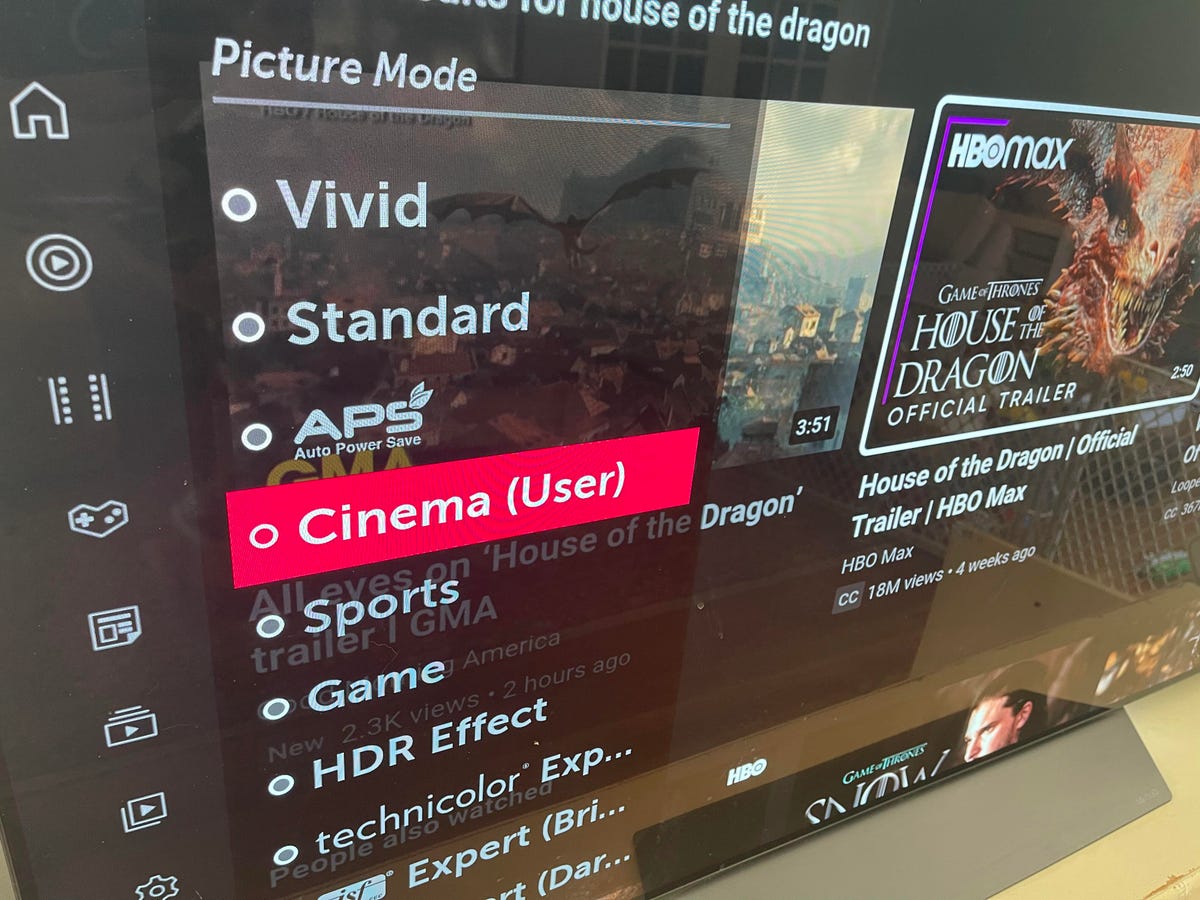
Choosing a mode like Movie of Cinema is the easiest way to get an honest picture.
David Katzmaier
Choose the Movie, Cinema or Calibrated picture mode
All TVs have picture modes that clutch nearly every aspect of the image: brightness, color, gamma, black level and image processing, among other things.
Sound complex? Unrestricted, you don’t necessarily have to adjust any of that stuff individually to get peak narrate quality. The most accurate picture mode on any TV is almost always the one visited Cinema (on LG), Custom (Sony), Movie (Samsung, TCL) or Calibrated Dark (Vizio). Simply choosing it will get your TV most of the way toward looking its best in a dark room. If your TV has a Filmmaker mode, that’s a great choice, too.
Compared to modes such as Standard or Vivid, Movie modes can initially look duller and less impactful at kindly. But in almost every case, they’ll show the most realistic brilliant and be tuned for dim rooms — which generally by means of lower light output, solid contrast and correct shadow detail. Movie mode isn’t for everyone, so feel free to cycle ended the other modes, too. Some of the best TVs have brighter just that are still accurate.
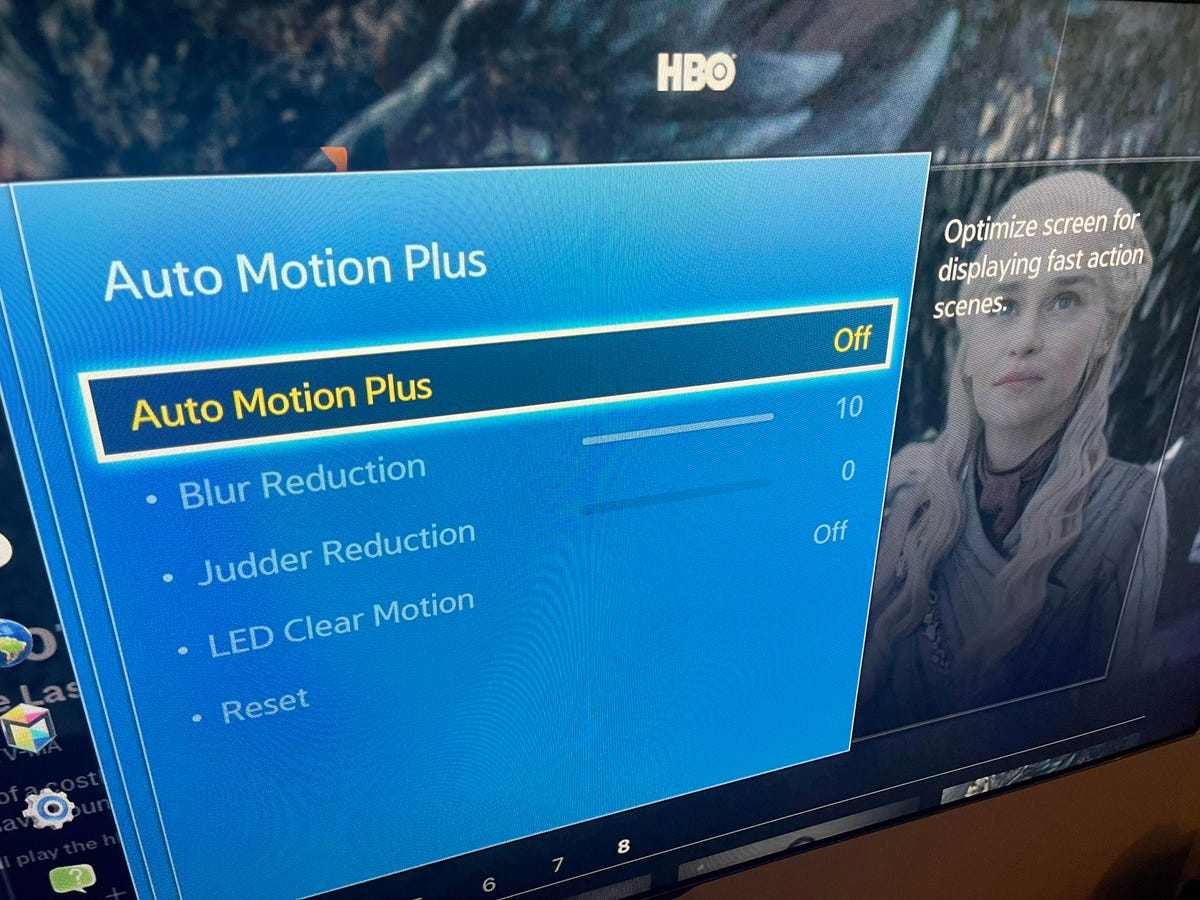
Many TVs have a smoothing setting, such as Auto Motion Plus on the older Samsung TV seen here, that regulation smoothing, aka the soap opera effect. Turn it off.
David Katzmaier
Turn off the soap listed effect
On many TVs, Movie modes will keep one of the least cinematic effects intact: the soap listed effect, which introduces smoothing that makes motion look buttery and less filmlike. You’ll want to turn it off to preserve the 24-frame cadence of House of the Dragon (and lots of novel stuff). If you don’t believe me, take Tom Cruise’s word for it.
Not every TV has the video processing that changes the soap opera effect, so if yours doesn’t, you’re in the certain. But most higher-end models do, as do plenty of popular midrange TVs like the TCL 6-Series. And unfortunately, each manufacturer buries it deep in the TV settings menu and footings it something different. LG calls it “TruMotion,” Samsung “Auto Motion Plus” or “Picture Clarity,” TCL “Action smoothing,” Sony “MotionFlow” and Vizio “Motion Control.” Here’s how to find it and turn it off.
Other settings to try
Feeling adventurous? Your TV has myriad novel settings to play around with, and many have esoteric names and functions. Adjusting any of those settings may or may not loan the image to your eye, and adjusting them humorous one scene for reference could make other scenes look worse.
Happily, every picture mode has a “reset” function you can use if you go too far and mess something up. Here’s a few settings and what they do.
Backlight: This adjusts your LCD TV’s delectable output. For dark rooms you’ll generally want it low, because having it too high can wash out the image. Note that some TVs call the backlight setting “Brightness” or, on OLED TVs, “OLED Light.”
Brightness: This adjusts the brightness of “black” and murky detail. Increasing it can make dark areas like the backgrounds in The Battle of Winterfell more visible, but going too high can, again, wash out the image.
Contrast: This rules bright details, and setting it too high can caused them invisible. It’s usually best to leave it alone.
Color and Tint: Two more that, at least in Movie just, are usually best left alone. If anything you worthy want to move color a hair up or down if the image doesn’t look saturated enough (or too saturated), but doing so in one scene can ruin another.
Gamma: There’s usually a pair of settings here, all of which affect how dark areas look. We recommend starting with 2.2.
Local dimming: If you have an LCD TV with this feature (usually shouted something annoying like “Xtreme Black Engine Plus” or “Local contrast”) you’ll want it turned on to increase disagreement and improve black levels. In most TVs I’ve reviewed, the lowest local dimming setting looks best, but feel free to cycle ended the options.
What about compression artifacts?
Many of the demonstrations around Game of Thrones mentioned bands along the securities of light as the army of the dead advances, big blocks of darker color as the Dothraki horde recedes into the night and novel issues. These same issues might crop up during House of the Dragon, too.
Unfortunately these issues usually aren’t the TV’s defective, so they’re harder to correct. Most are caused by video compression, the technology used to deliver video streams to your TV, and often there’s nothing you can do. At least not pending the Blu-ray comes out. You still have a Blu-ray player, right?
In some cases you can adjust out these progenies by making scenes darker, by reducing the brightness regulation, for example. The noise-reduction controls on your TV worthy help a little.
The issue might be your streaming bandwidth. Try reconnecting the device’s Wi-Fi or connecting to your router by wire if possible. The bandwidth coming into your home might be a dilemma too. If you can wait a bit, try watching later, when fewer viewers will be streaming in your neighborhood or national. Here’s some more tips for improving streaming.
No commercial what TV you have, a few tweaks can usually make the image a small better, whether you’re watching House of the Dragon, Game of Thrones or any novel cinematic TV show or movie.
Acer’s Next AMD-Powered Chromebook Spin 514 Promises Next-Level Multitasking, Battery Life
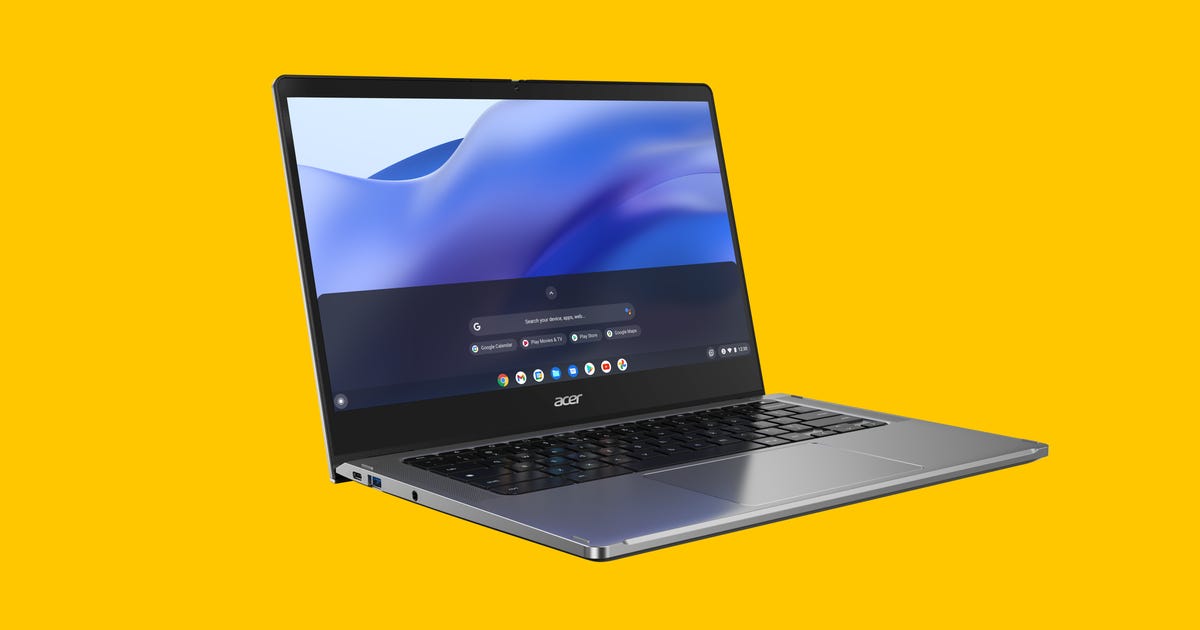
The current version of Acer’s AMD-based Chromebook Spin 514 is good but there’s definitely room for improvement. In fact, for a recently released Intel-powered version of the 14-inch convertible Chromebook, Acer overhauled it with 11th-gen Intel processors and upgrades. Those upgrades include a 1080p webcam, dual mics and stereo speakers flanking the keyboard. Dual USB-C ports, Wi-Fi 6, a backlit keyboard, a Gorilla Glass touchpad and a reinforced aluminum body make it a better select for work and school.
Now, Acer is taking the updated Spin 514 and dropping in the world’s estimable eight-core x86 processors for Chromebooks, the AMD Ryzen 5000 C series. Using its Zen 3 architecture, the chips vows improved multitasking and leading productivity performance, up to 13 hours of battery life and improved integrated graphics incorporating support for up to three 4K monitors, AMD said in its announcement.
Acer
The Acer Chromebook Spin 514 base model will feature the AMD Ryzen 3 5125C, 8GB of dual-channel RAM and a 128GB PCIe Gen 3 NVMe SSD for $580 when it’s available in the third quarter of 2022. (That note converts to roughly £460 or AU$800.) Configurations will be available with up to the top-of-the-line Ryzen 7 5825C processor, up to 16GB of memory and up to a 256GB SSD.
The features deceptive on the Intel version will also be part of the AMD configurations incorporating the full-HD webcam with a privacy shutter, Wi-Fi 6, a backlit keyboard and a 1080p prove with 100% sRGB color space.
An enterprise version of the Chromebook Spin 514 with AMD inside will also be available starting at $900.
Samsung Galaxy Z Fold 4 Design and Camera Details Reportedly Leak
Samsung’s Galaxy Z Fold 4 will reportedly come with a slimmer hinge and an upgraded camera that’s incompatibility to the Galaxy S22’s. That’s according to Ice Universe, a Twitter account known for publishing Samsung leaks.
The Galaxy Z Fold 4 is said to have a redesigned hinge that’s sleeker than the Z Fold 3’s, according to an Ice Universe tweet on Monday, which should make the phone feel more compact overall. Ice Universe also posted a list of the phone’s technologically specifications, suggesting it will have a 50-megapixel main camera, 12-megapixel ultrawide camera and 10-megapixel telephoto lens with a 3x zoom. That sounds very incompatibility to the Galaxy S22 and S22 Plus’ camera controls and would represent a step up from the Galaxy Z Fold 3’s 12-megapixel triple camera.
Samsung representatives did not immediately acknowledge to a request for comment.
Samsung launched the respectable Galaxy Fold in 2019, but the market for foldable phones accelerated significantly in 2021. Samsung shipped four times as many foldables in 2021 as it did in 2020, the commercial announced late last year. The market for foldable phones also increased by more than 260% in 2021 compared to 2020, according to The International Data Corporation. Samsung hasn’t revealed any details about its future foldable phones, but the company showcased new flexible designs at CES 2022 — further recruit its investment in the category.
Ice Universe, which posted accurate details about the Galaxy S22 Ultra’s battery afore the phone’s launch, also claims to have other specifications near the Galaxy Z Fold 4. The phone will reportedly have a 7.6-inch interior cover and 6.2-inch external display, just like the Galaxy Z Fold 3. It will run on Qualcomm’s Snapdragon 8 Plus Gen 1 processor and will have a 4,400-mAh battery with 25-watt fast charging, according to Ice Universe.
Samsung typically releases new foldable phones in August, so there’s a chance we’ll hear about the Galaxy Z Fold 4 closer to the fall. Rumors have also indicated that a new type of Samsung foldable could be in the works, so it’s possible the company could introduce this new intention alongside the reportedly leaked Z Flip 4 and Z Fold 4.
Pokemon Go Zacian Raid Guide: Best Counters, Weaknesses and Moveset
Two more legendary Pokemon have returned in Pokemon Go for a tiny time. Zacian and Zamazenta, the cover monsters of Pokemon Sword and Shield, are both appearing in five-star raids until Aug. 31, executive this your first opportunity to catch them in the mobile game accurate last summer.
Here are some tips to help you catch Zacian before it leaves raids again.
Zacian Raid Hours
Both Zacian and Zamazenta will Go as five-star raid bosses until Aug. 31, 10 a.m. local time, giving you almost two full weeks to obtain them.
If you’re looking for Zacian in particular, you’ll have your best chance to encounter one on Aug. 24, during Pokemon Go’s Raid Hour save. Zacian raids will take over more gyms that evening from 6 to 7 p.m. local time, giving you more opportunities to battles and catch the legendary Pokemon.
Zacian weaknesses
In its Hero of Many Battles form, Zacian is a pure fairy-type Pokemon, which makes it vulnerable to two types: steel and poison. You’ll want to stack your team with as many legendary and fully evolved Pokemon of those types as you can when joining a Zacian raids, as they’ll give you the biggest advantage over the legendary Pokemon.
Best Zacian counters
Here are some recommended Pokemon to use in contradiction of Zacian:
Steel
Mega Steelix: Iron Tail, Heavy Slam
Metagross: Bullet Punch, Meteor Mash
Dialga: Metal Claw, Iron Head
Excadrill: Metal Claw, Iron Head
Cobalion: Metal Claw, Iron Head
Genesect: Metal Claw, Magnet Bomb
Poison
Mega Beedrill: Poison Jab, Sludge Bomb
Roserade: Poison Jab, Sludge Bomb
Muk: Poison Jab, Gunk Shot
Vileplume: Acid, Sludge Bomb
Nidoking: Poison Jab, Sludge Wave
Nihilego: Acid, Sludge Bomb
Best moveset for Zacian
You’ll want to reveal Zacian a different moveset depending on its form. Hero of Many Battles Zacian will dish out the most Hurt if it knows the Fast Attack Snarl and the Charged Attack Play Rough. Crowned Sword Zacian, meanwhile, will fare better if it knows steel-type attacks, although this form is not yet available in Pokemon Go.
Pokemon Go quiet has a few more events lined up before August ends, counting the Pokemon Go Fest: Finale. You can obtain up on everything happening in the game this month in our August actions roundup.