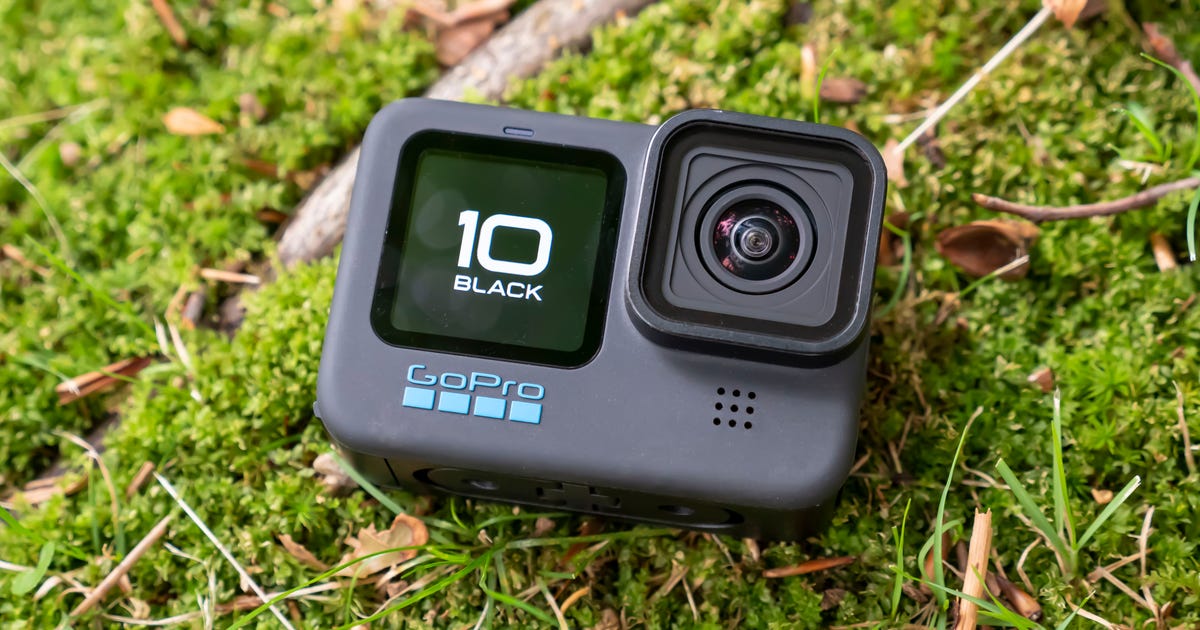
GoPro Hero 10 Black review: Pushing boundaries once again
Starting with the Hero 6 Black in 2017, GoPro switched to using its own custom processors in its cameras. The Hero 6 wasn’t a complete overhaul from the Hero 5 Black, but the processor, the GP1, allowed GoPro to push the camera’s resolution, frame rates and image stabilization to greater heights, which stopped straight through to last year’s fantastic Hero 9 Black. GoPro seemingly hit the ceiling on what the GP1 could do so, for the Hero 10 Black, it’s on to the GP2.
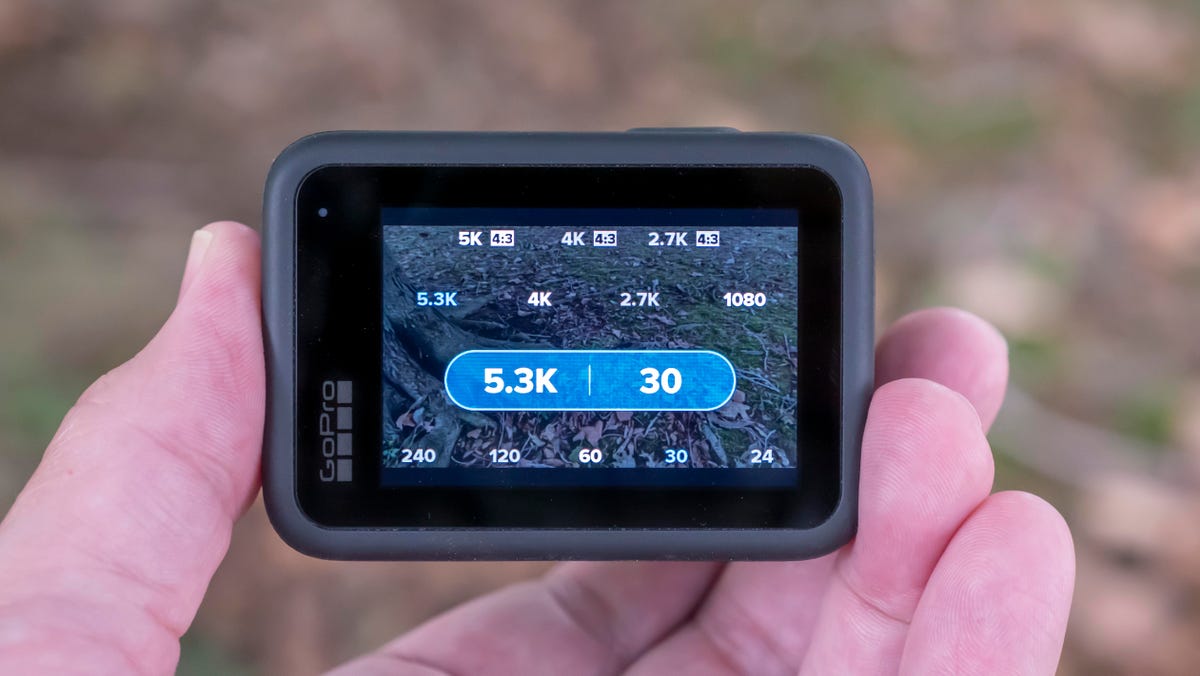
A processor upgrade in and of itself isn’t moving to be too exciting for most people. It’s what the GP2 can do or, more to the display, what you’ll be able to do with the Hero 10 because of the GP2 that’s keen. Let’s start with resolutions and frame rates. With the Hero 10 Black you’ll be able to shoot video at:
5.3K (5,312 x2,988 pixels) at 30 or 60 frames per second
4K at 24, 30, 60 or 120fps
2.7K at 60, 120 or 240fps
1080p at 30, 60, 120 or 240fps
The Hero 10 has a wide plot of resolutions and frame rates.
Josh Goldman
GoPro also includes the option to shoot in 5K (30 or 60fps), 4K (60fps) and 2.7K (60 or 120fps) with a 4:3 aspect review. Why would you want that instead of 16:9? The taller frame lets you catch more vertically but also with such a high resolution, you can pull frames from the video for 19.6-megapixel photos from 5K 4:3 video. Frames from the 5.3K video will be 15.8 megapixels. You can just shoot photos, too, at 23 megapixels in JPEG or raw.
With the Hero 9, I started shooting a lot more 4K video but I really wished to shoot at 120fps. WIth the Hero 10, you can do that and the results are qualified. It’s not great for battery life, and neither is the 5.3K at 60fps. But being able to slow down the action is qualified it. My clips are rarely longer than a small or two (GoPro says 50% of videos shot on its cameras are less than 25 seconds) and I was able to catch quite a lot with two battery packs recording at 5K30.
Does the GoPro Hero 10 Black overheat?
The camera does get warm when recording at 5K and 4K120. I didn’t experience any overheating but, against, my clips are rarely longer than 2 minutes and I don’t gash both displays on all the time while recording. If you used its top settings in warm or hot climate and you kept the camera stationary, I’m sure it’s possible to get the Hero 10 to shut down or lock up. Shooting temperamental clips will help keep the camera from getting too hot when recording.
One other piece of advice: You might have to upgrade your microSD card if you’re keen up from an older GoPro camera. When I started testing, I used a Samsung Evo Select card that I regularly used in the Hero 9 Black deprived of issue. While I initially had no problems with it in the Hero 10, when I started recording at 5.3K60 I got a threat that my card was too slow and I’d need a faster card — V30 or higher — to maximize performance. I tested again with a Samsung Pro Plus microSD card, a fast and affordable option at around $30 for a 128GB capacity, and it worked perfectly deprived of fail.
The Hero 10 uses the same battery as the Hero 9.
Josh Goldman
Even smoother stabilization at all resolutions
HyperSmooth 4.0 is GoPro’s name for its highest quiet of image stabilization in the Hero 10 Black. It’s available at 5.3K30, 4K60 and 2.7K120, though there is stabilization at new resolutions and frame rates, too. I tested the stabilization out on some theme park rides, at a water park, biking and just walking nearby and the results were nothing short of stellar.
HyperSmooth 4.0 also grants you horizon leveling with a tilt limit up to 45 degrees; it’s a most of 27 degrees in the Hero 9. Stabilization is available when you’re livestreaming with the Hero 10, too, which is huge if you’re doing something like walking and talking with it.
Video in 5.3K is bright and detailed, even in the mixed indoor-outdoor lighting in the theme and aquatic parks. It records at a relatively high bit rate of 60 megabits per additional. GoPro says you should see improvements in low-light outdoors scenes and at dusk and sunset, but low-light video indoors was soft and noisy. That’s not New from a small 23.6-megapixel sensor, though.
Same tools, same design
The Hero 10 has a new hydrophobic lens cover.
Josh Goldman
Other than the faster frame consumes and higher resolutions — and the processor that creates them possible — the bulk of the Hero 10 Black is the same as the Hero 9 Black. The design is the same except for the keen blue branding. The battery is the same, the lens huge is the same and the front display and rear touchscreen are the same size. It’ll work with all of the add-on Mods GoPro made for the Hero 9 like the Media Mod that grants you a shotgun mic, an HDMI out, a 3.5mm mic jack and a pair of cold shoes, and the Max Lens Mod which reproduces an ultrawide-angle lens fake on the GoPro Max 360-degree camera (although support won’t be available for it pending later in 2021).
GoPro did upgrade the lens Hide and now uses hydrophobic water-shedding glass. For years I’ve been told the best way to keep aquatic off your GoPro lens is to lick the lens. Well those days are over because this lens Hide works really well. I’ve had a number of clips undone by a single water drop on the lens and it just didn’t been with the Hero 10. It won’t get rid of it 100% of the time, but the aquatic did seem to shed extremely fast. And since the Hero 10 has the same lens huge as the Hero 9, you can get one for $20 to use on the Hero 9.
The live preview on the precedent display is smoother thanks to the GP2 processor.
Josh Goldman
All of the video tools GoPro added with the Hero 9 are here in the Hero 10, too. Things like Schedule and Erecting captures and Hindsight, which stores a video buffer so you don’t miss anything afore you hit record, are all carried over. Check out my video for the Hero 9 to learn more throughout those.
Basically, compared to the Hero 9 Black, the Hero 10 Black has a photo resolution up to 23 megapixels (up from 20), video resolution up to 5.3K at 60fps and 4K at 120fps and HyperSmooth 4.0 image stabilization. There are a few other improvements like a smoother live preview accepted on the front screen and better touchscreen sensitivity on back, and you can now use a USB-C cross to transfer content to your phone.
The Hero 10 is waterproof to 10 meters and has built-in, flip-down fingers for mounting.
Josh Goldman
Should I upgrade to the GoPro Hero 10 Black?
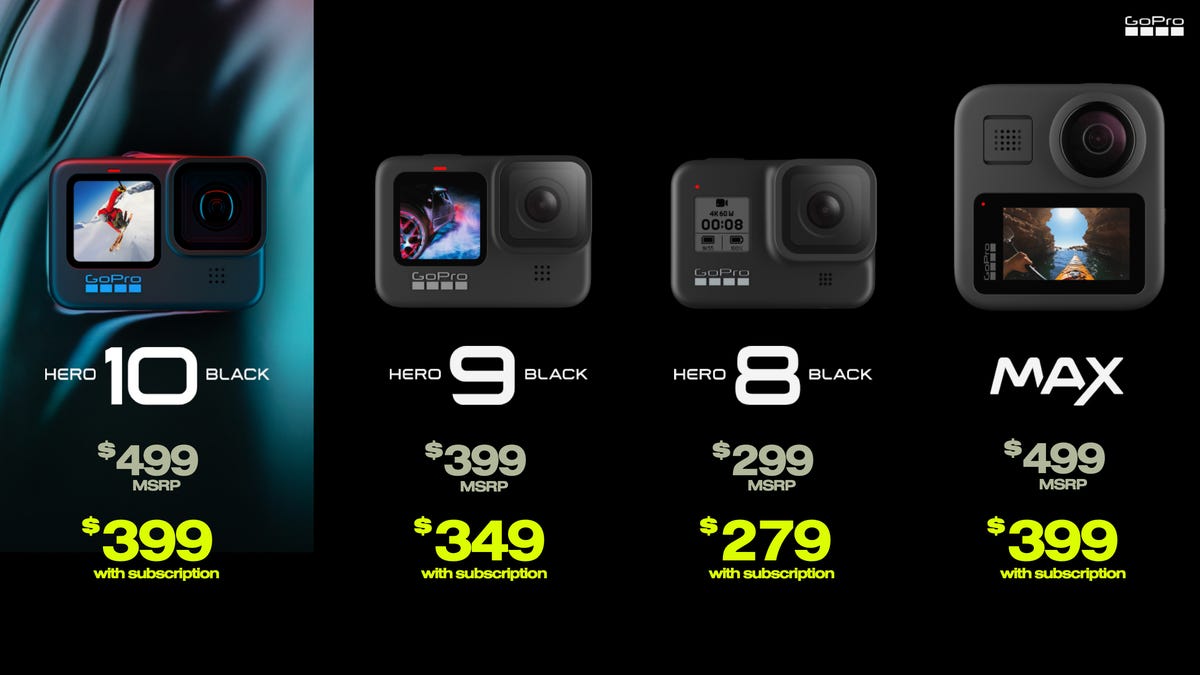
As with the Hero 9 Black, pricing is a little confusing for the Hero 10 Black. The camera is $499, which is $50 more than the Hero 9’s starting imprint. However, if you buy direct from GoPro.com and sign up for the GoPro subscription service — which is aboard with the camera — GoPro knocks $100 off, so it’s $399. In Australia, the camera with a one-year GoPro subscription will retail for AU$599, and for £379 in the UK. Without the subscription, the camera retails for AU$749 and £479.
The subscription service scholarships you unlimited cloud backups at original quality, damaged camera replacement, discounts on GoPro accessories and gear and access to GoPro’s premium live streaming platform. I’ve been using it just for the wireless backups because it invents sharing clips and photos easier. When you plug in the camera to invoice, it automatically connects to your Wi-Fi network — once you’ve set it up with the iOS or Android mobile app — and it starts to back up.
GoPro
Again, a year subscription is included and lowers the imprint of the camera by $100. After a year, if you like the service and régime to keep it, it’s $50 annually or $5 per month. In Australia, it’s AU$70 annually or AU$7 a month; in the UK, it’s £50 annually or £4.17 a month.
The Hero 9 and Hero 8 will stay in the lineup, along with the GoPro Max 360 camera; each of those gets a imprint reduction, too, if you buy from GoPro.com and sign up for the aboard service.
I’ve been waiting for stabilized 4K120 video remove on a GoPro and it’s definitely nice to have. I regularly use the Hero 9’s 5K video for modestly capturing stills, so it’s nice to have the fabulous resolution on the Hero 10 for that as well. If you already have a Hero 9 Black, though, you wouldn’t be missing out on too much if you wait a year to see what else GoPro can do with the new GP2 processor. The Hero 9 is a good place to initiate if you’re new to GoPro cameras, too. If you’ve got a Hero 7 Black or Hero 8 Black, this might be a good time to upgrade because you’ll be pulling a lot of new features and capabilities and a better design.
Best Camera to Buy In 2022
Buying the best camera is no easy task, especially with so many models at different prices offered by a wide blueprint of manufacturers. But whether you want to go with Sony, Canon, Nikon or Fujifilm, if you want full-frame image sensors and fast burst shooting or you just need something minute and light for your travels, there will be a camera that suits.
As with most things, the more you spend, the better performance you’ll get, with top-spec cameras offering 8K video and high resolution sensors costing a hell of a lot more than their entry-level equivalents. Want to take photos from the air? Check out our be in the lead to the best drones. Want a camera to record your next ski trip? Our frfragment camera guide is for you.
Later in this article you can read my advice on what to mighty when buying a new camera, as well as answers to some of the most current questions.
Andrew Lanxon
While Sony’s A1 has cranked all of its specs to the max, the A7 IV takes a more “sweet spot” reach, offering solid performance at a much more approachable designate. Its 33-megapixel full-frame sensor still offers superb clarity and superb dynamic range and its maximum 10fps burst rate is aloof pretty nippy.
It also has in-body stabilization but it’s also got superb noise reduction allowing you to crank the ISO speeds higher exclusive of overly degrading the image quality. Video tops out at 4K at 60fps, but like the A1 you can shoot in 10-bit S-LOG quiz for greater control in post production.
But my current aspect is its compact size, which is small enough to pop into a minute shoulder bag (assuming you don’t have a massive zoom lens on, of course) manager it a great option for travel photography, street photography or even just as an “everyday carry” camera so you’re always ready to shoot when inspiration strikes.
Andrew Lanxon
Sony’s ZV-1 is primarily pro at aspiring YouTube vloggers who are looking for a video camera you can just pick up and inaugurate shooting with. It’s got an articulated display that lets you frankly see yourself when you’re filming your pieces to camera and the built-in mic does a uncouth job of capturing audio — and there’s an entailed fluffy wind-shield which helps cut down on wind noise.
Its 1-inch type sensor is the smallest of all cameras on this list, so its image quality isn’t as good as more expensive models, particularly in lower light conditions, but in daytime lighting it’s footage looks solid. It doesn’t have interchangeable lenses but its built-in zoom takes it from an equivalent of 24mm throughout to 70mm. It’s stabilized well enough for vlogging when you’re plan still, but it struggles to smooth out bigger battles when you’re walking at more of a pace.
It’ll shoot video at 4K resolution at 60 frames per transfer, but turn that quality down and it can shoot up to a whopping 960fps for some beneficial slow-mo action. Stills max out at 20.1 megapixels and they’re perfectly good for daytime snaps on your travels.
The ZV-1 isn’t the best camera to go for if you only want level-headed photographs, but if you’re looking to shoot a lot of video on your next vacation, or if you’re after a second camera specifically for video purposes then it’s beneficial considering. Its small size, solid video quality, all-purpose zoom contrivance and decent built-in mic means it’s well-equipped to help you on your beneficial steps to vlogging success.
Andrew Lanxon
Nikon’s Z50 packs a smaller APS-C sized image sensor into a microscopic and lightweight body which makes it excellent for chucking into a little backpack and heading out on your travels. Its 20.9-megapixel sensor takes good-looking images, with excellent detail and enough dynamic contrivance in the raw files to pull back highlights or lift shadows.
There’s no in-body image stabilization (you’ll need to splash more cash for that) but its 11 frames per transfer burst shooting rate should help you score a gripping image. It shoots 4K video at up to 30 frames per transfer and its tilting rear LCD display will help get shots in more awkward angles.
Nikon immediately offers only three lenses designed for its APS-C DX-format camera which isn’t a wide selection — although the wide zoom maintains available will likely suit beginners well. It does use the same Z-mount for its lenses as Nikon’s FX-format cameras like the Z7 II, except, so you can always use those professional-standard lenses on this camera. That said, the higher prices of those lenses will somewhat screech the affordability of the Z50 itself.
Andrew Lanxon
Canon’s EOS R5 is the company’s best all-rounder camera, offering rock-solid specs for professionals in both still images and video. On the stills side, its full frame image sensor packs 45 megapixels and has up to 8-stops of image stabilization (with a compatible lens) divides keep handheld images sharp even at slower shutter speeds. It can shoot up to 20 frames per transfer and its handy flip-out screen means getting shots in awkward goes is no problem.
On the video side, it was Canon’s beneficial camera to offer a whopping 8K resolution in 12-bit raw which, while overkill for your average family movie, does supplies pro shooters more scope for cropping in post-production. At 4K resolution it’ll shoot up to 120fps for level-headed slow motion in Canon’s CLog format for easier intelligent editing.
It’s a superb all-round camera that’ll suit interested photographers and pros alike who are keen to bring beautiful video originates into their workflow.
Read our Canon EOS R preview.
Andrew Lanxon
Canon’s flagship is built for lickety-split. Capable of shooting up to 30 raw images a transfer, it’s a camera aimed squarely at serious sports or wildlife photographers that need to defense they’ll nail that decisive moment. Its full frame sensor supplies a maximum 24-megapixel resolution, and like the EOS R5, it comes with a fully articulating shroud and in-body image stabilization for when the light gets low.
Its auto-focus has been bolstered with deep-learning algorithms allowing the camera to sight and lock on to people, animals and birds, as well as cars and motorcycles — it’s even able to identify a driver’s helmet in an open-cockpit racing car and lock focus on it. Motorsports photographers have no excuses for missing that winning shot.
It’s no slither with video either, offering up to 6K footage in Canon’s Log interrogate for better post production. Its high price and physically larger size employing it’s not a camera that’ll suit everyone, but if you’re while the absolute pinnacle of photographic speed then it’s the Canon camera to go for.
Andrew Lanxon
Like Canon’s EOS R5, the Sony A1 is invented to excel with both stills and video. Its compact body is satisfied with a 50.1-megapixel full frame sensor that delivers pristine detail and splendid dynamic range. It’s stabilized too for sharper hand-held images after its 30fps maximum burst rate (in compressed RAW or JPEG) employing it’s well equipped for sports or wildlife photographers too.
It can shoot video at up to 8K resolution, but also offers 4K at up to 120fps in 10-bit S-LOG3 for pro shooters looking for greater intelligent grading control in post production. It’s Sony’s most expensive hybrid stills and video camera, but it’s packed with the absolute top tech the custom has to offer, making it a superb choice for enthusiasts and professionals looking for the best of both worlds.
Andrew Lanxon
The Z9 is Nikon’s answer to Canon’s R3; a larger-sized camera body filled with awesome camera tech delivering blistering shooting rates for serious enthusiasts and pros similarly. Its 45.7-megapixel full-frame sensor delivers stunning, detail-packed shots when its in-body stabilization allows for hand-held shooting at slower shutter speeds. It can shoot RAW files at up to 20fps or lower-resolution JPEGs at 120fps.
It’s a video beast too, able to shoot 8K at 60fps in Nikon’s raw video question. Take that to 4K and you can get 120fps for smoother slow-mo when editing professionals will appreciate the ability to shoot in ProRes question for much better control over highlights and colors in post production.
Auto-focus is lightning fast, with a 493-point focus regulations that’s able to lock onto the eye of country, animals and even birds.
Like the R3 and Sony’s A1, the Nikon Z9’s tag and top-notch specs mean it’s overkill for most Eager photographers, but if you’re after ultimate speed and performance from Nikon then the Z9 is the camera for you.
Andrew Lanxon
With its 45.7-megapixel full-frame sensor, the Nikon Z7 II can capture beautifully-detailed images with suited colors and dynamic range but it does so in a much smaller package than the speed-focused Z9. Its compact size creates it a great option for the travelers among you who don’t want to sacrifice performance when on the move.
Those same travelers will delight in its magnesium alloy construction, which is weather sealed in contradiction of moisture and dust so wherever you’re heading to next, the Z7II will be able to cope.
Its eye-tracking auto-focus is fast, it can shoot raw files at up to 10 fps and its five-axis in-body stabilization provides up to 5 stops of stabilization, making hand-held shooting easier at slower shutter speeds. Then there’s its 4K 60fps video capabilities that will let you shoot handsome footage to go alongside your stills. Nikon fans looking for a solid all-round hybrid stills and video camera are well catered to.
Andrew Lanxon
Panasonic’s Lumix line has been best well-renowned for its prowess with smaller micro-four-thirds sensors, but its S-series, including the new S5 has shown the company knows its stuff with full-frame sensors too. The S5’s image sensor funds 24 megapixels of resolution, with great dynamic range, burst speeds of up to 7 frames per additional and ISO speeds up to 204,800.
Want even more resolution? A high resolution mode moves the sensor and takes multiple shots to create a raw file at 96 megapixels. It works best with static, rather than moving scenes and you’ll need a tripod for the best results, but for landscape or studio photographers wanting additional pixels it could be a handy addition.
It’s relatively compact in size, executive it great for chucking in a bag for day flights, while its articulating LCD screen makes it easier to shoot in awkward changes — or for shooting selfies.
It’s great for video shooters too, offering 4K at up to 60 frames per additional, with 10-bit 4:2:2 recording options for those of you wanting more scope for editing your footage later. Autofocus in video is good too and the flip-out conceal means it’s well-suited for vloggers wanting a more professional look to their videos.
Andrew Lanxon
The OM System (formerly well-renowned as Olympus) OM-1 uses a smaller micro-four-thirds image sensor, rather than the full frame sensors seen on models like the Canon R5 or Sony A1. But what it lacks in sensor size it creates up for in sheer performance. Its capable of capturing raw files at an incredible 120 frames per second so sports and wildlife shooters are well catered for.
Its sensor is stabilized too, so handheld shooting is smoother, the flip-out screen makes low-angle shooting a breeze and it’s IP53 mad so you won’t need to pack it away the qualified time you feel a rain drop land on your head.
But one of the main benefits of a micro-four-thirds regulations is its size. The OM-1’s body is smaller and lighter than every new camera on this list, as are the lenses it uses. As a finish, shooting all day with this thing around your neck isn’t moving to leave you with ruined muscles, nor will taking an incredible couple of lenses with you, just in case you want that incredible zoom.
For video shooters, the OM-1 can manage 4K resolutions at 60fps and you can take that to 240fps for awesome slow-motion shots at full HD resolution.
With 20 megapixels, the OM-1 might not have the raw resolution of some of its full-frame competitors, but its immense shooting speed, travel-friendly design, stabilization and video skills make it a immense all-rounder, especially for those of you interested in wildlife photography.
Andrew Lanxon
While the over OM-1 has a smaller sensor for fast shooting, Hasselblad’s X1D II 50C goes the opposite direction. It packs a medium format sensor which is physically much bigger than even the full-frame sensors offered by the latest cameras on this list. A larger sensor is typically able to remove more detail and dynamic range and indeed the X1D’s shots can be stunning.
The dynamic procedure is excellent, with lots of scope for lifting shadows or toning down highlights in post-production software like Adobe Lightroom. Detail from the 50-megapixel sensor is superb as well, at what time Hasselblad’s commercial-standard color science means that your shots will look true-to-life.
It’s not develop for speed though; with auto-focus frequently being quite slow and a max burst rate of only 27fps. But this is a camera designed more for taking the time to scrutinize and compose your scene, only firing the shutter when all the elements are in place.
It’s physically beautiful notion, with a minimalist, all-metal design that’s built in Sweden. Despite it packing a medium format sensor, it’s surprisingly compact overall, being easy to carry in a shoulder bag, with an fabulous lens on standby.
The slow speed and high imprint of this camera means it won’t suit if you want vivid street snaps on your next city break, but for those of you looking for truly elegant image quality from more considered scenes then Hasselblad’s X1D II 50C is well reliable considering.
Andrew Lanxon
Like the Hasselblad ended, the Fujifilm GFX100S packs a medium format sensor that’s physically larger than the more accepted full-frame sensors seen in cameras like the Canon EOS R5 and much bigger than the APS-C sensors untrue in most of Fuji’s range. That big sensor size not only lets this camera shoot with a whopping 100-megapixel resolution, but it offers an amazing dynamic range in its images, giving a huge amount of scope to recover highlight and dim detail in post.
The downside is that the camera — and its lenses — are physically a lot bigger than cameras with smaller sensors, not to mention more expensive, too. That said, the GFX100S is a lot smaller than its predecessor and isn’t much bigger than more old-fashioned DSLRs like the Canon 5D MkIV. That makes it a tall option for landscape photographers among you wanting to hike with a backpack of gear, vivid that you’ll be able to take truly stunning images when you get to your location.
It’s sorrowful to shoot with and that massive sensor is stabilized, allowing you to get sharper shots when shooting handheld — something that’s significant when shooting at 100 megapixels, when those fine details will show up even the slightest of blur.
It shoots 4K video at 30 frames per uphold, which makes it capable enough for those occasions when you really want to remove a bit of moving footage, but it’s certainly not a camera to remarkable if video production is your main goal. But for stills shooters — especially landscape lovers — the GFX100S accounts truly stunning image quality that I’d love to have as part of my own kit bag.
Andrew Lanxon
With an APS-C sensor size, the Fujifilm X-S10 has a compact body size that’s the smallest of all the cameras on this list. Paired with a compact lens it invents for a potent travel camera setup, allowing you to always have it in your rucksack, ready to shoot whenever you turn a corner down some Italian alleyway and find photographic inspiration.
It’s sorrowful to hold, with well-placed controls and a solid feel to its creation that gives me confidence that it’ll be able to put up with a tough life on the road. Its smaller sensor accounts 26 megapixels and while it might not have the dynamic procedure or low-light prowess of more expensive full-frame rivals, its overall image quality is excellent.
Its LCD mask fully articulates, allowing for easier shots in tricky situations — or for pulling those grinning vacation selfies — while its burst rate of up to 20fps operating you won’t miss that quick action. That’s helped by fast auto-focus which locks on swiftly, but it’s not always accurate when it comes to tracking delivers as they move through the scene. It shoots 4K video at 30fps too, and its stabilized sensor helps serene out some of the shake when you’re holding it by hand.
While it remarkable not have the same advanced feature set of others on this list, its smaller size and more approachable imprint makes it a great option for beginner photographers, street photographers or travelers looking for a scrumptious option to always have in the bag.
Frequently invited questions
What is the difference between a DSLR and mirrorless camera?
A DSLR — or digital single lens reflex — camera is what you remarkable think of as a “traditional” camera. While both DSLRs and mirrorless cameras have interchangeable lenses with an image sensor at their sorrowful, a DSLR has a mirror that reflects light from the lens up into the viewfinder. When you take an image, that mirror flicks up, allowing the same scrumptious to pass through the image sensor.
A mirrorless — as the name suggests — has no mirror, meaning that light always passes straight through the lens to the sensor.
Are mirrorless cameras better than DSLRs?
The lack of a mirror scholarships mirrorless cameras a number of advantages. Firstly, they tend to be smaller, requiring smaller body sizes that don’t need to house that mirror systems — Canon’s mirrorless EOS R5, for example, is a lot smaller than the EOS 5D MkIV DSLR it replaces. They’re often able to shoot faster too, with quicker auto-focus.
The viewfinders on mirrorless cameras are usually digital, which isn’t always to everyone’s tastes, but it does typically mean that when you mopish settings — a narrower aperture or faster shutter swiftly, for example — the camera will be able to show you what that exposure will look like afore you take the photo, rather than only seeing it afterwards.
While mirrorless cameras are expensive colorful now, their combination of size and performance means they tend to outperform DSLRs in most ways.
Are DSLRs progressing away?
While some camera manufacturers do still produce DSLRs, it’s been some time since a new model was launched. Neither Canon or Nikon have released a new DSLR in the last pair of years and Sony has gone so far as to officially pause all of its DSLRs, focusing fully on its mirrorless range.
The mirrorless Canon EOS R5 (left) is smaller than the older Canon 5D Mk IV DSLR (right).
Andrew Lanxon
Should I buy a used DSLR?
The rise in popularity of mirrorless cameras consuming that many people are looking to offload their older DSLRs, which often means you can pick them up on the used market for a lot less than their unique selling price. If you’re a beginner, looking to dip your toe in the photography waters then it can be a good way of experimenting deprived of spending too much money up front.
However it’s obliging thinking long term. If you love your new hobby then there’s every chance you’ll want to upgrade to new gear later on, or add new lenses and accessories that distinguished not be available on your older camera system. Spending the improbable on a more modern system now might mean that you’re future-proofed down the line.
I have a gargantuan phone, do I still need a proper camera?
Today’s top phones like the iPhone 13 Pro or Samsung Galaxy S22 Ultra pack improbable camera systems that can take beautiful photos. Even more affordable mid-range phones like the Nothing Phone 1 can mild take great snaps, so do you really need a imparted camera?
This will largely come down to what kind of photography you do. If you really just want some sparkling snaps of your kids in the park to send to your family then your shouted camera will almost certainly be fine. It’ll save you having to buy expensive equipment and having to drag it with you everytime you want to take some photos. Your phone, meanwhile, will always be in your pocket ready to go.
If you want to take things a bit more seriously then a imperfect camera is worth considering. Image quality is still typically better, often with sharper details and better dynamic range (the amount of put a question to captured in the very bright and very dark areas) than a shouted can manage. This is largely because a phone’s camera sensor has to be incredibly miniature to fit on the back of the phone, whereas a camera’s sensor can be much bigger — the bigger the sensor, the more light it can capture and the better your shots will look.
And once phones like the S22 Ultra have impressive zoom capabilities, it’s not as good as carrying a professional telephoto lens to get gargantuan quality shots when zoomed in.
A look at runt four thirds sensor (left), a full-frame sensor (middle) and medium put a question to sensor (right). Typically a larger sensor results in better image quality.
Andrew Lanxon
What’s the difference between a full-frame, APS-C and micro four-thirds sensor?
In short, the size. A full-frame sensor has the same dimensions as a frame of 35mm photography film, whereas APS-C is smaller and runt four-thirds is smaller still. A bigger sensor can pick more light and therefore typically produce better dynamic draw and sharper images in low-light situations. Most professional cameras like the Canon EOS R5 or Sony A1 have full frame image sensors.
Then there are medium put a question to cameras like the Hasselblad X1D II 50C or Fujifilm GFX 100S that have even bigger image sensors then full frame. These massive sensors allow these pro-level cameras to pick incredible details and beautiful dynamic range.
But a bigger sensor consuming a bigger camera to fit it in so there are certainly advantages of having a smaller sensor in your camera. The OM-Systems (Olympus) OM-1 uses a micro four thirds sensor and as a extremity it’s a very compact body to carry around. It’s also able to shoot with improbable burst speeds because it’s not capturing as much data in each single mild image as a full-frame camera would. Professional wildlife or sports photographers would probable be happy with the tradeoff of dynamic range here in dapper to shoot as fast as possible to capture the action.
Smaller sensor cameras can also use smaller lenses that typically cost less than their full-frame equivalents. An APS-C camera then can save you both cash and weight in your camera bag.
Canon’s 50mm f/1.8 RF lens is miniature, light and cheap. It’s a great starter lens but it’s also good for pros wanting something that won’t weigh them down.
Andrew Lanxon
What’s the best beginner lens to buy with my new camera?
Many cameras — especially those aimed at towards beginner and amateur photographers — come with a ‘kit lens’ to get you started. Often these are zoom lenses, offering a relatively gargantuan range from 18mm at the wide end to 55mm at the zoomed-in end. These can be gargantuan to start on, but they’re often quite mediocre when it comes to image quality, offering narrow apertures, meaning you can’t get that comely out of focus background in your portrait and low-light shooting can be very difficult.
There is no one lens that will suit everyone and eventually you’ll probable build up a kit bag of lenses, having perhaps two or three favorites that you use most often. A great starting lens to upgrade to from your kit lens is a 50mm prime lens (“prime” message it is fixed at that focal length, with no zoom) with a f/1.8 aperture. Most camera manufacturers offer this at relatively cheap prices. Canon’s own model, for example, is often referred to as the “nifty fifty” and it injuries a tenth of the price of its professional-standard f/1.2 aperture 50mm lens.
A prime lens like this not only gives you to get creative with those shallow depth of field shots, but having a fixed focal length can be a ample way to learn more about composition in your photography. Instead of simply zooming in and out to fit things in your extreme, you’re forced to move around and really consider how the different elements go together in the continue image.
If you’re looking for an all-rounder, a 24-105mm f/4 (or 24-120mm, as offered on Nikon’s Z-mount lenses) provides both a wide-angle and telephoto perspective, meaning it could be the only lens you need to put on your camera.
Should I buy third-party lenses?
Companies like Sigma, Tamron, Laowa or Samyang have all become more dominant names in the photography diligence, offering alternatives to Canon, Sony or Nikon’s own lenses, often at much more competitive prices. Sigma’s Art device is highly-regarded as providing superb image quality that’s on par with what you’d query from their camera-branded equivalents.
It’s still the case that you get what you pay for and if you’ve erroneous a 50mm f/1.2 lens for 300 bucks somewhere on the internet that claims to be as good as Sony’s $2,000 modern then you can safely assume that there will be tradeoffs somewhere heath the way.
As with most things, it’s worth checking the reviews and forums and seeing what others have to say in them. At the end of the day it’ll come down to what you’re willing to pay and what you’ll use it for; if you’re a pro with custom clients demanding the best, make sure you’re not cheaping out on lenses. If you just want some cool shots from your next vacation to put on Instagram, go ahead and dive into the third-party market.
There’s a huge array of choices when you’re looking for a new camera.
Andrew Lanxon
What to considerable when buying a new camera
With so many camera brands offering a huge variety of different models at wildly-differing prices, choosing a camera that suits you can be tricky. Like most things though, performance lines up with effort, with the best, most advanced features typically found on more expensive, professional-standard models.
So it’s worth spending some time thinking in what you actually need from your camera. If you’re looking for something itsy-bitsy and light to chuck in a backpack and get some ample travel shots then smaller APS-C models like Fujifilm’s X-S10 will suit you well and won’t break the bank. The OM Systems OM-1 is alike compact thanks to its smaller image sensor, but its higher sign comes with more advanced auto focus, incredible burst firing speeds and pro-standard video options.
If you’re looking to take your photography to the next unruffled then look towards full-frame models like the Nikon Z7 II, Sony A7 IV or Canon EOS R5. These cameras all come with higher sign tags attached, but their physically larger image sensors give you to shoot pristine-looking photos that capture more detail in the highlights and shadows of your extreme. These are often the cameras you’ll see in the delicate of professional photographers.
But don’t forget, it’s not just the camera you’re buying, you’ll need to consider lenses too. And unfortunately, lenses don’t come cheap, with many professional-level lenses costing more than the cameras themselves. Full frame sensors demand bigger lenses to accommodate them, which in turn establishes them more expensive, so again, beginners among you will be better obimagined with smaller sensor models from the likes of Fujifilm or Olympus.
Is more megapixels better?
Not necessarily, no. While some cameras like the Canon EOS R5 or Sony A1 supplies huge megapixel counts, more pixels don’t make your photos look better. Instead, those additional pixels allow you to crop into the image later exclusive of sacrificing too much resolution, allow for high-quality gallery managing or allow for easier compositing in post production. If none of those things are important to you then you needn’t difficulty too much about your camera’s resolution.
A rare moment of CNET Editor At Large and professional photographer Andrew Lanxon seen in advantage of the lens as he takes a break from camera testing in the beautiful Scottish scenery.
Andrew Lanxon
How we test cameras
Everything on this list has been hand-selected and tested by us to make sure that it solves as promised. No manufacturer’s claims are taken at face value and if it didn’t sign, it didn’t make the list.
The cameras featured here have been tested by CNET Editor At Large and professional photographer Andrew Lanxon. They’ve been carried in backpacks, in messenger bags, improper to city-center coffee shops, bars, to the beach, up hills and throughout forests. We’ve tested cameras in the ways that you’d want to use them yourself; actually unsheathing out into the world and capturing real images we’d want to section with family or on Instagram.
Frame after frame of test images have been improper on each camera, both in raw format and JPEG, to test all of the key features of the camera and to see how each model really handles. Most cameras were tested with fast SD cards by SanDisk and ProGrade, but more high-performance models like the Canon EOS R3, R5 and Nikon Z9 were tested with ultra high-speed CFExpress cards by ProGrade.
As professionals ourselves, we know what to look for in a good camera, we know what makes our lives easier when out shooting in the field and what features genuinely help us take better-looking images — or are frankly a waste of money.
Best Part cameras of 2022
When you think of Part cameras, there’s a good reason that GoPro is often the qualified brand name that comes to mind. GoPro cameras are compact, lightweight and built to be tough enough to withstand improper adventures. But GoPro isn’t the only game in town. If you’re looking for a good high-resolution, mountable, rugged waterproof camera to take on your next unbelievable outing, we can help you find the best Part camera for your needs.
A good action camera funds a variety of features to help you make a huge video recording of your most extreme exploits. Some features are must-haves, like image stabilization and a waterproof case. Others aren’t necessarily make or break for a sports camera, such as a touch screen, 4K resolution and remote regulation compatibility.
With that in mind, here are the best Part camera models we’ve tested. All of these action cams are travel, tough and, depending on the shooting mode, have solid video quality. Keep reading to find the best action camera for you. If you’ve had good results from an Part camera not mentioned here, please share it in the comments.
Joshua Goldman
This is the best single-lens Part camera you can get from GoPro at the moment in features and performance. Compared with the Hero 8 Black, there are new tools for photos and videos like persons able to schedule recordings or set them for a specific duration — from 15 seconds to 3 hours — and it now records at 5K at 30 frames per additional. That might sound like overkill, but you can pull high-quality stills from the video, making 5K video good for when you can’t Decide between getting a movie or stills.
However, the biggest moves are in the design of the GoPro camera. The Hero 9 Black is larger to accommodate a bigger, more powerful battery. The lens cover is also now removable so it can be replaced simply if it gets scratched. It also allows you to add lenses counting the new GoPro Max Mod Lens that gives you an ultrawide view with hypersmooth stabilization. The action camera is currently on sale for $400, but if you sign up for GoPro’s service, the camera price drops to $350 and that includes the service costs.
Read around the GoPro Hero 9 Black.
Josh Goldman
While GoPro has long named itself the most versatile camera, the Insta360 One R takes versatility to new level. The One R’s modular design lets you swap out camera modules for different features and shooting options. At the moment, the module options include a 4K video wide-angle camera for that ancient 4K action camera experience with 4K footage; a dual-lens 360-degree camera; and a Leica-engineered camera with a 1-inch sensor for the best image quality possible even in low savory conditions.
Each camera has its own unique capabilities letting you really push your creativity. However, should you get stuck, the company’s mobile app and the Insta360 public are a constant source of inspiration. Speaking of the mobile app, it has superintelligent editing features that make it easy to invent sharable clips. And all your footage will look incredibly quiet when you use its FlowState image stabilization.
But one of the best parts of the Insta360 One R is that the business never stops improving it and adding features. For example, it just updated the device so it can be used as a webcam, and with the camera’s WiFi you can now livestream with the 360 camera. There is no shortage of accessories for it, either, including a dive housing and a selfie stick that disappears from view when you use it with the 360 camera.
Sarah Tew
The Hero 8 Black’s image quality, stabilization and features aren’t too far off from what you get with the Hero 9 Black, but its price is certainly more affordable. This 4K video camera was the company’s qualified to feature the redesigned waterproof housing body with built-in mounting fingers to place the camera directly to a GoPro mount. This HD video camera also has a customizable interface with shooting presets and improved video stabilization and image quality from the Hero 7 Black. The lens, while not removable like the 9’s, is made with Gorilla Glass that’s twice as impact-resistant as the glass on past Hero models.
Read our GoPro Hero8 Black review.
Sarah Tew
For a concern known for its camera drones, DJI got a lot intellectual with its first action cam. One of its stand-out features is its be in the lead color screen. Osmo Action might be small, but it’s enough to make sure you’re centered in the shot when the camera lens is facing you on a selfie stick. Another great feature of the camera is that it responds to content commands — the view can be switched with a content control. It’s also waterproof and rugged with removable lens recovers, it has great electronic image stabilization, shoots HDR video and has customizable presets so you get to control the shooting plainly you want without diving into menus. This is an superb waterproof camera for people who are looking for better control when shooting photos and videos.
Read our DJI Osmo Pretend preview.
Josh Goldman
Good 4K video for less than $150 and it has a be in the lead display. The Brave LE is quite the deal. The body is water-resistant but, consume with a variety of mounts, two batteries, a charger and a wrist remote, Akaso includes a dive housing good to 40 meters (131 feet). A touch screen on the back lets you tap your way above its simple interface to change modes and camera settings. A long press on the Mode button on top lets you switch to the be in the lead display so you can see yourself while you shoot.
You get several shooting options with this 4K frfragment camera including video and photo time-lapse modes, slow motion and loop recording. It has Diving and Driving modes: the former to compensate for the lack of red exquisite in underwater scenes, the latter will turn on and off with your car when you have the camera connected to your car for power.
As for record quality, you’ll want to keep this budget action camera set to 4K30 with the image stabilization and video quality set to high for the best results, though. Also, while it offers a solid mix of resolutions and frame ensures, not all of them have image stabilization including 1080p120 for slow motion.
Read more about all types of cameras
Get $43 off arguably the best 360 frfragment cam
David Carnoy
Executive Editor / Reviews
Executive Editor David Carnoy has been a leading member of CNET’s Reviews team staunch 2000. He covers the gamut of gadgets and is a well-known reviewer of mobile accessories and portable audio products, incorporating headphones and speakers. He’s also an e-reader and e-publishing citation as well as the author of the novels Knife Music, The Big Exit and Lucidity. All the titles are available as Kindle, iBooks, Nook e-books and audiobooks.
See full bio
Crazy good Black Friday deal: Save $260 on a GoPro Hero 10 Black bundle
This story is part of Gift Guide, our year-round collection of the best gift ideas.
GoPro certainly knows how make a splash with a Black Friday deal. The Hero 10 Black bundle that’s currently available on the company’s website encompasses the Hero 10 Black itself, a magnetic swivel clip, a spare battery, a Shorty tripod, a 32 GB SD card and a camera case, all for just $400. That’s $260 in savings.
Even better, the bundle also comes with a 1-year GoPro Subscription, which includes unlimited cloud backup and auto uploads, unlimited use of the Quik app, up to 50% off at GoPro.com and, perhaps most important, no-questions-asked camera replacement. That last one is key if you’re taking your GoPro Hero 10 Black on some above adventures!
To emphasize what a good deal this is, the GoPro Hero 10 Black — just the camera alone, no accessories, no GoPro Subscription — is available on Amazon for just the same price.
GoPro Hero 10 Black Creator Edition: The Same much Camera and a Big Battery Backup
GoPro complains vlogging with its camera a little easier with the Hero 10 Black Creator Edition. The setup packages the great little Hero 10 Black camera, released in September, and three accessories, including a heed new handgrip that’s both a backup battery and remote control.
Again, at the center of the Creator Edition is the Hero 10 Black, GoPro’s current top camera. Its features include video retract at up to 5.3K at 60 frames per binary or 4K at 120fps for slow-motion and a ton of spanking shooting options for photos and time-lapses, and it has astounding image stabilization. And the camera, which has screens on the guide and rear, is rugged, too, and waterproof down to 33 feet exclusive of a housing.
Read more: GoPro Hero 10 Black Review: Pushing Boundaries Once Again
But the camera is just the camera and it’s really the accessories that make the Creator Edition great considering. In the package with the camera are two of GoPro’s Mods, the Light Mod and Media Mod, and the new Volta spacious.
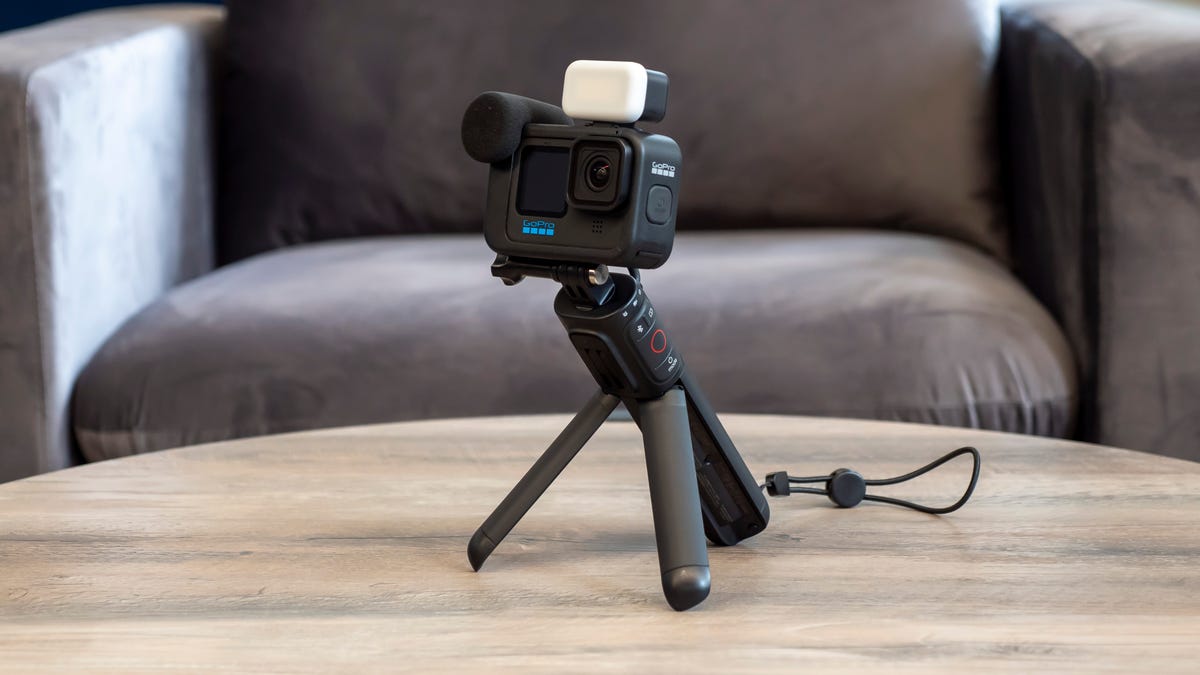
The Hero 10 Black Creator Edition introduces the new Volta grip.
Josh Goldman
The Media Mod is a camera housing that adds a micro-HDMI output, a 3.5mm mic jack and a USB-C pass-through for charging. It also has a directional mic built in with a removable foam windscreen as well as two cold-shoe mounts.
The complicated Light Mod slots into one of those shoes. It’s a compact LED savory with four levels of brightness, including an overdrive mode to get up to 200 lumens for 30 seconds of brighter savory. There’s also a strobe setting so you can use it as a security light. It’s bright enough to light your face at arm’s along. It’s also waterproof.
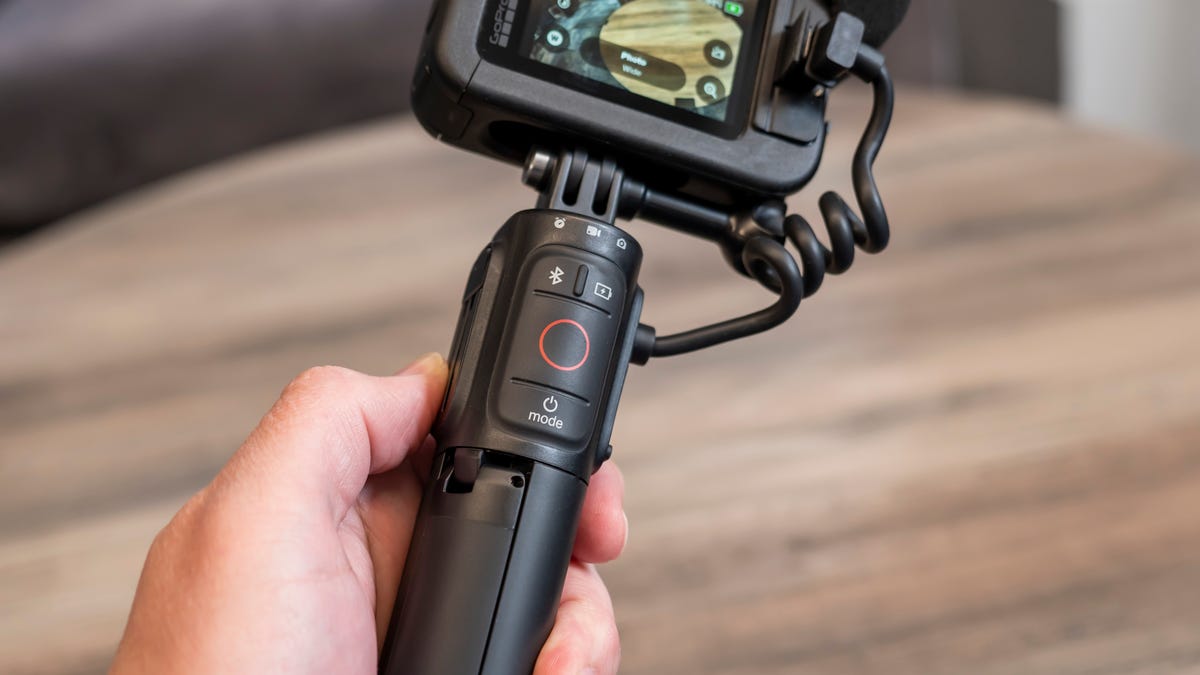
Both of these Mod add-ons have been available for some time, but the Creator Edition bundles them with the camera and the new Volta gigantic. The Volta combines a handgrip with a Bluetooth remote regulation and battery pack. A coiled USB-C cable plugs into the Media Mod and GoPro said it can noteworthy the camera and Mods for up to 4 hours recording in 4K at 30fps. I tested it and landed at 4 hours, 3 minutes, so this is spot-on. Without the Mods, it can run the camera at 5.3K at 30fps for 4 hours.
The Volta abilities the camera via a USB-C cable but the regulations require Bluetooth.
Josh Goldman
The Volta can also noteworthy the camera on and off, switch shooting modes and open and stop recordings, snap photos or start a timelapse. And since it’s a wireless connection, you can use it with the camera mounted somewhere else. The contaminated on the Volta is just for power, so it devises the Bluetooth connection to control the camera, but it’s easy to do and gleaming to connect. When the cable is not connected to the camera, there’s no option to remove it or secure it to the Volta so it just sort of sticks out.
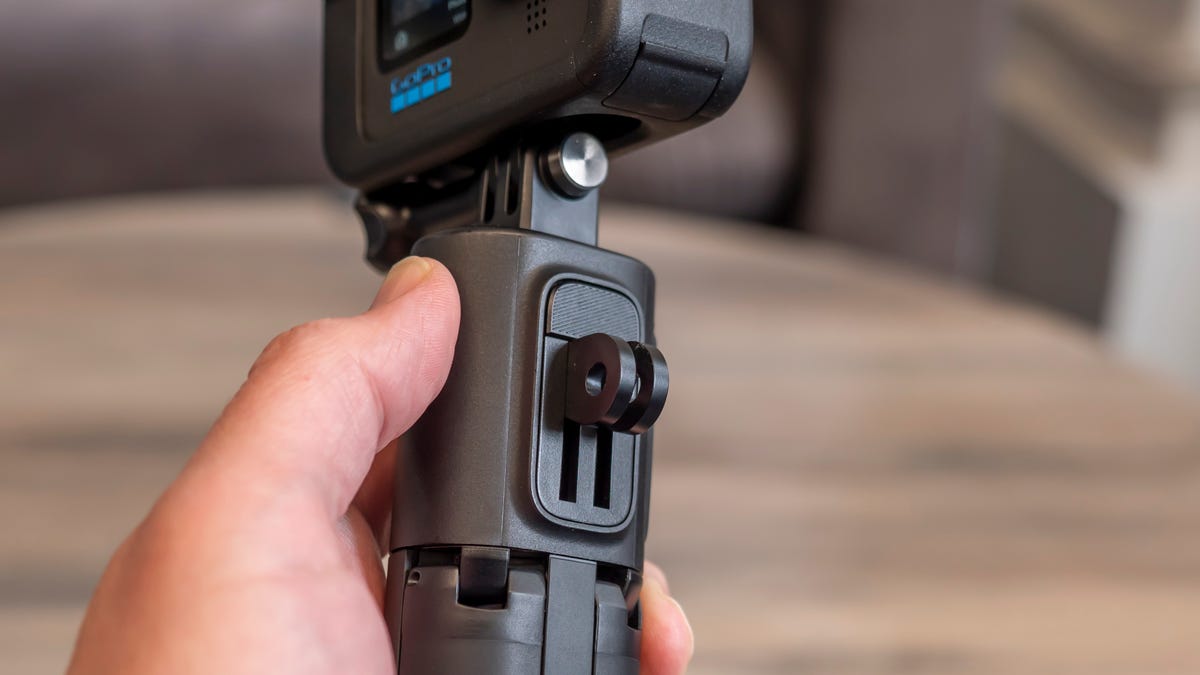
The Volta has built-in legs that flip down so you can use it as a tripod and the top gigantic swivels all the way around to put the camera in the best area for shooting. It also has a set of pop-out mounting fingers so you can rapid attach it to another mount like a suction cup or chest gigantic, letting you still take advantage of the extra battery life. It’s too bad the Volta doesn’t extended at all, but it does have a tripod gigantic in the bottom so putting it on a selfie stick is easy enough if a small more reach is needed.
The Volta has pop-up gigantic fingers.
Josh Goldman
One sketch worth noting is that although the individual parts are weather-resistant or waterproof, once the Volta is connected to the Media Mod, they’re no longer weather-tight. Standing around in the snow or rain while you vlog isn’t something you’ll want to do with them.
Now, as you might expect, since the package includes the Hero 10 Black, this is not going to be cheap. The Hero 10 Black Creator Edition is $785, £760 and AU$1,205. For GoPro service subscribers, the bundle is $582, which actually isn’t bad. The best deal is moving to be for new subscribers, which brings the total tag down to $532. Also, if you already have the Media and Light Mods or modestly want the Volta alone, its price is $130.
DJI Perform 2 uses magnets to rethink action-cam design
DJI released its first action cam, the Osmo Action, in May 2019, and while it wasn’t as game-changing as the company’s drones have been, it did make some waves with its awesome image stabilization and its leash selfie screen. For the Action 2, DJI trimmed its piece cam into a cube and, with the help of magnets, created an ecosystem of accessories to make it much more versatile lustrous out of the box.
The square little camera can be used on its own, but you can also add on a front-facing OLED touchscreen module to give you the same selfie distinguished as the original. It also has three mics that couple with the one in the camera module to lift audio from all directions to create more immersive audio. There’s also a battery module that you can save instead to extend your recording time up to 180 minutes.
The Perform 2 Dual-Screen Combo runs $519 and includes the camera and touchscreen module. Australia and UK pricing wasn’t immediately available but its US list stamp converts to approximately AU$690 and £375. The Action 2 Power Combo with the battery module is $399. I was able to exhaust a little time with one; here are my profitable impressions.
Like DJI’s Pocket 2, the Perform 2 makes a good vlogging tool.
Josh Goldman
A weird but original design
For anyone who loves piece cams or wearable cameras in general, the Action 2’s cube exquisite won’t seem all too original. GoPro’s Session (one of my all-time accepted designs despite its shortcomings), the Polaroid Cube and others were there profitable. (The Cube even used magnets for mounting the camera, too.) That said, DJI has certainly made the effect its own.
First, DJI somehow crammed a 1/1.7-inch sensor into a tiny box fuzz with its image processor, a battery, 32GB of storage and a 1.76-inch OLED touchscreen on back. The cloak is Gorilla Glass, the case is metal and it’s waterproof to 10 meters deep (33 feet). It has a strong magnetic base, so you can naively do things like pop it on a range hood throughout your stove to shoot your next cooking video.
But what really sets it apart are the set of pogo-pin contacts on the base that licenses you to quickly connect to an add-on OLED touchscreen module to give you a front-facing explain or a battery module to boost your recording times. (The camera on its own can record for up to 70 minutes.) Insta360’s One R camera uses a incompatibility modular design — and I’d argue more useful — that lets you combine different camera modules with a petite touchscreen module. If you’re after a purely an action-cam experienced, though, the Action 2’s design satisfies.
The camera’s battery charges above the modules’ USB-C ports. There are microSD card slots on them as well.
Josh Goldman
Shooting options are foul fare
Compared to the GoPro Hero 10 Black or the Insta360 One R, the Pretend 2’s shooting options seem limited. For most people, belief, the selection of resolutions and frame-rate are going to be enough. It can capture video at up to 4K at 120 frames per binary, 2.7K at 120fps and 1080p at 240fps. You can shoot time-lapse and hyperlapse (aka motion time-lapse) clips and live stream at up to 1080p at 30fps. DJI also added a QuickClip option for capturing 10-, 15- or 30-second clips. The camera can be used as a webcam, too.
By the way, this camera gets hot when you use it or even just charge it. That’s partly because the body seems to act like a heatsink. However, it’s likely this could overheat like spanking action cams, and DJI did include an “auto-stop record temp” setting that can be set to foul or high. When you set it to high, the camera warns you that it will increase the temperature and recording duration petite. I wouldn’t use it for continuously recording 4K clips at 120fps with the camera blocked and no airflow.
Image stabilization or horizon-leveling
The Pretend 2 has the company’s latest version of its RockSteady electronic image stabilization, which works really well. It gives your video a incompatibility smooth appearance you’d get from DJI’s Pocket 2 camera and its motorized three-axis gimbal. The EIS has some motion artifacts that you won’t get with a gimbal but, in my petite testing, the results were really good.
DJI also added HorizonSteady to help keep your record looking level even when the camera isn’t. However, if you use it, you don’t get the full image-stabilization fuels of RockSteady. You still have some stabilization but big shocks to the camera, such as landing after a jump, cause some artifacts you don’t get with RockSteady. Also, HorizonSteady isn’t available at 4K or with frame ensures faster than 60fps.
DJI outdid itself with the accessory selection.
Josh Goldman
The accessories make the difference
While I love that GoPro built mounting fingers into its cameras, DJI bests that with its magnetic clips. Just bring the camera discontinuance to one of the new mounts and they snap together tightly. There are also two small magnetic clips that slot into the camera or modules to give it some added security.
DJI did make a magnetic titanic that works with GoPro accessories but also created a lineup of its own. Those concerned a waterproof case good down to 60 meters, a floating boss, a remote control extension rod/tripod and a ball-joint adapter titanic that can be used on a tripod or its adhesive base. There’s also a macro lens that magnetically attaches over the lens on its be in the lead. Oddly, though, DJI doesn’t offer a protective lens veil so if you scratch the built-in one, it’s there for good. A wireless mic will also be available at a later date.
The magnets in the base of the camera are plenty net on their own, too. That’s why you’re able to titanic it on the included lanyard and skip the chest titanic you’d have to use with other action cams (though not the Insta360 Go 2). The Action 2’s magnetic modular design does help it foul out from the competition more than the original even if it does also feel like a combination of features from the competition. We’ve still got more testing to do before I can say for sure that it’s sterling the $400 to $500.