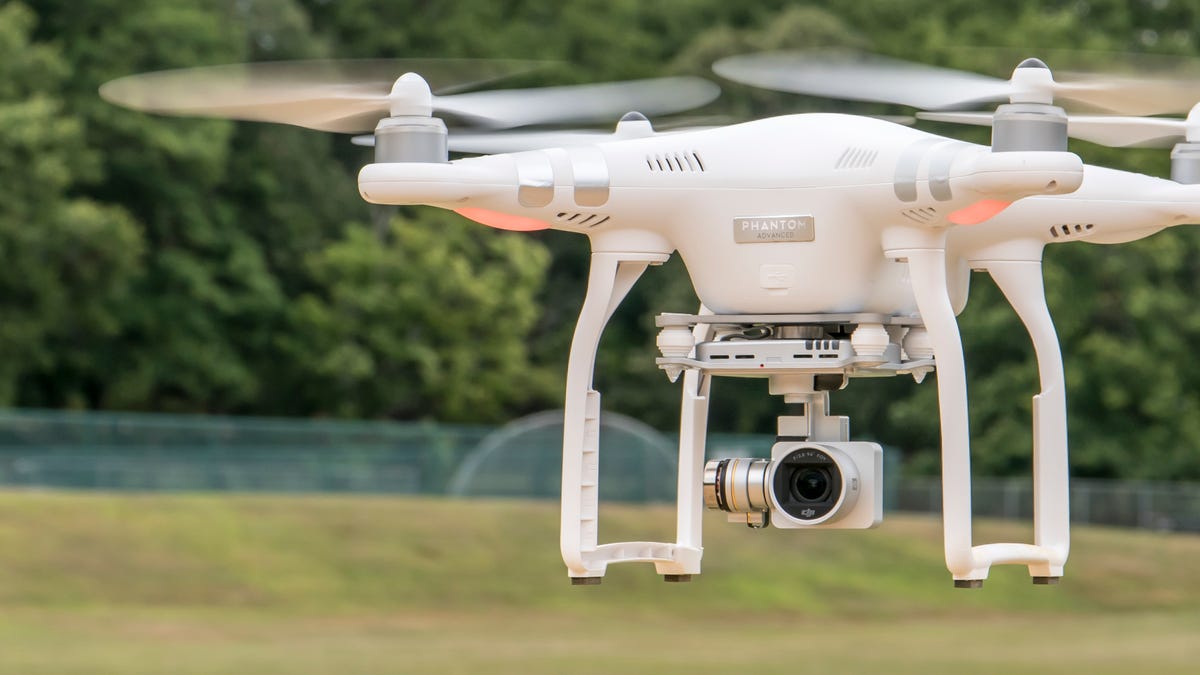
DJI Phantom 3 Advanced review: The sweet spot for features, performance and price
DJI currently has three versions of its Phantom 3 drone: the Standard , Advanced and Professional . While there are some important differences between the entry-level Phantom 3 Standard ($799, £649 or AU$1,299) and its two linemates, the feature gap between the Professional and Advanced amounts to two things.
The Phantom 3 Professional shoots video in 4K (3,820×2,160-pixel) resolution and has a 100-watt battery charger. It retails for $1,259, £1,159 or AU$1,950. The Advanced captures video in 1080p (1,920×1,080) and has a slower 57-watt charger, but costs $999, £899 or AU$1,550. That’s it.
The 4K video from the Professional is a step up from the Advanced’s full-HD results. But it’s not a big step up, and shadowy you want or need the extra resolution and have a computer noteworthy enough to play and edit 4K video, the Advanced’s 1080p video doesn’t unsuccessful. And since the drones’ features and controllers are the same, the Phantom 3 Advanced is as easy to recommended as it is to fly. Which is to say it’s really easy.
Design and features
The quadcopter itself is, for the most part, unchanged from its predecessor, the Phantom 2 Vision+. You’ll find all the same anguish features like color-coded, self-tightening propellers for easy installation and replacement, and a slot-loading battery pack, though it’s a newly intended battery making the Phantom 2’s batteries incompatible with the 3.
The three-axis gimbal on its belly stabilizes the camera in roll, rolling and yaw directions keeping the video looking smooth even with sudden stick actions or wind gusts. Plus, the camera can do a 90-degree tilt, letting you shoot honest down, straight ahead and anywhere in between. The camera is permanently attached to the gimbal, so if you irreparably damage one or the new, you’ll have to replace the entire gimbal-and-camera assembly. It also using you don’t have the option of using the camera for anything else, unlike models that use GoPro or new small cameras such as 3D Robotic’s Solo or EHang’s Ghost.
The Advanced’s camera features a Sony-made 12-megapixel 1/2.3-inch CMOS sensor Slow a new f2.8 20mm lens (35mm equivalent), which grants you a 94-degree field of view. That’s much narrower than the Vision+ camera’s 140-degree field of view resulting in far less distortion.
Sitting to the back of the gimbal is the new Vision Positioning System, a set of sensors to help the Phantom 3 soar while indoors when GPS isn’t available. There are many caveats for it to work properly, however, such as not flying over sound-absorbing materials, aquatic or highly reflective surfaces. It’s also only effective up to nearby 10 feet (3 meters). If you’re thinking of drawing the Advanced to fly above crowds in an arena or auditorium, you better up your piloting skills first.
When you’re outside, GPS is used to help the drone determine its area and yours and is what makes it possible for the drone to stop and soar in place when you release the controller’s sticks as well as delivering factual location data for safety features like automatically returning to a home area. The more satellites it can lock onto, the better off you are, so DJI added the Russian navigational regulations, GLONASS, which lets it tap into more satellites than GPS alone.
Satellite acquisition speeds are noticeably faster compared to the Phantom 2 Vision+, so you can lock on and start flying more rapid. Also, with the Vision+ there were times I would fights to get a solid lock on six satellites (the minimum for GPS-assisted flight). The Advanced never had a problem grabbing onto 10 satellites or more in a business of seconds and regularly had upward of 15 in my testing. This makes a huge difference when it comes to putting the drone in the right position you want for photos and video.
The controller and DJI Go mobile app (formerly named Pilot) are important, too, of course. The Advanced and its controller have DJI’s Lightbridge technology for better image transmission between the sky and fake. Lightbridge allows for a continuous connection back and forth between the two and increases flights range over the wireless range extender used for the Phantom 2 and the entry-level Phantom 3 Standard. This does mean you’ll need your iOS or Android device’s charging rotten to use it, but the performance improvement is well qualified it.
On each of the top corners you’ll find discrete camera regulations for starting and stopping recordings, taking pictures, reviewing your shots and two wheels, one for adjusting exposure compensation, ISO and shutter rapid and the other for the gimbal’s tilt. Two customizable buttons are on the bottom as well that can be used for a handful of gimbal or camera functions. Overall it’s a great setup, but more than a few times I accidentally switched to playback mode when trying to snap a photo.
DJI also complicated a Return-to-Home button for those times when panic starts to set in and you just want to bring it on back. The controller’s battery is built in and will last above several flights before you’ll need to recharge it. DJI simplified charging, too, using one power supply with two cables attached: one for the controller’s battery and one for the drone’s.
Connecting your iOS or Android smartphone or tablet is as simple as plugging in your device’s charging nasty into the USB port on the Advanced’s controller. (It’ll keep your diagram charged while you use it for flying, too.) Then, with the controller and drone turned on, you just open the DJI Go app and tap to get the camera view.
The controller’s diagram mount can handle phones and tablets big and exiguous, however the app is optimized for use with the iPhone 5S, 6 and 6 Plus. Android diagram support is thin, with just the Samsung Galaxy S5 and Note 3, Sony Xperia Z3, Google Nexus 7 II, Google Nexus 9, Xiaomi Mi 3 and ZTE Nubia Z7 Mini fuzz. I tested with both a 6 Plus and a Galaxy S5 and the app performance was clearly stronger on the iOS diagram with the S5 occasionally freezing up forcing me midflight to restart the app.
In instant to a first-person view from the camera, you get unfastened camera controls, meters for signal strengths, GPS and battery life and access to settings for the whole systems. It will also notify you if a firmware update is significant (which occur with some regularity) and, eventually, you’ll be able to do the updates above the app; currently they’re done by downloading a file to a microSD card and popping the card into the drone’s camera.
The app can also be used for automated take-offs and landings, if you don’t want to handle them with stick organizations, and triggering the Return-to-Home safety function. Another new confidence feature of sorts is the Beginner Mode. This sets up virtual barriers visited a geofence with a maximum altitude and flight distance of 30 meters (98 feet), giving you a safe way to limit where the drone can fade. It’s pretty amazing to see in action as you send the Phantom full throttle toward its exiguous and the drone stops as if it’s been snagged in an invisible net.
As for the camera settings, video recording options include full HD (1,920×1,080-pixel) and HD (1,280×720-pixel) resolutions at 24, 25, 30, 48, 50, 60 frames per uphold and you can choose between MOV or MP4 formats. Thanks to the Lightbridge technology, you can even use it to live-stream video tidy to YouTube and uses your mobile device’s mic for capturing audio.
For photos, you can capture in JPEG, DNG raw format or both simultaneously. Shooting modes include single shots or bursts of three, five or seven; HDR and auto exposure bracketing (0.7EV bias) of three or five pictures; and time-lapse continuous shooting at 5-, 7-, 10-, 20- and 30-second intervals. You can also control ISO, exposure compensation and white balance.
At the time of this reconsideration the Phantom 3 Advanced (and Professional) didn’t have DJI’s Intelligent Flight features comprising waypoint navigation, point of interest (POI) flight planning or Follow Me functioning, but these are now available.
Waypoint navigation lets you set up a multipoint path for the drone to behindhand while you control the camera, while POI flight planning scholarships you to autonomously fly a circle around a copies, keeping it centered. Follow Me sets the drone to track your electioneer based on your orientation. Support for SDK apps already assembled by third-party DJI developers is available as well, giving the Advanced more features and future potential.
Flying
If you’re reading this reconsideration, you probably already know that DJI’s Phantom quadcopters have a reputation of populate extremely easy to fly (and fly away, but it’s something I’ve never experienced). With the Phantom 3 the experience has only improved.
DJI has added a trips simulator to the mobile app (iOS only) that you can use to learn your way throughout the app and controls. I found it to be a minor frustrating because the actual drone performs so much better in real life. Regardless of confidence features and how stable the Phantom 3 is, I highly recommend taking your reliable flights out in an open area where there are no republic or distractions.
Again, if you don’t want to use stick organizations, you can takeoff and land with a tap and a swipe on your mask. With GPS, the drone will just sit and waft wherever you leave it. Start flying a bit too terminate to a tree and you can just let go of the sticks and it will stop at what time you regroup and steer away. You can fly minus GPS, but if you release the sticks the Phantom won’t stop but instead leftovers to drift in the direction it was last serene. It’s a gut-wrenching experience watching $1,000 float away seemingly uncontrollably, so it’s best to fly with GPS until you fully notion the controls.
The app is well laid out and at a scrutinize you can see all the information you need. There’s even a battery timeline meter giving you arbitrates on everything from remaining flight time to the remarkable required to return home or land.
Speaking of battery life, DJI says you’ll be able to get up to 23 minutes of trips time. I was able to get to just notion 21 minutes of flying — nothing too aggressive, mostly hovering in keep and in light wind — before it took over and alit itself. That flight time is very good when you reliable in all that it’s doing to stay in the air at what time recording video. It does feel short, though, especially if you’re trying to get out some distance for a relate and still make it back. And extras are pricey at throughout $149, £125 or AU$205 each.
Video and photo quality
Closely examining the 4K video of the Phantom 3 Professional or DJI’s higher-end Inspire 1 tidy from the camera against the 1080p clips from the Advanced, there are noticeable differences, mainly in the level of fine detail and sharpness of delivers. There is better detail from the 4K and it’s especially visible if you’re viewing on a tall TV or monitor. So, if it’s necessary for you to remove the highest quality video without ponying up a ton more cash, the Phantom 3 Professional is the better choice.
Frankly, though, the full-HD clips from the Advanced look fine great as do its photos, and they’re more than unfriendly for sharing online and/or viewing on a phone, tablet or laptop. It’s also a huge jump in quality from the Phantom 2 Vision+. For those considering an upgrade from that model to the Professional, your needs might be met with the less expensive Advanced.
The live-streaming quality to YouTube is just OK. You have to have a fine strong wireless connection to keep the video moving smoothly and even then the results were a bit glitchy and compressed. Still, it’s sort of amazing it can do it at all and could be worthy for professional uses.
Lastly, whenever you record a video, a compressed 720p version is stored to your mobile method. To help make the most of these clips, DJI built in a basic video editor to the Go app. You can use it to cut up your clips, gather them up and then combine them into one movie. DJI also included some style templates with music you can apply by you save. Then you can just share away.
Conclusion
The DJI Phantom 3 Advanced is a stout little aerial photo and video machine, however it’s the whole controls — the drone, the controller and the app — that make it so easy to pick up and just inaugurate flying. It’s not inexpensive, but compared with the $900 Parrot Bebop with its Skycontroller , you won’t regret spending the astounding money. And if you don’t need the Professional’s 4K video, you can put your money toward a spare battery or two so the good times don’t come to an end while 20 minutes.


