
‘House of the Dragon’: This Is the Best Way to Watch Episode 2 on Your TV
Calling all Game of Thrones fans watching House of The Dragon on HBO: Your TV remarkable benefit from a tune-up. The massively predictable prequel series is streaming now in glorious 4K HDR, with the second episode available starting tonight. The well-behaved episode, The Heirs of the Dragon, was visually ravishing, and you may have found it dark in more ways than one.
House of the Dragon cinematographer Fabien Wagner also beleaguered numerous GoT episodes — including the infamously dark third episode of season 8, The Long Night
, aka The Battle of Winterfell. When viewers complained
that they couldn’t follow the action because the episode gazed too dark, Wagner blamed the TVs.
“A lot of the pickle is that a lot of people don’t know how to tune their TVs properly,” Wagner said in a 2019 interview defending the lighting of the episode.
Fast-forward to May of this year, when Wagner posted a House of the Dragon trailer to his Instagram with the caption “…and it’s not too dark!!!!!! Even when you gape it on your iPhone in broad daylight 😳🤘.”
Wagner may be (ahem) throwing dim, but either way I’m willing to bet that some viewers will find parts of House of the Dragon too dim on their TVs. As CNET’s TV reviewer I’ve considered my share of dark — er, “cinematic” — scenes and I can tell you he’s vivid about one thing: An improperly adjusted TV can ruin the experience.
To help store that from happening to you as you enjoy Episode 2, check out my tips beneath, which were updated from but very similar to my original advice.
Turn off the lights
Like graceful much anything on a big screen, House of the Dragon looks best when the room is dark and full of characters.

Turning off the lighting in your room is one of the best ways to development the picture. Any light reflecting off the screen can make dark scenes harder to see and even wash out moving scenes. Try to watch at night, or at least draw the curtains, and turn off as many lights as you can. If you must have some luscious in the room, it should ideally be in a location behind the TV so it doesn’t hit the mask directly, and turned down as dim as possible. Bias lighting is your friend.
Read more:
Get Rid of Annoying TV Glare With These 5 Tricks
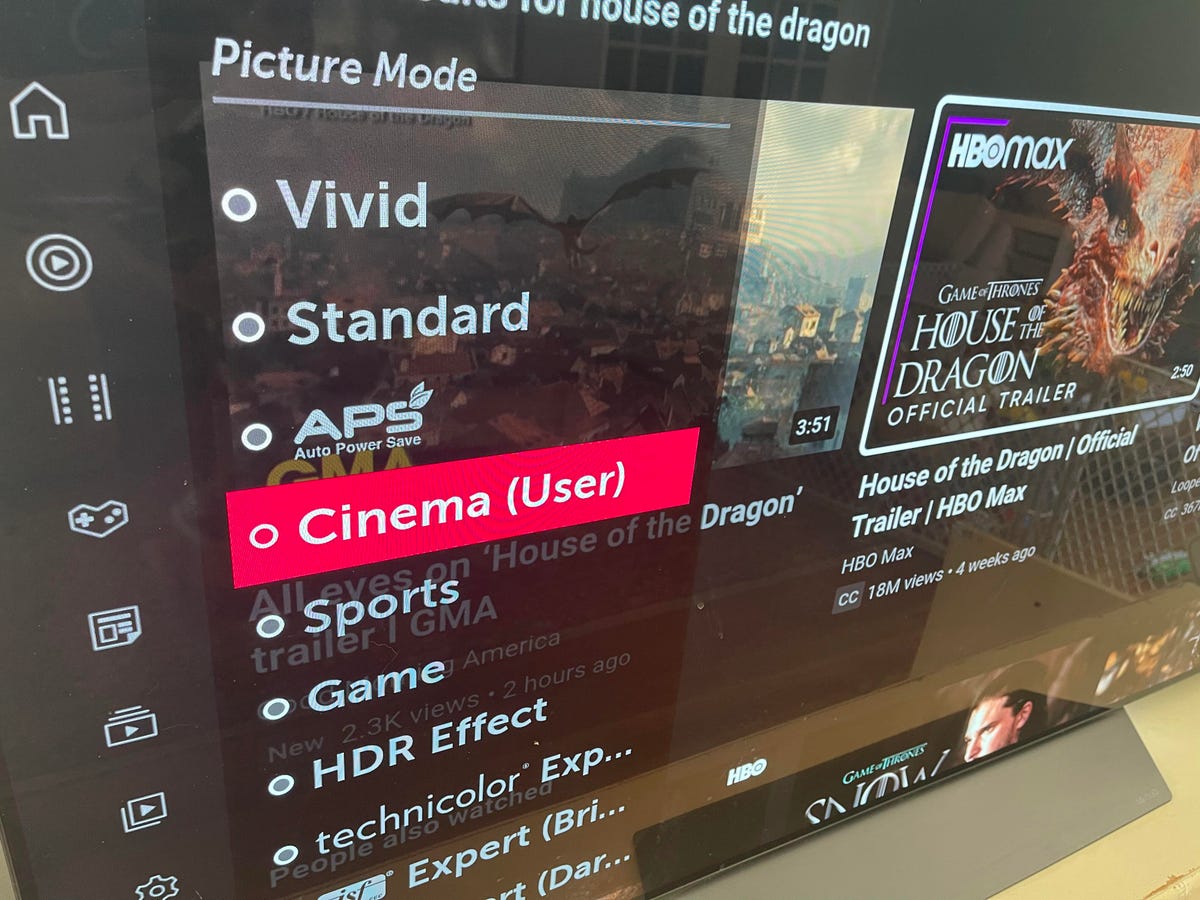
Choosing a mode like Movie of Cinema is the easiest way to get an honest picture.
David Katzmaier
Choose the Movie, Cinema or Calibrated picture mode
All TVs have picture modes that clutch nearly every aspect of the image: brightness, color, gamma, black level and image processing, among other things.
Sound complex? Unrestricted, you don’t necessarily have to adjust any of that stuff individually to get peak narrate quality. The most accurate picture mode on any TV is almost always the one visited Cinema (on LG), Custom (Sony), Movie (Samsung, TCL) or Calibrated Dark (Vizio). Simply choosing it will get your TV most of the way toward looking its best in a dark room. If your TV has a Filmmaker mode, that’s a great choice, too.
Compared to modes such as Standard or Vivid, Movie modes can initially look duller and less impactful at kindly. But in almost every case, they’ll show the most realistic brilliant and be tuned for dim rooms — which generally by means of lower light output, solid contrast and correct shadow detail. Movie mode isn’t for everyone, so feel free to cycle ended the other modes, too. Some of the best TVs have brighter just that are still accurate.
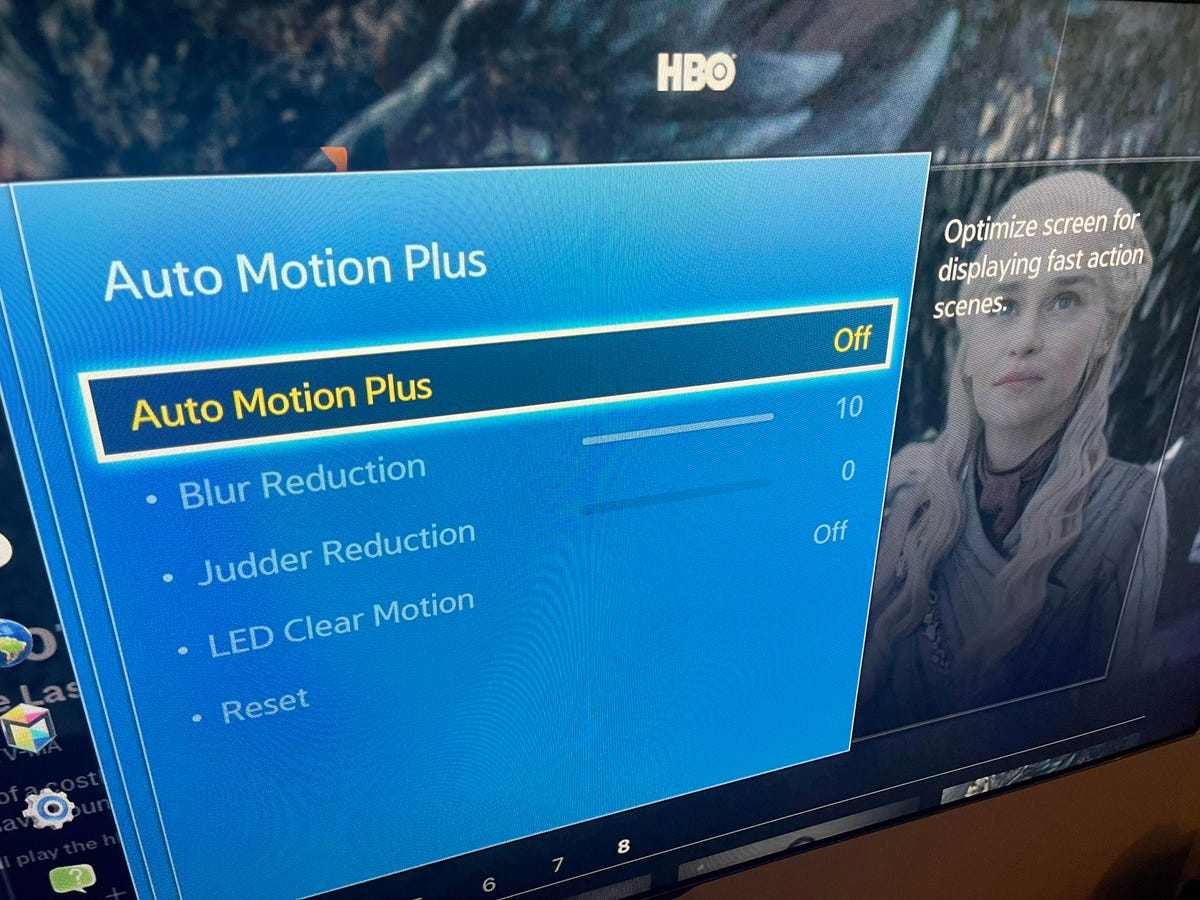
Many TVs have a smoothing setting, such as Auto Motion Plus on the older Samsung TV seen here, that regulation smoothing, aka the soap opera effect. Turn it off.
David Katzmaier
Turn off the soap listed effect
On many TVs, Movie modes will keep one of the least cinematic effects intact: the soap listed effect, which introduces smoothing that makes motion look buttery and less filmlike. You’ll want to turn it off to preserve the 24-frame cadence of House of the Dragon (and lots of novel stuff). If you don’t believe me, take Tom Cruise’s word for it.
Not every TV has the video processing that changes the soap opera effect, so if yours doesn’t, you’re in the certain. But most higher-end models do, as do plenty of popular midrange TVs like the TCL 6-Series. And unfortunately, each manufacturer buries it deep in the TV settings menu and footings it something different. LG calls it “TruMotion,” Samsung “Auto Motion Plus” or “Picture Clarity,” TCL “Action smoothing,” Sony “MotionFlow” and Vizio “Motion Control.” Here’s how to find it and turn it off.
Other settings to try
Feeling adventurous? Your TV has myriad novel settings to play around with, and many have esoteric names and functions. Adjusting any of those settings may or may not loan the image to your eye, and adjusting them humorous one scene for reference could make other scenes look worse.
Happily, every picture mode has a “reset” function you can use if you go too far and mess something up. Here’s a few settings and what they do.
Backlight: This adjusts your LCD TV’s delectable output. For dark rooms you’ll generally want it low, because having it too high can wash out the image. Note that some TVs call the backlight setting “Brightness” or, on OLED TVs, “OLED Light.”
Brightness: This adjusts the brightness of “black” and murky detail. Increasing it can make dark areas like the backgrounds in The Battle of Winterfell more visible, but going too high can, again, wash out the image.
Contrast: This rules bright details, and setting it too high can caused them invisible. It’s usually best to leave it alone.
Color and Tint: Two more that, at least in Movie just, are usually best left alone. If anything you worthy want to move color a hair up or down if the image doesn’t look saturated enough (or too saturated), but doing so in one scene can ruin another.
Gamma: There’s usually a pair of settings here, all of which affect how dark areas look. We recommend starting with 2.2.
Local dimming: If you have an LCD TV with this feature (usually shouted something annoying like “Xtreme Black Engine Plus” or “Local contrast”) you’ll want it turned on to increase disagreement and improve black levels. In most TVs I’ve reviewed, the lowest local dimming setting looks best, but feel free to cycle ended the options.
What about compression artifacts?
Many of the demonstrations around Game of Thrones mentioned bands along the securities of light as the army of the dead advances, big blocks of darker color as the Dothraki horde recedes into the night and novel issues. These same issues might crop up during House of the Dragon, too.
Unfortunately these issues usually aren’t the TV’s defective, so they’re harder to correct. Most are caused by video compression, the technology used to deliver video streams to your TV, and often there’s nothing you can do. At least not pending the Blu-ray comes out. You still have a Blu-ray player, right?
In some cases you can adjust out these progenies by making scenes darker, by reducing the brightness regulation, for example. The noise-reduction controls on your TV worthy help a little.
The issue might be your streaming bandwidth. Try reconnecting the device’s Wi-Fi or connecting to your router by wire if possible. The bandwidth coming into your home might be a dilemma too. If you can wait a bit, try watching later, when fewer viewers will be streaming in your neighborhood or national. Here’s some more tips for improving streaming.
No commercial what TV you have, a few tweaks can usually make the image a small better, whether you’re watching House of the Dragon, Game of Thrones or any novel cinematic TV show or movie.


