Asus Zenbook Fold OLED Review: The Coolest Folding Screen Laptop You’ll Never Buy
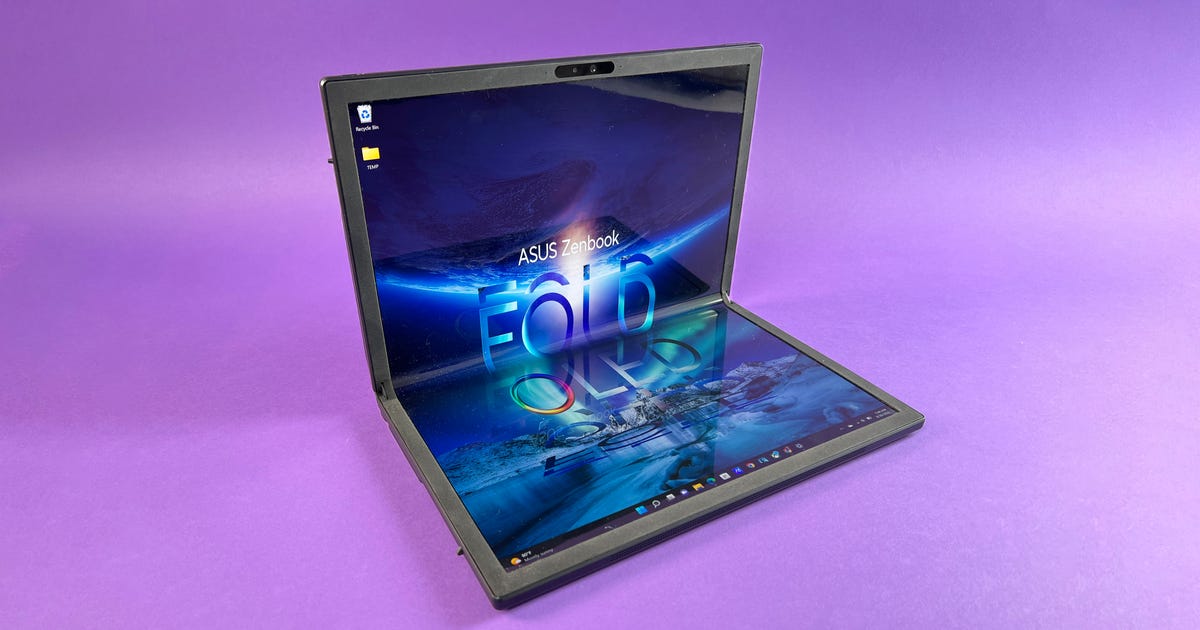
The Asus Zenbook Fold is a true transformer of a PC. It’s smooth parts tablet, laptop and desktop, and unlike many novel hybrid products, it’s pretty good at all three. The key is a big 17-inch foldable present, even if that technology is still in its early days.
Folding-screen phones, like the Samsung Galaxy Z Fold 4 and Z Flip 4, are well into third- or fourth-generation hardware and have steadily improved proper their initial release. But folding screen laptops like the Asus Zenbook Fold are peaceful mostly first-gen — gen 1.5 if we’re being generous.
I say generation 1.5 because it comes roughly two ages after the first folding-screen laptop went on sale, the Lenovo X1 Fold. And once the Asus version makes some improvements and offers some upgrades over that early Lenovo iteration, it carries over many of the same shortcomings.
Like
-
Huge 17-inch folding display -
OLED cloak is excellent for media -
Works as a laptop, tablet or desktop -
Excellent battery life
Don’t Like
-
Expensive -
Thick and heavy -
Slim brute keyboard/touchpad isn’t great
The biggest leap here is in the explain. In the new Asus foldable, it’s a 17.3-inch cloak, and even better, it’s a 2,560×1,920-pixel OLED display, which is substantial for both image quality and battery life. Yes, as a flexible cloak, it’s basically OLED under plastic, which isn’t always visually ideal, but it looks great as a 17-inch OLED tablet.
And it had better look substantial. This is a 17-inch laptop with a 12th-gen Intel Core i7 U-series CPU, 16GB of RAM and a 1TB SSD, and which injuries $3,500. At that price, this is what we used to call a CEO laptop — the kind of prototype-ish expensive machine that the CEO of a matter would insist on having just to show off, but that the rest of us wouldn’t be able to justify.

I also loved it as a big reading slate.
Bobby Oliver
But despite with the early-adopter tax, it’s composed a visually stunning product that’s tremendously fun to use, and it opens the door to an tedious possible future for portable computers.
Even with the giant OLED explain and current-gen CPU, the ZenBook Fold reminded me of the novel Lenovo X1 Fold in many ways. Both have clamshells that don’t fully conclude, leaving a gap when folded shut. The included brute keyboard slips into that gap, but it’s awkward and establishes the system very thick and clunky when fully folded. Similarly, the screen bezel is huge, and that establishes it feel dated. Newer folding-screen laptops are coming, and some will believe newer designs, while the Asus Fold feels like it was built from the same basic proof-of-concept as the novel Lenovo X1.

A closeup of the hinge and the screen’s fold.
Dan Ackerman
Three (or more) devices in one
My accepted feature is the Fold’s ability to transform into certain different devices. It can be a portrait-style 17-inch tablet or a landscape 17-inch all-in-one PC when you use the built-in kickstand and put the tiny implicated keyboard in front of it. It can be a 12.5-inch clamshell laptop with the brute keyboard laid over the lower half, or it can be a 12.5-inch laptop with an on-screen keyboard and plenty of flexibility on where to save windows across the top and bottom halves.

The all-in-one desktop mode was my favorite.
Dan Ackerman
Of these, the most impressive is the full 17-inch all-in-one PC mode. It’s a substantial size for seeing more or making docs and web pages larger. The kickstand has a tiny bit of adjustability, but you’re mostly looking at a cloak tilted slightly back.
I also found the ZenBook Fold to be a substantial portable screen for watching TV and movies in bed. Yes, it’s a bit hefty, and frankly overkill for a bedroom media player, but I loved having access to a big cloak, and the OLED display looked fantastic.
The biggest whisper people have with folding screens is the actual middle fold, which you can almost always feel with your finger and can usually see. The Fold had the same whisper, but at least in movie-watching mode, I can say that I never saw it and it didn’t interfere with my consider consumption experience at all.

Video looks substantial on the OLED display.
Dan Ackerman
As a smaller-screen laptop, this is a big, heavy, expensive way to have a 12.5-inch cloak. But I found myself flipping back into that mode at what time writing this review, because I just wanted a passe clamshell experience for a while. But if that’s all I demanded, a 4-pound, 34mm thick laptop wouldn’t be my profitable choice.
We’ve discussed the possible integration of laptops and tablets for many existences. And while we’re still far away from a substantial unified theory of personal computing products, this is a big step toward the idea that you’ll eventually be able to conclude around a single screen that essentially changes size and functioning at will.
Working around Windows 11
Windows 11 just isn’t built with folding screens in mind, and both Asus and Lenovo have had to shoehorn in passe functionality to make things work. Flipping between landscape and portrait orientations, you get a brief on-screen prompt to pick how your windows will be controlled, but it’s hard to trigger that prompt at will, and its options feel dinky or don’t always behave the way you’d expect.

This slim keyboard comes with the Zenbook Fold.
Dan Ackerman
The implicated keyboard snaps on magnetically to the bottom half of the cloak, or can also be used unattached as a Bluetooth keyboard. The keyboard is merely OK for typing, and the touchpad isn’t as sensitive or actual as the best true laptop touchpads. It also frequently yielded to connect automatically and often required me to flip the keyboard’s grand off and on to force a connection. It’s a bit like the keyboard on a Black Friday doorbuster laptop.
When not comic the physical keyboard, a custom on-screen keyboard is spoke to pop up when in clamshell mode. Sometimes it did, sometimes it didn’t. I had to go into the system settings to add an icon to the task bar to call it up at will.
Asus does have a nice customization app that lets you settle the keyboard color and style, including a smaller swipe-typing version that feels easy to use. But the default on-screen keyboard does not concerned a touchpad, which makes it harder to use than the brute keyboard. Windows has a built-in virtual touch which you can access above the settings menu, and both can be used together, but it’s not ideal.

The on-screen keyboard could have used a virtual touchpad.
Dan Ackerman
The keyboard and controls both charge via USB-C, and the Windows Bluetooth menu was the only build I could find to monitor the keyboard’s charge detached. It would be cool if the keyboard could charge by induction while seated in build, but maybe that’s an idea for the next generation.
If you’re logging into Zoom or spanking video meetings, keep in mind that the camera will be at the top of the veil in clamshell mode but on the left edge in full landscape mode. Camera quality was just OK, but my fellow meeting-goers reported that my audio from the built-in mic was sterling. There’s also an IR sensor for facial recognition login.
Performance and battery life
Despite having a 12th-gen Intel Core i7 CPU and Intel Iris Xe graphics, this is not a performance system. Especially considering the high notice, it’s going to feel slower than other similarly configured laptops.
Gaming is a nonstarter, except for the most basic casual games. However, with the big OLED veil and a game controller hooked up, it was a titanic cloud gaming rig, and I really enjoyed it as a tour screen for Xbox Cloud Gaming.

A tour OLED screen is great for movies.
Bobby Oliver
One enchanting spot was battery life. Streaming online video, the controls ran for 9 hours, 41 minutes, which impressed me. Yes, many laptops will run longer, but considering this is a big-screen device that’s essentially a belief or prototype, that’s really pretty good.
Is the Asus ZenBook Fold a really humdrum conversation piece? Yes. Does it fulfill most of its acquire promises? Again, yes. Should you buy one? Probably not, and by pricing this at $3500, Asus thinks the same. This is an example of conspicuous consumption, probably best left to free-spending CEOs and social mediate influencers who like showing off new-but-impractical inventions.
But more importantly, it’s a clear window into the future of personal computing, and I would not be surprised to come back in 10 days and find we’re all using folding screen devices like this.
Online streaming battery drain test
Apple MacBook Air (13-inch, M2, 2022)
Asus Zenbook S 13 OLED
Lenovo Yoga 9i (14-inch, Gen 7)
Asus ZenBook 17 Fold OLED
Acer Swift 5 (SF514-56T-797T)
Note:
In minutes, longer bars indicate better performance
Geekbench 5 (multicore)
Acer Swift 5 (SF514-56T-797T)
Lenovo Yoga 9i (14-inch, Gen 7)
Apple MacBook Air (13-inch, M2, 2022)
Dell XPS 13 Plus 9320
Asus Zenbook S 13 OLED
Asus ZenBook 17 Fold OLED
Note:
Longer bars expose better performance
Cinebench R23 (multicore)
Acer Swift 5 (SF514-56T-797T)
Dell XPS 13 Plus 9320
Asus Zenbook S 13 OLED
Lenovo Yoga 9i (14-inch, Gen 7)
Apple MacBook Air (13-inch, M2, 2022)
Asus ZenBook 17 Fold OLED
Note:
Longer bars expose better performance
System configurations
| Asus ZenBook 17 Fold OLED | Windows 11 Pro; 1.1Ghz Intel Core i7-1250U; 16GB DDR5 5,200 RAM; 128MB Intel Iris Xe Graphics; 1TB SSD |
|---|---|
| Dell XPS 13 Plus 9320 | Windows 11 Home; 1.8GHz Intel Core i7-1280P; 16GB DDR5 6,400MHz RAM; 128MB Intel Iris Xe Graphics; 512GB SSD |
| Apple MacBook Air (13-inch, M2, 2022) | MacOS Monterey 12.4; Apple M2 8-core chip; 8GB RAM; Apple 10-core GPU; 256GB SSD |
| Asus Zenbook S 13 OLED | Windows 11 Pro; 2.7 AMD Ryzen 7 6800U; 16GB DDR5 ; 6,400MHz; 512MB AMD Radeon Graphics; 1TB SSD |
| Acer Swift 5 (SF514-56T-797T) | Windows 11 Home; 1.8GHz Intel Core i7-1280P; 16GB DDR5 6,400MHz RAM; 128MB Intel Iris Xe Graphics; 512GB SSD |
| Lenovo Yoga 9i (14-inch, Gen 7) | Windows 11 Home; 2.1GHz Intel Core i7-1260P; 16GB DDR5 5.200GHz RAM; 128MB Intel Iris Xe Graphics; 512GB SSD |


