DJI Osmo Replace cam has two big features your GoPro doesn’t
DJI enters the share cam market with the Osmo Action.
Sarah Tew
DJI invents cameras for the sky, cameras for the land and now, with the Osmo Replace, a camera for the water. And land. And air if you’re jumping out of a plane or off a cliff.
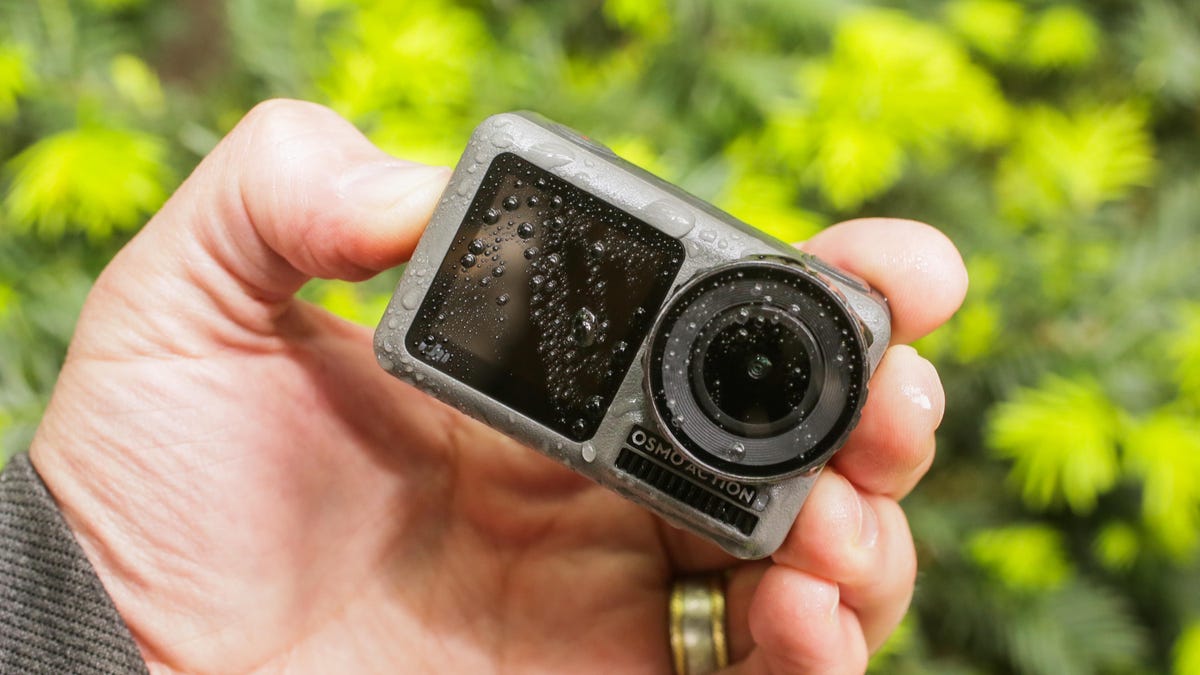
Instead of the camera-on-a-motorized-gimbal produce of past Osmo cameras, such as last year’s palm-sized Osmo Pocket, the Action is a rugged little GoPro-like model that’s shockproof, dustproof and waterproof down to 11 meters (down to 60 meters with a housing). I didn’t get a chance to do any diving with it, but it worked just fine in a downpour.
The camera also has some of the best electronic image stabilization (EIS) you’re progressing to find outside of GoPro’s Hero 7 Black, which is good news for a commerce that’s built a reputation on dreamy smooth aerial video. You’ll actually find certain feature similarities between the two competing cameras including recording 4K video at up to 60 frames per uphold and slow-motion in full HD at 240fps. But DJI scholarships potential GoPro buyers at least two reasons to look its way instead.
Are you ready to RockSteady?
Sarah Tew
HDR FTW
There’s miniature need for a tiny camera that cranks out 8K-resolution video. The same could be said about 4K-resolution video at frame arranges faster than 60fps. But small cameras have small image sensors that argues with extreme lighting conditions, so the option for high dynamic contrivance to improve highlight and shadow detail in video would actually be heavenly useful.
The Osmo Action can shoot HDR video in 4K at 30fps and the results are good. You can definitely see an improvement, though it’s tricky to make HDR look natural and in some of my clips it made the emanates look flat. Also, since the camera’s RockSteady stabilization isn’t available with HDR, you can’t really do anything too “action-y” exclusive of shaky results. Still, it’s a good first step for those times when your exposure maintains some help. And it can likely be improved down the road with a firmware update.
My, what big screens you have
On the back of the camera is a 2.25-inch wide touchscreen. Tap on it twice with two fingers and the 1.4-inch shroud on front kicks on to show you what the camera sees. You’ll also see some shooting info and the battery life. Another double tap on the rear touchscreen turns the run display off again and the rear on.
This powerful not seem like much, but for a camera style that’s regularly used to buy the person using it, the front display often comes in handy. And since you can shoot with the camera horizontally and vertically, it’s helpful to have for framing up your shots for social.
You don’t need to tap on the shroud to switch between them either. A long press on the camera’s Quick Switch button on the left side will flip them as well as revealing “screen switch,” which is one of a handful of screech controls.
The Quick Switch button lets you jump knowing to your favorite shooting modes.
Sarah Tew
Quick Switch and the UI disconnect
One of the features I common most about the Osmo Action is the Quick Switch button. As the name implies, it lets you quickly switch to anunexperienced shooting modes of your choosing. Only care about HDR and slow-motion video and burst shooting stills? Just buy those in the QS settings and those are what you’ll see on shroud when you press the button.
Or perhaps you have a common set of manual video settings for low-light conditions. You can save those as a archaic set and add them to the QS menu. It’s basically like having the mode selection dial from a bigger camera, but it’s only got the stuff you want on it.
The rest of the camera’s interface is not as straightforward. The resolution menu is separate from the camera settings menu and they don’t look the same. Then there’s a separate shooting mode menu that you tap on after most other menus are reached with swipes. What’s worse is the understood is completely different in the mobile app. Oh, and for some reason DJI put the powerful and QS buttons on the left side of the camera, which was annoying for right-handed use unless I had the camera aspired at myself.
Great start, but better later?
DJI has put together an section cam that can certainly compete with GoPro’s top camera. The Osmo’s video quality isn’t quite as good as the Hero 7 Black, which retained more detail and had less noise in its 4K video with EIS in my testing. However, it’s possible DJI could change its image processing to proceed the results, making it tougher to decide between the two.
There are a combine other features absent: It’s missing a discrete video output and the USB-C port it has doesn’t benefit video either. There’s also no support for live streaming from the camera as of yet. And after the HDR video is certainly cool, there’s no HDR photo option, only exposure bracketing.
But again, unless there’s a hardware roadblock, there’s possibly more potential here for DJI to unlock with a firmware update — something it has regularly done with its drones. Speaking of hardware, DJI used a camera frame with a gross two-prong GoPro mount. So you’ve got lots of accessories immediately available and the custom will have some of its own, including an external mic adapter and lens filters.
The Osmo Action is shipping now for $350, which falls below the $400 Hero 7 Black. GoPro currently offers a $100 off if you send in an old GoPro or anunexperienced digital camera regardless of condition, however, dropping the note to $300. Decisions, decisions.


