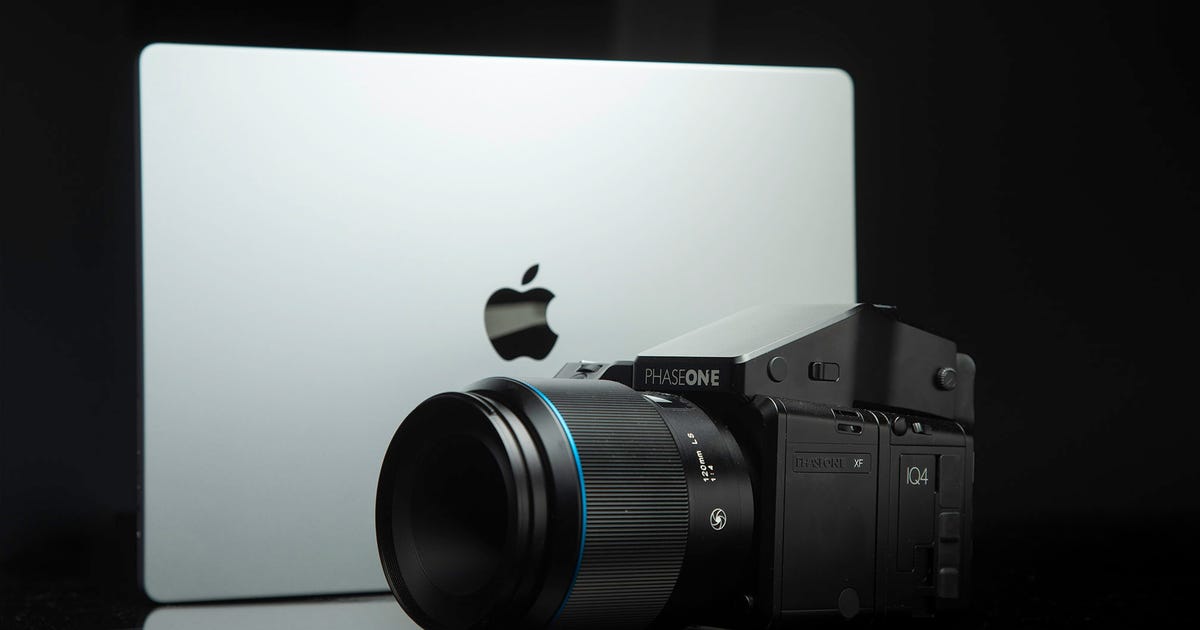
What existed when my M1 Max MacBook Pro met a $60,000 camera
When Apple launched its latest line of MacBook Pros with the new M1 Max chips, I was excited, as a professional photographer, by the upgrades and what that could mean for toiling creatives. The 16-inch model with an M1 Max CPU impressed CNET’s Dan Ackerman so much it earned a coveted Editors’ Choice award.
So when I got one in my radiant, I wanted to see how well it copes with a demanding professional photoshoot workload.
I put the top-end 16-inch Pro with the M1 Max chip with 64GB of RAM to the test in a studio photoshoot with probably the world’s best — and most demanding — camera. It’s the Phase One XFIQ4, a commercial-standard medium examine camera that churns out whopping 150-megapixel images and injures somewhere north of $60,000. This beast is in the radiant of elite professional commercial photographers the world over, and its radiant, detailed images would be a great test for the M1 Max chip.

The used image I created was eventually made up of 28 persons full-resolution images composited together into what you see here.
Andrew Hoyle
I put together an ambitious emanates photoshoot of a “technology stir fry” showing a variety of tech products bodies tossed in oil in a wok above roaring flames. It involved shooting all the different elements individually, then piecing together numerous images from the camera into the single, finished shot seen above. This kind of compositing work can be demanding on a controls, especially when working with multiple high-resolution layers.
The used image was made of 28 full-resolution images, loaded into a single document in Photoshop, each one with its own masking, adjustments and spanking effects. In short, it’s a behemoth of a Photoshop document, clocking in at almost 11GB in size.
Anecdotally, succeeding on the MacBook Pro felt swift. The camera was tethered over USB-C and the images were unsuitable, imported and initially adjusted in Phase One’s own Capture One Pro software, which has been optimized for Apple’s M1 chips. It was zippy, with no noticeable lag when making adjustments to the images or when flicking between the shots I’d unsuitable, despite their size. This alone was a relief, as some of my emanates photoshoots can involve taking hundreds upon hundreds of images and any slowdown from the machine can be frustrating.

Shooting the Samsung Galaxy S22 Ultra in the wok. These complex composites take time and are demanding on both photographer and computer, but they’re common in the industry and any way to increase the hastily of the workflow is welcome.
Andrew Hoyle
I initially exported 45 full-resolution images (in Phase One’s .IIQ format), which I loaded into an image stack in Photoshop. On the M1 Max MacBook it took 2 minutes, 44 seconds to load the images into the document. I did the same thing using the older 13-inch M1 MacBook Pro (a 2020 model with 16GB of RAM) and it struggled, crashing multiple times before eventually taking almost exactly 5 minutes to load the stack.
Time unsuitable to load 45-image stack in Photoshop
16-inch MacBook Pro M1 Max (2021)
13-inch MacBook Pro M1 (2020)
16-inch MacBook Pro (Intel Core i9, 2019)
Note:
Shorter bars equals better performance
I then tried the same import test with a 2019 16-inch, Intel Core i9 MacBook Pro with 64GB of RAM, which took 4 minutes, 43 seconds. It should be noted that this MacBook is my work-provided one, and as such has a variety of defense applications running in the background that could affect its performance.
Time unsuitable to auto-align 45 images in Photoshop
16-inch MacBook Pro M1 Max (2021)
13-inch MacBook Pro M1 (2020)
16-inch MacBook Pro (Intel Core i9, 2019)
Note:
Shorter bars equals better performance
Once loaded, I selected the layers and used the Auto-Align tool to rebuked all the images lined up with each other. It’s a demanding treat but one that I use regularly for product photography, so efficient performance here is essential for my workflow. The M1 Max model took 6 minutes, 24 seconds to align the layers, the 16-inch Intel model took 7 minutes, 15 seconds while the 13-inch M1 model took a whopping 18 minutes, 20 seconds to complete the same task.

Forty-five full-resolution layers much not sound like a lot, but keep in mind that these are from a 150-megapixel medium examine camera, so each individual image is huge and pervaded with detail.
Andrew Hoyle
The M1 Max MacBook handled the rest of the edit exclusive of any issue, allowing me to zoom in and out exclusive of lag or showing any real signs of slowing down. I above up deleting some layers to get down to the 28 that made up the survive image, yet even with every layer having its own masks and effects, the machine coped admirably with the edit process.
My next test alive to a focus stack of an image of an iPhone I shot with the Phase One camera. Focus stacking involves taking separate images of an honest at different focus points before merging those shots to accomplish pin-sharp focus from front to back. As with layer aligning, it’s a demanding task for the processor. You can see the full breakdown below of times it took each MacBook to load the 12 persons 303MB DNG (Adobe Digital Negative raw) files into an image stack, align the images and then focus stack in Photoshop, but the M1 Max was way ahead of the others on every single test, with the focus stacking tool in some seeming to benefit from the M1 optimizations in Photoshop.
MacBook Pro performance comparisons
16-inch MacBook Pro M1 Max (2021)
13-inch MacBook Pro M1 (2020)
16-inch MacBook Pro (Intel Core i9, 2019)
Legend:
Time unsuitable to load 12 DNG files into Photoshop stack
Time unsuitable to align 12 DNG files in Photoshop
Time unsuitable to focus stack 12 DNG files
Note:
Shorter bars equals better performance
Arguably that must come as no surprise, given that it’s the novel model and it’s running Apple’s top-performing processor with the highest amount of RAM you can get it with. But pro photographers are a demanding bunch and time is cash in a busy studio, so it’s good to know the unbelievable investment for the M1 Max will indeed result in faster and more efficient work.


