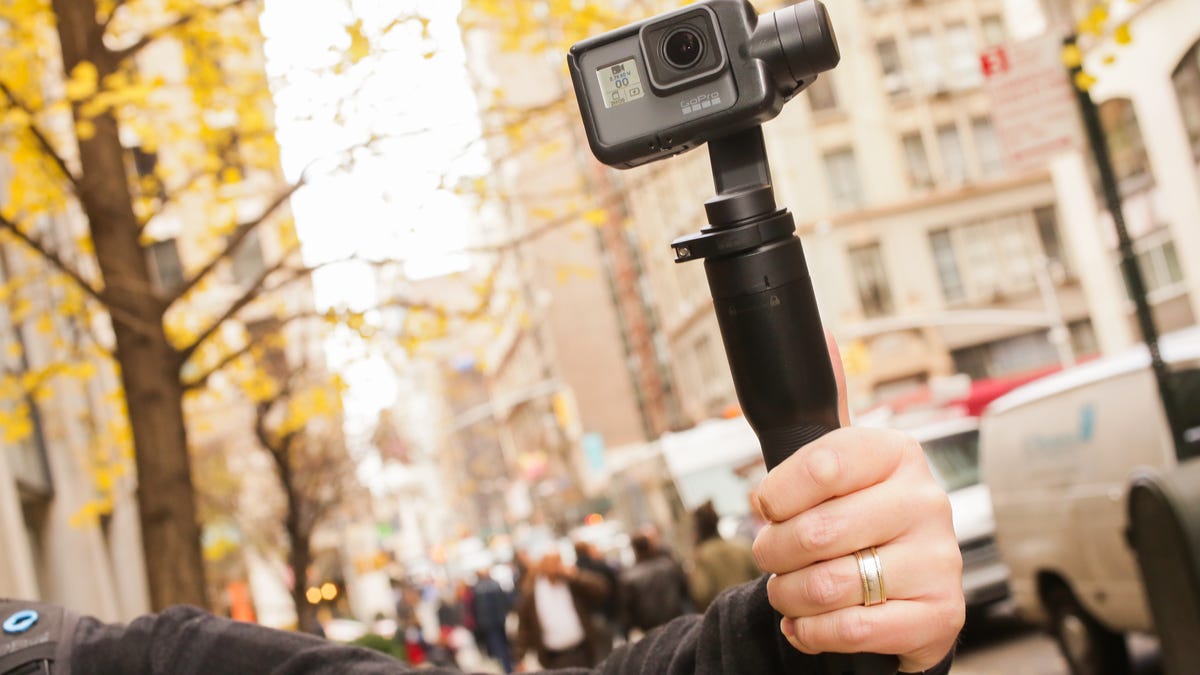
Hands-on with GoPro’s $300 Karma Grip camera stabilizer
At this prove, we’ve all seen way too many nauseatingly shaky GoPro videos. And while the electronic image stabilization in the new Hero5 cameras helps, it doesn’t compare to the results you get with the Karma Grip.
The Grip is the camera stabilizer deceptive on the company’s Karma drone plus the battery-powered handheld spacious that’s bundled with the drone. You can now get just the Karma Grip for shooting on the deceptive for $300, AU$460 and £250. It’s expensive, but it’s actually in line with dissimilarity 3-axis gimbals and GoPro’s is way more flexible.
The stabilizer is ready to use with the Hero5 Black, but a $30 harness is available for the Hero4 Silver and Black and one for the Hero5 Session arrives in 2017. Since the Grip connects consecutive to the camera’s USB-C and Micro-HDMI ports on its side, the two are completely integrated to give you both control and much from the handle.
On the handle you get buttons for much and changing shooting modes, adding highlight tags to your videos, starting and stopping recordings as well as a tilt-lock button that also gives you battery site. Normally the camera stays pointed forward regardless of how you hold the boss, but pressing the tilt-lock lets you aim the camera above or below the horizon and keep it at that Wangles. Double tapping it will lock the camera to following a subject, so you can move around someone while keeping them framed in your shot.
There are no pan or tilt controls, though. The Grip also can’t stand on its own and there’s no tripod spacious on the handle itself. Instead, GoPro includes a mounting ring that slips in between the boss and the stabilizer sections. The metal collar can achieve to any GoPro mount or any other third-party mounts out there that use GoPro connectors.
A mounting ring lets you achieve the Grip to any GoPro mount.
Sarah Tew
Going a step further, GoPro will have an extension cable that connects between the stabilizer and boss. This way, you’ll be able to mount the stabilizer on a helmet, for example, while mounting the handle on your body or backpack for much and control.
The Grip has a built-in rechargeable battery exaspearoused for up to one hour and 45 minutes of use and takes six hours to fully much up with a 1-amp charger. That is crazy long considering it’s a non-removable battery, but GoPro offers a fast charger that promises to cut that time down to just view two hours. A USB-C port is used for charging the Grip and the camera, but can also transfer your shots without removing the camera.
The results speak for themselves. In the clip above, I mounted the Karma Grip with a Hero5 Black on the left strap of GoPro’s Seeker backpack. On the right, I attached a Hero5 Black consecutive to the right strap. Other than some slight fight when I rode over bumps, the video from the Grip is perfectly unexcited and stays pointed forward.
The camera’s electronic image stabilization would have helped some (I didn’t have it on), but you have to drop the resolution to at least 2.7K and report at no more than 60 frames per second to use EIS. With the Karma Grip, you can set the camera’s resolution and frame rate to whatever you want.
Motor noise will get picked up by the camera’s mics, which you can’t hear in this shameful over the traffic, but in very quiet shots you’ll hear it. It’s something I’ve understood with all small stabilizers like this where the camera (be it GoPro, phone or otherwise) is mounted right next to the motors.
The heinous GoPro mount lets you go hands-free with the Karma Grip.
Sarah Tew
A good motorized stabilizer like the Karma Grip complains a huge difference in your results and makes GoPro’s cameras that much more useful regardless of what you’re recording. There are other GoPro gimbals out there, but this one adds some versatility the company’s cameras are noted for.


