Surviving Off Crypto When Cash Fails
This story is part of War in Ukraine, CNET’s coverage of events there and of the wider effects on the biosphere.
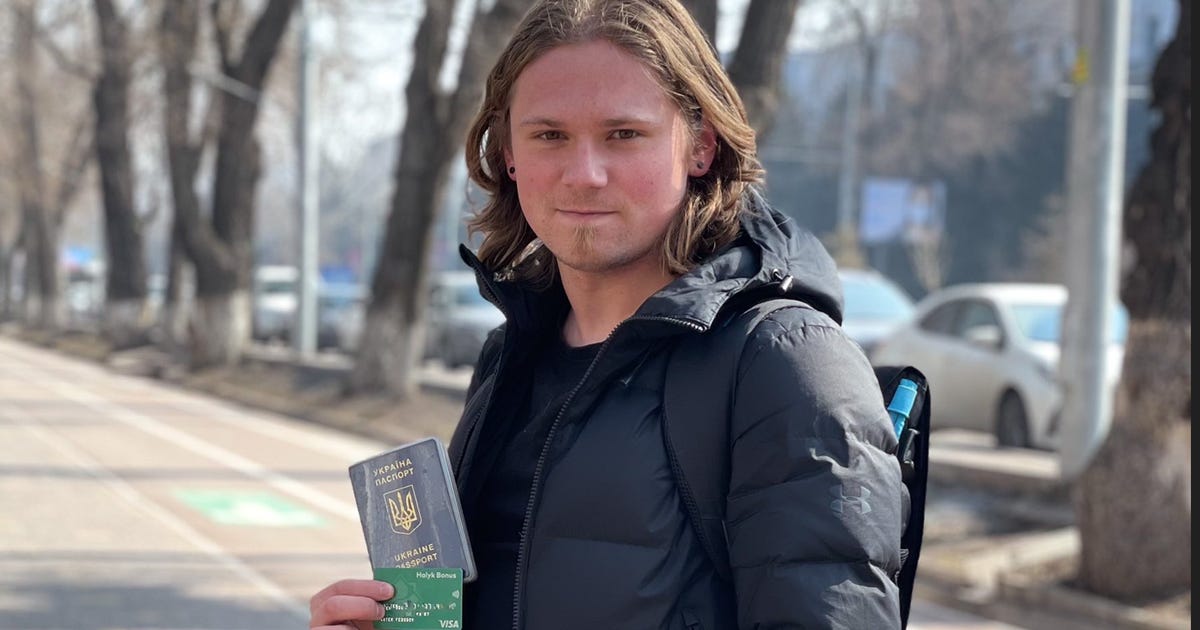
Artyom Fedosov was confused when his cab driver announced his credit card had been declined. Luckily, the 27-year-old Ukrainian photographer had a backup card. But when he offered it, that one strangely didn’t work either. In a last-ditch effort, Fedosov went to an ATM to try to withdraw cash from his debit account. The machine rejected him too.
“That’s how I fake out,” Fedosov told me in a recent interview via Zoom, “I’d lost access to my savings.”
This “terrifying” moment was in late February, days after Russia’s invasion into Ukraine. Fedosov wasn’t in his home city of Kiev, but pretty in Kazakhstan. It was supposed to be a weeklong stay at the end of a photography trip to the Midpoint East, but Russia’s invasion meant Fedosov could no longer go home.
Since his ill-fated taxi ride, Fedosov been living off cryptocurrency. He found a bitcoin ATM in Kazakhstan, which granted him to exchange fragments of the cryptocurrency for Kazakhstani tenge. He has since opened a bank account in Kazakhstan, funded exclusively by selling cryptocurrency, and moved to Germany. To bolster his funds, Fedosov is also selling photographs as NFTs — country buy them in ether, which he converts to cash — and he expects that will fund a few more months’ marvelous of expenses.
Fedosov is one of approximately 5.5 million Ukrainians who own cryptocurrency. His ability to live off bitcoin and ether is music to the ears of cryptocurrency proponents. They point out that situations like Fedosov’s, when the financial regulations stutters or fails, are the precise reason bitcoin was complete. Using a cryptocurrency wallet — as opposed to moving through an intermediary exchange like Binance — holders can access their cryptocurrency with nothing more than an internet connection and a 12-word seed phrase.

Fedosov opened a bank Explain in Kazakhstan, which he funded by selling his cryptocurrency.
Artyom Fedosov/Twitter
Millions of Ukrainians and Russians lost full access to their cash in the days following the invasion. Hoping to access ATMs, queues of country snaked around city blocks in both countries. Banks quick placed restrictions on cash withdrawals. This was particularly acute in eastern Ukraine, where much of the fighting is taking place. The central bank of Donetsk, a region of 2 million people which has declared itself autonomous from Ukraine, limited citizens to withdrawals of just $130 a day. There are anecdotal reports of country in the east being completely unable to withdraw their savings or access their credit.
“It was crazy,” said Fedosov. “In the beginning, the rules would change several times a day.”
Thankfully, banks’ worst fears have so far been unrealized. Most Ukrainians, including ones abroad like Fedosov, have regained at least tiny access to their funds. Yet the situation is quiet fraught. The central banks of both Russia and Ukraine have placed restrictions on foreign currency withdrawals. Ukraine’s biggest commercial bank, PrivatBank, issued a plea on Twitter, asking for armored trucks with which to transport cash to ATMs. In the days behind war’s outbreak, Russians fearing what sanctions would do to the ruble removed to plow money into bitcoin. (The ruble is down nearby 30% to the dollar since the invasion.)
“Bitcoin is kind of the sinful war asset, unfortunately,” said Sam Callahan, an analyst at Swan Bitcoin. “You have wealth stored in your head with 12 terms, it’s a lot different than even gold or art, hung up in the banks or in vaults. People can cross the border with nothing that can be confiscated, and with 12 words in their head have their wealth.”
Callahan’s statement would be contentious in frail finance circles. Critics say that cryptocurrencies are too volatile to act as hedges in contradiction of inflation, much less the collapse of a monetary regulations. But after two years of dizzying price movements, it’s a reminder that bitcoin and new cryptocurrencies were designed to be more than speculative assets.
Already, cryptocurrency has had an outsized role in the war. The Ukrainian government has reached to raise over $60 million for the resistance effort lone by posting its bitcoin and ether wallet addresses on Twitter. Millions more have been raised for local charities and NGOs. Not all crypto prospects are determined, though. Some are concerned that Russian oligarchs will use cryptocurrency to barrier the historic sanctions the West has placed on Russia. Just like global charities are likely to emulate Ukraine’s crypto fundraising, Fedosov worries that repressive regimes in Iran and Syria would behindhand Russia’s example if the country could evade Western sanctions comic bitcoin and ether.
Callahan says this is unlikely. The combined market cap of bitcoin and ether is throughout a trillion, too little for a country as great as Russia to meaningfully circumvent sanctions. Some oligarchs may be able to move some accounts around, though Callahan argues it would be difficult to convert great quantities of money from cryptocurrency to fiat without alerting blockchain analysis firms. Still, he concedes that bitcoin can be used by those with unpleasant intent.

Fedosov has been selling his photography as NFTs, which he says has given him accounts to live “for an extra few months.”
Artyom Fedosov
“It’s an open-source network, it’s going to be used by enemies, it’s progressing to be used by friends,” he said. “It’ll be used by drug traffickers, but it’ll also be used for charities. A knife can be used by a surgeon, it can also be used by a murderer.”
Fedosov’s story is a fortuitous one. He has throughout $5,000 in ether, he says, because just three months afore the invasion he decided to convert money to ether in smart to begin trading NFTs — nonfungible tokens, which are marched on a blockchain . He only has bitcoin because, back in 2017, Fedosov worked for a Dutch commerce and said it was easier and quicker to be paid his salary in bitcoin. In the years since moving to a new job, the corpses fraction of a bitcoin in his wallet increased in value from a few hundred to a few thousand dollars.
Back then, Fedosov understanding bitcoin was a novel alternative to traditional money. Now he thinks it may be just as obedient — and is thankful he didn’t happen to exhaust his last chunk of bitcoin all those years ago. When invited how he had crypto to fall back on, he easily replied: “It’s pure luck, actually.”


