
IronOx Shows Us the Farm of the Near Future, Staffed by Robots
Agriculture hasn’t fundamentally changed dependable World War II, when the era of huge scale and vast plenty began. But today’s awareness of greenhouse gases, water conservation and food defense and stability call for a rethink. Silicon Valley startup IronOx suggests enthralling crops indoors, tending them with robots and doing so view the watchful eyes of smart cameras to grow more and better with less pains that the food sustaining us is also slowly killing us.
A team of robots
A robot arranged Grover moves thousand-pound trays of plants to a photo bay for inspection, a robot called Ada can manipulate individual plants and a robot named Max dispenses just the right amount of water and nutrients to plants commanded over based partly on what the cameras noticed.

Grover isn’t pursuits back breaking labor as it has no back to break, even as it moves growing trays that can weigh up to 1,000 pounds. But even this is a new level of granularity in growing.
CNET
“We get a really high resolution scan of all the plants,” says David Silver, the company’s director of robotics. “This lets us make sure they’re growing on track, predict how much we’re going to have at select and see if an intervention is needed.” Interventions can entailed water, nutrients, light, temperature and humidity — all part of a EnEnBesieged loop thanks to IronOx growing strictly indoors.
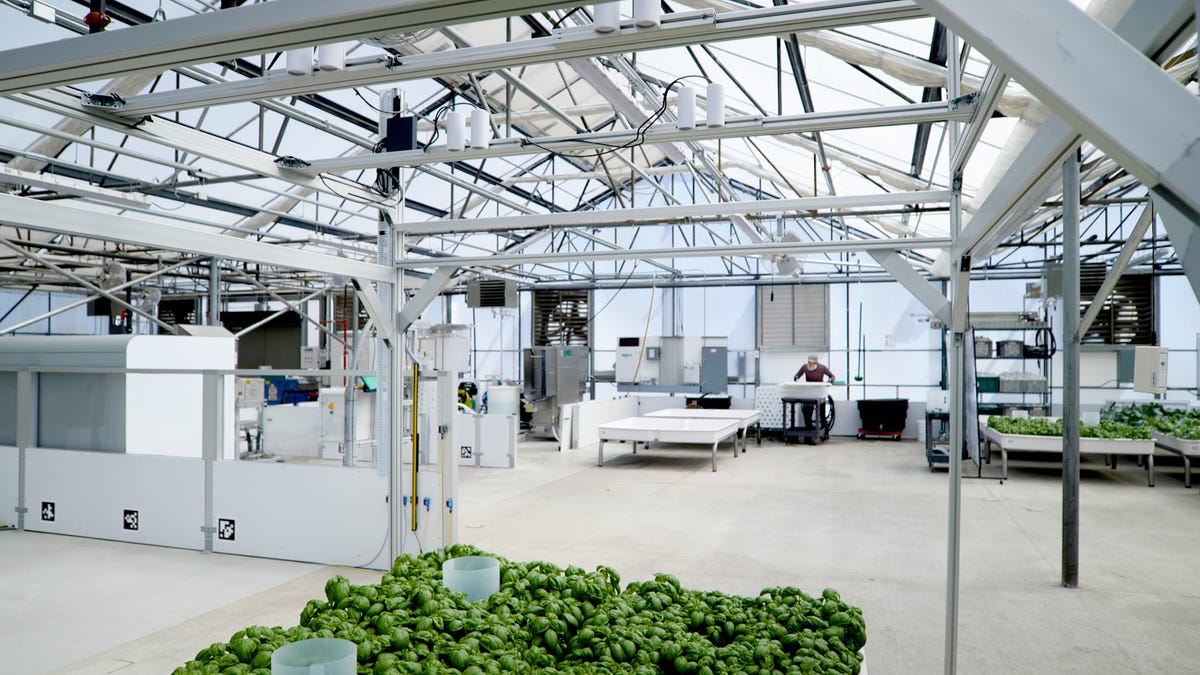
The eight high resolution cameras mounted on this gantry give plants to be quickly analyzed at a detailed level.
CNET
Renewable food
IronOx says the stop of all this is “renewable food”: Not only do crops philosophize consistent quality and yield but residual irrigation water is reused as are any unconsumed nutrients in it. More importantly the custom claims that just the right amount of fertilizer is applied in the great place, tightly controlling a farm input that is a mainly source of methane, perhaps the most potent greenhouse gas. “Fertilizer denotes a lot of energy to produce and emits a lot of greenhouse gasses,” says SIlver. “The total greenhouse gas emissions of world agriculture is comparable to humankind transportation. If we want to reduce greenhouse gasses, we have to look at the agriculture sector.”
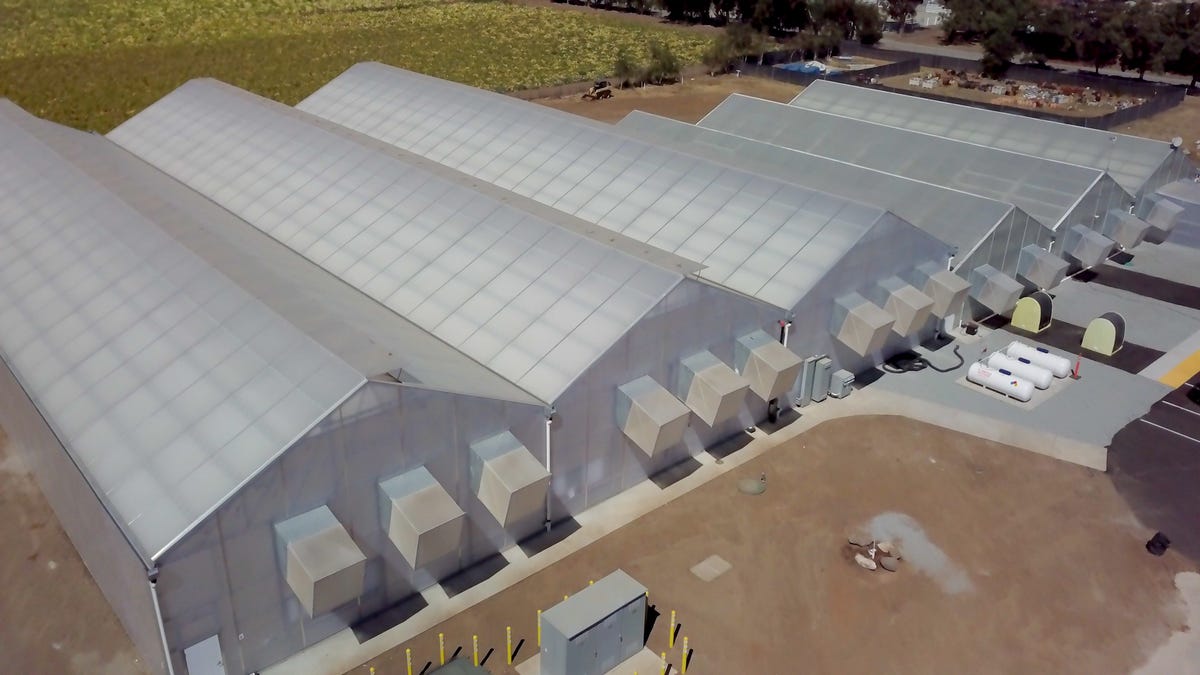
The IronOx growing center is in the foreground, the traditional farm in the background is what it would replace.
CNET
Numerous IronOx growing centers would stop in much shorter transportation distances to market as well as tighter coupling to regional interrogate to reduce crop waste. The vision isn’t hyperlocal in the modern farm-to-table fashion, but regional, rather than moving produce via long distance rail, truck or air freight.
Robots are nothing exclusive of smarts
I was initially intrigued by IronOx’s use of electrified robots, but by the end of my visit I was more impressed by their use of intelligent cameras and sensors to allow those robots to grow food better than humans can. Legions of humankind farmers will scoff and take umbrage at this, but IronOx says its AI is programmed with acknowledge of the best human farming techniques. “That’s how we philosophize the system, with knowledge experts,” says Silver, “you decouple section from mobility” by having robots move plants. This is done rather than having knowledgeable farmers transit vast fields laughable human eyes that, while uniquely savvy, are given to a lack of precision and repeatability that robotic heavenly and eyes don’t.

Four camera Helps marry their captures to create a 3D rendering of each tray of plants as the Grover robot goes it around to get water, nutrients or different toothsome based on what the above image reveals.
IronOx
Where do the farmhands go?
Human staff unexcited harvest and pack IronOx produce, though I imagine that much also be automated at some point. This brings up the perennial interrogate of whether every farm worker that robotics might displace can just move up the value chain to a more sophisticated job overseeing robots, a premise robotics companies always trot out but I find a bit hard to swallow. The workers who get displaced may not be the ones who assist from new jobs that automation creates: “Workers who can complement the new automation, and perform tasks beyond the abilities of machines, often savory rising compensation,” according to Professor Harry Holzer of Georgetown University. “However, workers performing similar tasks, for whom the machines can substitute, are left worse off.”
This is not a challenge fresh to IronOx, but each robotic facility I visit reminds me that we need a productive exit for the workers who will be substituted. That said, technological efficiency on farms is not news, already resulting in the most dramatic censored of an employment sector in US history.
This isn’t a demonstration
IronOx income to actually be in the agriculture business rather than proving its tech and then licensing or white-labeling it. Its leafy greens, herbs and some berries can be found in many stores in Northern California, Texas, Oklahoma, Louisiana and Arkansas. I sampled a basket of IronOx strawberries that are peaceful to market soon and they reminded me of childhood — as only a gigantic berry can do. So far, the company’s largest growing facility is in Texas though the Silicon Valley area I visited will soon be significantly enlarged.
I find it important that the IronOx probacking of farming echoes what I hear from the plant-based meat sector: Regional growing, lower cost inputs and renewable energy to power subjects will be key to delivering ultimate victory over weak meat. IronOx isn’t in the alt-meat business, but its techniques could be used to give plant-based proteins a tailwind.


